

Dialogue between the President of Uzbekistan and entrepreneurs – linguistic analysis by CERR
CERR experts conducted a linguistic content analysis of Uzbek President Shavkat Mirziyoyev's speech at a meeting with entrepreneurs. Using a visualization of the most frequently used words, the analysts determined which issues the head of state focused on most.
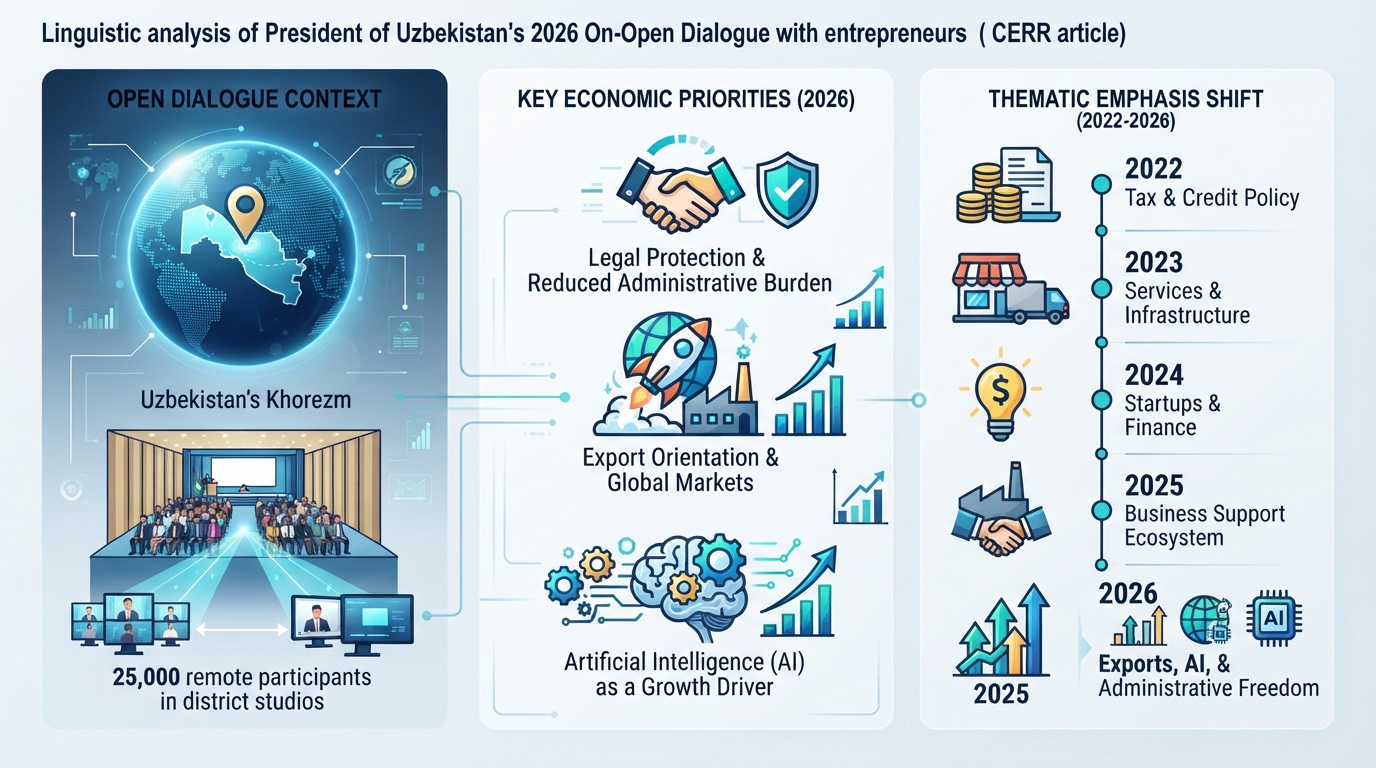
**Linguistic Analysis of the Dialogue between the President of Uzbekistan and Entrepreneurs Conducted by the Center for Economic Research and Reforms**
The Center for Economic Research and Reforms (CERR) conducted a linguistic analysis of the speech of the President of Uzbekistan during the 2026 Open Dialogue, identifying key points and changes in economic policy.
**Key Findings of the Analysis:**
* **Priorities for 2026:** The focus was on entering foreign markets, developing national brands, ensuring international competitiveness, reducing administrative pressure on businesses, and strengthening legal protections for entrepreneurs.
* **Artificial Intelligence as a Growth Driver:** For the first time, the concept of "artificial intelligence" (AI) was presented as an independent driver of economic growth and was used significantly more frequently than in previous years.
**Event Context:**
The traditional Open Dialogue between President Shavkat Mirziyoyev and entrepreneurs took place in the Khorezm region on the eve of Entrepreneurship Day. The event was attended by entrepreneurs and investors from all regions of the country, as well as approximately 25,000 business representatives who joined from district studios.
**Analysis Methodology:**
CERR specialists analyzed the President's speech, identifying the most frequently used words and expressions, key areas of focus, and the dynamics of these emphases over the past five years.
**Detailed Analysis Results:**
The President emphasized the creation of a comprehensive ecosystem to support entrepreneurship, the development of exports and national brands, increasing productivity through AI, and reducing administrative barriers and fines.
**Word Usage Statistics:**
The speech contained 4,211 words (compared to 4,241 words in 2025). The most frequently used terms were:
* "entrepreneur" — 92 times
* "business" — 32 times
* "export" — 31 times
* "market" — 28 times
* "state" — 27 times
* "enterprise" — 25 times
* "product" — 18 times
* "system" — 15 times
* "project" — 14 times
* "service" — 13 times
* "loan," "bank," "region," and "industry" — 12 times each
* "tax," "international," "artificial intelligence," "program," and "opportunity" — 11 times each
* "fine" — 10 times
**Key shifts in emphasis:**
1. **Shift to foreign markets:** The words "export" (31) and "market" (28) have reached their highest frequency in the last five years, occurring almost twice as often as "business." This indicates a shift from domestic support to a focus on external markets.
2. **Growing Importance of AI:** The term "artificial intelligence" was used 11 times. In comparison, it was mentioned once in 2023, four times in 2024, and not at all in 2025. In 2026, AI was given the status of an independent economic policy area related to productivity, cost, and added value.
3. **Liberalization of the Business Environment:** The use of the words "inspection" (7 times), "court" (5 times), "license" and "permit" (3 times each) indicates the continued relevance of the issue of liberalizing the business environment.
**Keyword Frequency:**
* "foreign market" — 11 times
* "for entrepreneurs," "added value" — 9 times each
* "small business," "respected entrepreneur" — 5 times each
* "new product," "for export," "new opportunity" — 4 times each
**Three-word Phrases:**
* "value-added tax" — 5 times
* "accelerated market entry," "construction, sanitation, quarantine" — 3 times each
* "implementation of artificial intelligence," "a million foreign tourists," "creating a level playing field," "share of small businesses" — 2 times each
**Linguistic analysis over the past five years (2022–2026):**
A comparison of the dialogue texts reveals a consistent shift in priorities:
* **2022–2023:** Tax and credit policy.
* **2024:** Services and infrastructure.
* **2025:** Startups and financial support.
* **2026:** Exports, artificial intelligence, and administrative freedom.
This trend reflects the transition of the national economic strategy to a new stage – ensuring competitiveness in foreign markets.
**Substantive areas of the speech:**
The speech was divided into nine substantive areas:
* **A sharp reduction in administrative pressure:** 605 words (14% of the speech).
* **Tourism development opportunities and the conclusion:** 14%.
* **Export potential and national brands:** 14%.
* **The "artificial intelligence – management efficiency – new investments" ecosystem:** 13%.
These four areas accounted for 55% of the speech.
Also prominent were:
* **Expanding business opportunities in the regions:** 12%.
* **Economic growth results:** 11%.
* **Changes in Khorezm:** 5% (introductory part).
**Conclusion:**
The speech at the 2026 Dialogue marks a new stage of economic policy, focused on transforming entrepreneurs from domestic market participants into competitive global players. The five key pillars of this stage are defined as exports and national brands, AI-driven productivity, access to capital markets, personnel training, as well as administrative freedom and legal protection.
Linguistic analysis confirms that the head of state's speech not only clearly outlined the priority areas of economic policy but also reiterated the role of entrepreneurs as a key partner and driving force for the country's development, creating a positive attitude and an atmosphere of trust.
**CERR Public Relations Sector**