

Delhi air quality worsens ahead of Diwali
On Wednesday morning, Delhi's air quality index reading was at 377, in the "very poor" category.
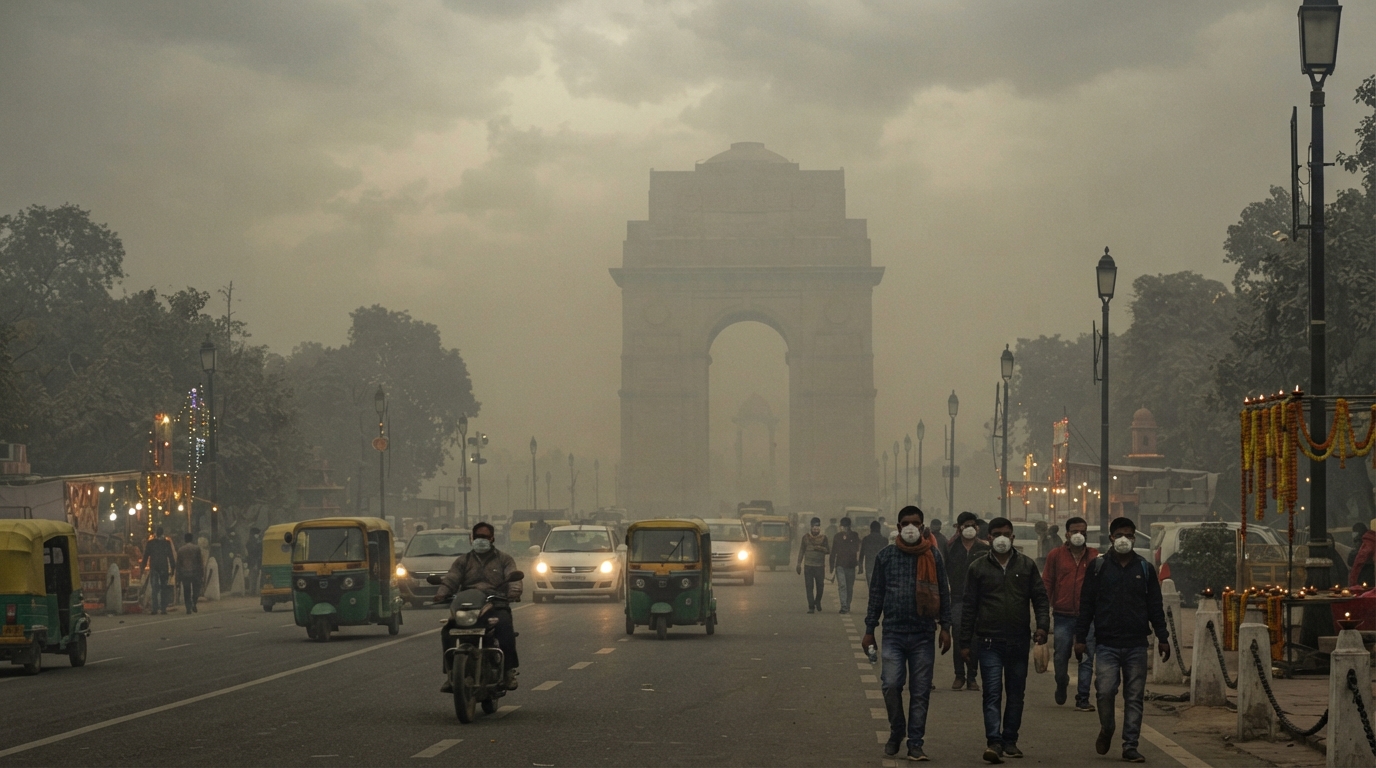
Delhi’s air quality deteriorates ahead of Diwali
Air pollution is a yearly issue in Delhi and much of northern India.
Delhi is once again facing worsening air pollution as the arrival of winter brings a familiar decline in air quality.
The city’s Air Quality Index (AQI) — which tracks PM2.5, fine particulate matter that can clog lungs — has climbed above 300, entering the “very poor” category and prompting health worries for millions of residents.
Long-term exposure to such polluted air can lead to respiratory issues and aggravate existing conditions, with children and older people especially at risk.
In response, authorities have activated Stage II of the Graded Response Action Plan (GRAP), putting in place steps to reduce dust, vehicle emissions and other pollution sources.
Delhi and nearby parts of northern India deal with hazardous air every winter, especially around Diwali, one of India’s biggest festivals, which is only days away.
The festival is marked by lights, lamps and fireworks, which often make the city’s already poor air quality worse by releasing fine particles and harmful gases into the atmosphere.
The annual pollution emergency is caused by a mix of factors, including vehicle exhaust, industrial emissions, dropping temperatures, low wind speeds and the burning of crop stubble in neighbouring states.
The sudden jump in pollution comes after an unusually clean October, when Delhi posted its lowest average AQI for the month in eight years.
Experts say the abrupt decline is due to falling temperatures, weak winds and a rise in crop-residue burning in the neighbouring states of Punjab and Haryana.
A recent storm brought rain and stronger winds, which helped clear the air. But once the weather calmed, north-westerly winds returned, carrying smoke from burning fields toward the capital.
India’s pollution watchdog classifies AQI readings from 301 to 400 as “very poor”, while anything above 400 is deemed “severe”. On Wednesday morning, Delhi’s AQI was 377.
The index measures eight major pollutants, including PM2.5 — tiny particles about 30 times smaller than the width of a human hair that can travel deep into the lungs.
Firecrackers used during Diwali release particulate matter and gases into the air, adding to the existing pollution.
With Diwali only days away, there are fears that fireworks could drive pollution levels even higher.
Last year, Delhi woke up to a toxic haze the morning after the festival, despite a court order calling for less-polluting firecrackers.
Over the years, authorities have imposed firecracker restrictions, including complete bans on their manufacture, sale and use, but enforcement has been difficult.
On Monday, India’s Supreme Court permitted the manufacture, sale and use of certified green firecrackers in Delhi and nearby areas for a limited time.
It said the crackers could be used only between 06:00 and 07:00 local time (00:30-01:30 GMT) and between 20:00 and 22:00 (14:30-16:30 GMT) on 7 and 8 November, during the Diwali weekend.
The court also prohibited fireworks within 300m of hospitals, care homes, schools and other designated silence zones.
Green firecrackers use altered chemical formulas intended to produce fewer emissions than standard fireworks. They must also include QR codes so buyers and authorities can check the manufacturer and certification details.
Still, making sure only approved firecrackers are sold remains a major challenge.
In its latest order, the Supreme Court noted that conventional firecrackers had continued to be sold as green alternatives, even when a total ban was in force.
Even Mumbai, India’s financial capital, has seen very high pollution levels in recent days.
It has ordered police to patrol designated sales areas, conduct random QR-code checks and confiscate illegal firecrackers.
During especially severe pollution spells, Delhi authorities have also introduced measures such as hybrid schooling, work-from-home arrangements and restrictions on certain vehicles.
The issue is not limited to the capital. Mumbai, India’s financial hub, has also recorded elevated pollution levels over the past month, despite the coastal winds that usually help disperse pollutants.
On 24 October, Mumbai’s AQI reached 322, putting it in the “very poor” category. The surge was blamed on a combination of low wind speeds, construction dust, garbage burning, firecracker emissions and pollutants drifting in from neighbouring regions.
The city’s air quality has improved in recent days — and on Wednesday it recorded an AQI of 89, classified as “satisfactory”. Nearby Navi Mumbai recorded a “moderate” AQI of 118.
The improvement comes after nearly two weeks of smoggy conditions, with residents posting photos and videos of the haze on social media.