

Convulsions of the Arab Monarchies
"Saudi shuttle" vs. "Afghan bluff": Does Riyadh want to prevent a war?
**Convulsions of the Arab monarchies**
The Middle East has frozen one step away from a full-scale war, with key intrigues unfolding beyond official statements. Against the backdrop of reports that Tehran has already approved a closed list of targets for a harsh response to a possible Israeli attack, two opposite lines have emerged: the nervous diplomacy of the Arab monarchies and outright information leaks from the Pentagon.
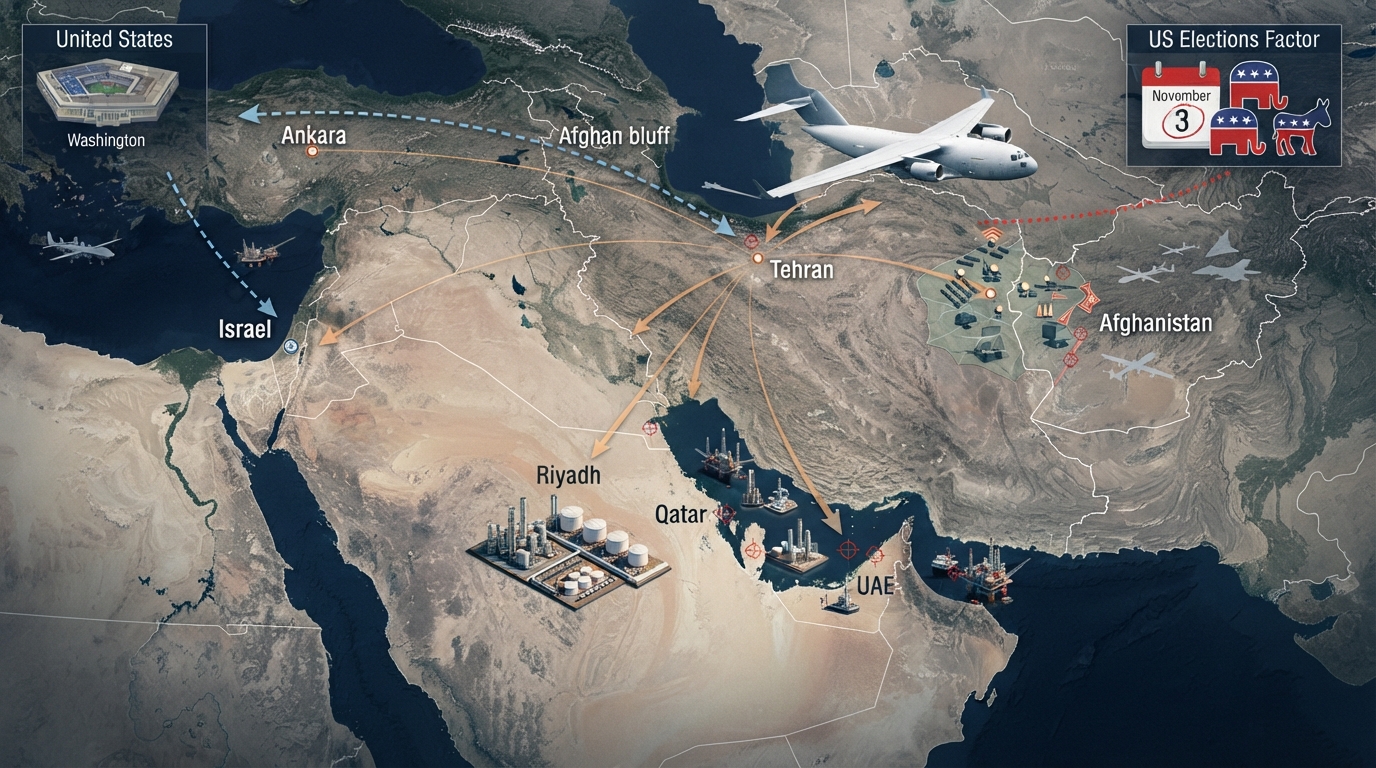
The main sign of the day indicating critical tension was the sudden landing of a Saudi Arabian military transport aircraft at Tehran airport. This flight is not merely a protocol visit, but a sign of urgent "shuttle diplomacy" that Riyadh has deployed to prevent a disaster capable of burying the economic stability of the entire Persian Gulf.
**The "Saudi shuttle": fear of Iranian retaliation**
The diplomatic activity launched by Riyadh is explained by quite practical fears. Saudi Arabia and its Persian Gulf neighbors understand full well that in the event of a full-scale confrontation between Israel and Iran, they will be the first to come under strike. If Tehran decides to deploy its full missile and drone potential, the critical oil and logistics infrastructure of the Arab monarchies will inevitably fall into the crosshairs, as has already happened in previous years.
In essence, the Saudi aircraft in Tehran is playing the role of a mediator in an extremely delicate game. Through behind-the-scenes channels, Riyadh is trying to achieve a two-fold goal: on the one hand, to convey American and Israeli signals to Iran about the "limited" nature of the impending attack, so that Tehran does not resort to a maximum retaliation scenario. On the other hand, to secure firm safety guarantees from the Iranian leadership for Saudi Arabia's oil and gas facilities in exchange for maintaining strict neutrality and refusing to provide its airspace for Israeli aviation.
**The Pentagon's "Afghan bluff"**
Simultaneously with real Saudi diplomacy, an opposite narrative is being actively pushed in the Western information space. Claims have appeared in the American media, citing sources in the US defense departments, that Washington and Tel Aviv intend to use the airspace and even abandoned military airfields of Afghanistan to strike Iran.
This scenario looks like an outright "Afghan bluff" by the Pentagon for several reasons at once. The assumption that the leadership of the Islamic Emirate of Afghanistan (essentially the former Taliban) would make a deal with the US, or even more so with Israel, completely contradicts the movement's core tenets. For Kabul, any official assistance to Western forces or the Jewish state against a Muslim country is a direct betrayal of their own ideology, which they will not commit to under any circumstances.
The only thing American strategists could theoretically count on is the illegal "stealth" use of Afghanistan's airspace for unmanned aviation, taking advantage of Kabul's lack of modern high-altitude air defense systems. But presenting such gray-zone schemes as "strategic planning" and a logistical base is nothing more than wishful thinking.
The goal of this leak is obvious — to artificially expand the geography of the potential conflict on paper in order to disorient Iranian intelligence and force Tehran to scatter its air defense forces toward its eastern borders.
**The time window — the US election factor**
All this multi-vector maneuvering is strictly tied to the date of November 3 — the day of the US midterm elections. Israeli "hawks" led by Benjamin Netanyahu are rushing to strike precisely within this time window, while American Democrats are forced to unconditionally support any actions of their ally so as not to lose the votes of the pro-Israel lobby.
For Donald Trump, whose rating is currently under strong pressure, an escalation in the Middle East before November 3 will become a powerful electoral argument. He will get a 100% pretext to declare that if the Democrats come to power, they will lead the world to a global catastrophe, whereas during his tenure, a relative balance was maintained in the region. That is why the Israeli right, by escalating the situation, is objectively playing into the hands of the Republicans. While Washington bluffs with Afghan scenarios and Tel Aviv selects targets, Saudi Arabia is trying to keep the region from falling into the abyss with its "shuttle" flights, realizing that the price of someone else's election games could prove too high for it.
Russian diplomacy in this situation maintains an emphasized neutrality, keeping close contacts with both Tehran and Riyadh, closely observing whose arguments will ultimately carry more weight — real economic diplomacy or election-related military blackmail.
**P.S.** As reported by Reuters, a delegation from Qatar has also arrived in Iran for talks. A source familiar with the situation reported that the Qatari mediators arrived in Tehran in coordination with the US to reduce regional tension.
According to the agency, a senior Iranian official stated that the Qatari delegation is "conducting talks within the framework of mediation," but disclosed no details. Another Iranian source reported that "Iran had clearly communicated its demands and position on the current situation to the mediators in advance." This indicates that the talks may still be at the stage of conveying positions rather than reaching concrete results.
At the same time, as reported by the Iranian outlet Pars Today, official representative of the Iranian Foreign Ministry Esmaeil Baghaei stated that high-level delegations from Turkey, Pakistan, and Saudi Arabia have arrived in Tehran. Pakistan is represented by Army Chief Field Marshal Asim Munir, Saudi Arabia by Defense Minister Prince Khalid bin Salman, and Turkey by MIT intelligence service chief İbrahim Kalın. The meeting, which took place at Pakistan's request, addressed issues of regional security, Israel, Lebanon, and Palestine.