

Compensation has been fully paid to the victims of "Doc-1 Max", and officials are checking on the surviving children, parents say
It is reported that the remaining part of the compensation to the "Doc-1 Max" victims has been fully covered at the state's expense, and officials are visiting the children who acquired disabilities. The parents had appealed to the authorities several times, including through Gazeta; over the course of 3 years, only 20 percent of the damage had been recovered.
Compensation for "Doc-1 Max" victims has been fully paid, officials are checking on surviving children — parents
On October 20−24, 2026, compensation for children harmed by the drugs "Doc-1 Max" and "Ambronol" was paid in full by the state. This was reported to Gazeta by parents of children who died and were recognized as having acquired disabilities.
Farrux Toshpo‘latov, press secretary of the Bureau of Compulsory Enforcement (MIB) under the Prosecutor General's Office, which was required to execute the portion of the court verdict regarding compensation payments, also confirmed this information.
According to several court rulings on the case, compensation was to be recovered from former leaders and deputies of the Pharmaceutical Industry Development Agency, who were found guilty in this case, as well as representatives of Quramax LLC, the official dealer of the drug manufacturer in Uzbekistan.
According to Gazeta's independent study based on bank documents provided by parents, only 20 percent of the damages amount had been recovered from the convicts over 3 years. The last recovery was made in August 2026.
The remaining 80 percent of the compensation paid in October was covered at the state's expense.
For now, it is unknown how many people were paid compensation, when, and in what amount, as well as whether the funds covered by the state will subsequently be recovered from the convicts or not.
"We will soon provide information to the public on this matter in cooperation with the Ministry of Health, and we may also organize a press conference," said MIB press secretary Farrux Toshpo‘latov.
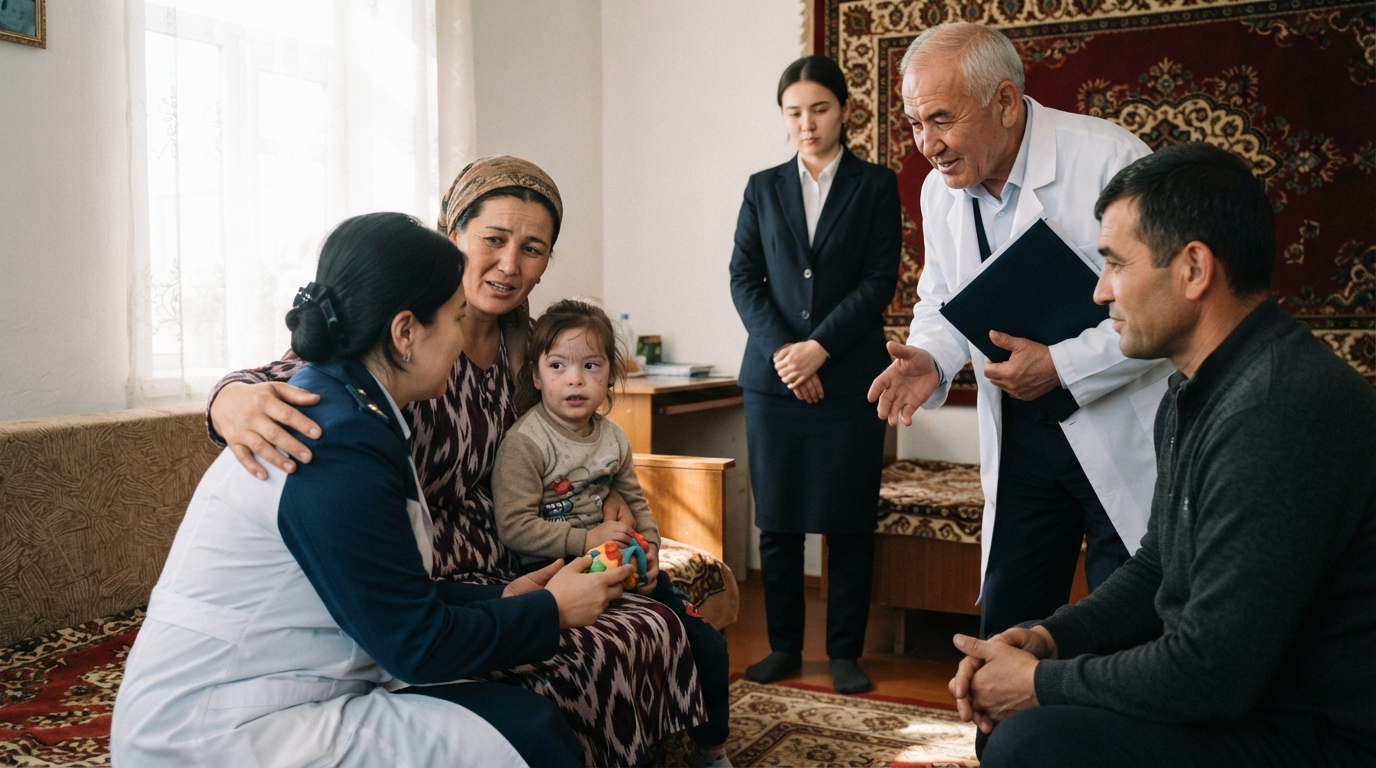
After the compensation was paid in full, on October 25, a group of officials from Tashkent traveled to Karakalpakstan to check on the condition of the children who acquired disabilities from the drug.
The father of victim Shahram Abatbayev from Shumanay District said that officials visited their home and the hospital where Shahram is receiving treatment.
"One of the visitors said, 'the president sent us to monitor that the money has been paid.' Another introduced himself as a doctor from the Children's National Medical Center in Tashkent. He said, 'If you need to go to the capital for treatment, let us know, we will solve ticket and hospitalization issues ourselves, I will treat him myself.' He also left his phone number," the father said.
The mother of Umida Tajimuratova from Xo‘jayli District stated that the ENT doctor who came with the officials examined her daughter and said he would take her to Tashkent, adding that they are planning to go on November 4.
"Until now, no one had come to ask about our daughter's health. Yesterday, four people came. Two of them were from Tashkent. They reprimanded the patronage nurses, asking 'why haven't you checked in until now?' They also took photos with my daughter," the mother said.
The father of Muxtorjon Rahmonov from Bukhara said that on October 26, a group of people from the Ministry of Health visited his home.
"One of them left his phone number, saying 'our president sent us thinking about the children's health; if you have any problems, contact me.' My son's condition has not changed from before; he still cannot hear or see. We even went abroad for treatment, but it was to no avail. We wanted to get him an implant for his ear, but we couldn't afford it since it cost $20,000. Now we will get the implant using the compensation that was deposited," the father said.
The father of victim Mansurbek Kemamov from Sirdaryo reported that he was informed representatives from television, the regional administration, and the Ministry of Health would arrive on October 26 to check on his child's health.
Gazeta has been covering the "Doc-1 Max" topic for several years. The publication has released reports from the first-instance court hearings that lasted from August 2023 to February 2024, full transcripts of several sessions where victims testified, a live stream from the courtroom where the verdict was announced, and reports from crucial sessions of the appeal court that began in April 2024.
In April 2024, when one of the appeal court sessions was postponed, parents expressed dissatisfaction to the judge. Several of them also addressed the Gazeta reporter, asking not to delay the execution of the court verdict regarding compensation payments, stating "The living children must be saved."
In January 2024, while the first-instance trial was ongoing, Gazeta wrote about the medical history of Mansurbek Kemamov, who, despite being poisoned by the drug, was left off the list of victims by investigative authorities. It also detailed the letters and relevant applications written by the boy's father, Safarali Mansurov, to various agencies to get his son included in the list.
The first-instance court verdict noted that 68 children died from the drug, and 18 acquired disabilities. On the day the verdict was announced, presiding judge Muso Yusupov stated in a meeting with journalists that there was a separate criminal case regarding the victims' condition and that investigative actions were being conducted, adding that this case would be submitted to court as a separate criminal matter.
On November 18, 2024, the verdict regarding victims who applied later in the "Doc-1 Max" case was announced at the Uchtepa District Court for Criminal Cases. In it, five more children, including Mansurbek Kemamov, were added to the list of children who acquired disabilities from the drug.
On October 10, 2024, Gazeta published an appeal sent by parents whose children acquired disabilities from the drug and who were waiting for full payment of compensation for treatment expenses, asking "Who should we address now, the president?" In it, some parents reported that due to complications from the drug, their children had lost their vision and hearing, could no longer walk, suffered severe kidney and stomach damage, and that their condition deteriorated as the weather grew colder. Furthermore, they emphasized that no one was checking on their children's condition.
At the end of 2024, the editorial team published a large two-part feature dedicated to the victims and casualties of "Doc-1 Max" (part one, part two). Based on interviews with the victims' relatives, transcripts prepared from the court proceedings, and details from the verdict, it recounted the final days of the deceased children, the medical histories of the children who acquired disabilities, and what they were enduring. The features also raised the issue of compensation payments once again.
In October 2025, parents who had still not received the full compensation money addressed a video appeal to President Shavkat Mirziyoyev.