

Dark clouds gather along the border.
Every few months, Kazakhstan welcomes millions of foreign citizens, raising concerns: is the country becoming a transit point for refugees and illegal migrants? However, the reality is more complex. The massive influx of people crossing the border barely intersects with those actually moving there for permanent residence and work. And the few who receive official refugee status remain invisible among these millions.
**7.2 million in six months**
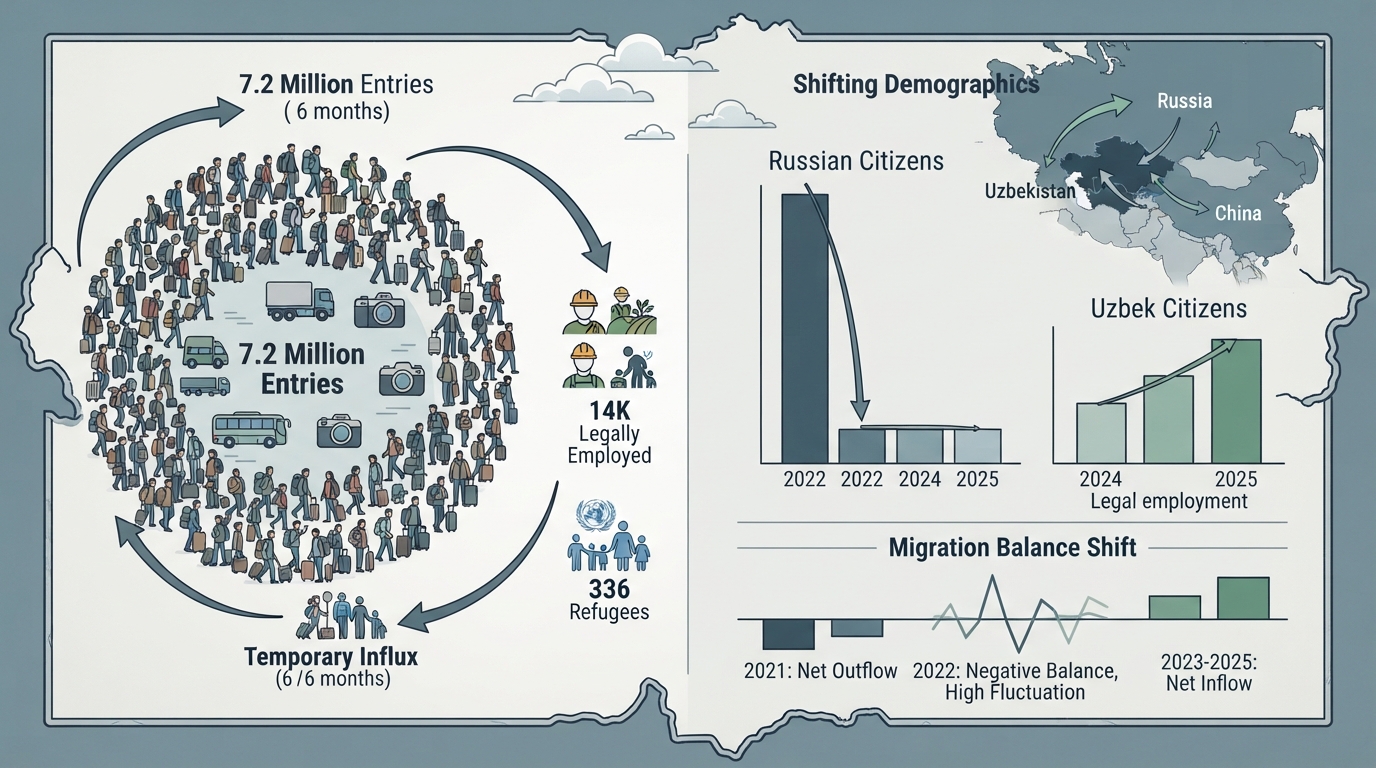
According to the Migration Service of the Ministry of Internal Affairs, 7.2 million foreign citizens entered Kazakhstan in the first half of 2026, a 4% decrease from the previous year. During the same period, 7 million people left the country. Almost 90% of the total influx are citizens of the CIS, primarily from Uzbekistan (2.56 million), Kyrgyzstan (1.55 million), and Russia (1.52 million). The most significant increase was observed in the flow from China: over the past six months, the number of Chinese citizens arriving increased by 55%, reaching almost 586,000.
These figures reflect border crossings, not permanent relocations, so the same individual may be counted in the statistics multiple times a year, for example, a long-haul truck driver or a shuttle trader who regularly crosses the border. A more accurate picture is provided by an analysis by the Bureau of National Statistics for the end of 2025. It shows that only 12% of arrivals indicated employment as their purpose of visit, 4% stated study, and 84% came for other purposes, such as tourism, guest visits, or family matters.
The number of legally employed foreigners in the country is significantly lower than the entry data might suggest. At the end of 2025, just over 14,000 migrants were working with permits from local authorities, the majority of whom arrived from China, Uzbekistan, Turkey, and India. Their main industries are construction, agriculture, and mining. Regarding residence permits, 17,200 were issued in the last quarter of 2025, a 68% increase compared to the previous quarter. This trend indicates a shift from temporary travel to longer-term settlement, although the absolute numbers remain small compared to the multi-million influx.
According to UN data, as of mid-2025, Kazakhstan officially hosted approximately 336 refugees and 237 asylum seekers. These are predominantly from Afghanistan and other countries, not Russia. Russians are rarely granted refugee status in Kazakhstan, as military mobilization is not formally considered grounds for protection under the Refugee Convention.
**Russians of 2022**
The first wave arrived in late February 2022 after the outbreak of the war with Ukraine, but the truly massive exodus began after the announcement of partial mobilization in September 2022. In September of that year alone, approximately 406,000 Russian citizens entered Kazakhstan, with peaks reaching up to 30,000 per day. By the end of autumn 2022, the number of arrivals exceeded 500,000, and according to some estimates, including Russia's Forbes, approximately 700,000 people have left Russia since the start of mobilization, of which approximately 200,000 went to Kazakhstan.
By early November 2022, more of those who crossed the border in September had returned to Russia than had left. According to the Ministry of Internal Affairs of the Republic of Kazakhstan, approximately 98,000 entered and 64,200 left, and this was only in the first few weeks. By the end of 2022, according to various estimates, of the approximately one million Russians who moved to the republic for a more or less long-term stay, no more than 300,000 remained.
In February 2024, the Russian Consul General in Almaty reported that of the 400,000 who arrived in 2022, no more than 80,000 remained in Kazakhstan by the end of 2023. According to the Chairman of the Migration Service Committee of the Ministry of Internal Affairs of the Republic of Kazakhstan, as of early 2025, approximately 87,000 Russian citizens were permanently residing in the country – not only those who arrived in 2022, but also those Russians who had lived in Kazakhstan before.
Where did the rest go? Some returned home, unable to cope with the bureaucracy, the lack of their usual jobs, or simply homesickness. Others moved further afield, to Georgia, Armenia, Turkey, and European countries, where 1.3 million Russians arrived in 2022. Those who remained in Kazakhstan found employment with local companies, work remotely for Russian or international companies, or opened their own businesses.
It's significant that the entry of Russians into Kazakhstan was not a one-off incident. In 2024, Russian citizens made 2.8 million trips to the republic, approximately 40% of which were classified as business tourism. This means that the military events of 2022 have ingrained Kazakhstan much more firmly into Russia's everyday business and tourism orbit than they had previously.
**Uzbeks prefer Kazakhstan to Russia**
According to the Migration Agency of Uzbekistan, the number of Uzbek labor migrants in Russia decreased from 1.2 million in early 2024 to 698,000 in early 2025. At the same time, the number of Uzbeks legally employed in Kazakhstan increased more than 50% – from 196,800 to 322,700 in the same year.
Tightening migration laws in Russia, an increase in deportations, xenophobic sentiment following terrorist attacks and high-profile criminal cases, and the depreciation of the ruble have made the Russian labor market less attractive. Meanwhile, Uzbekistan is actively seeking alternative destinations for its citizens. In 2024, more than 467,000 labor migrants returned home, including 257,000 from Russia and 129,000 from Kazakhstan. The Uzbek government is promoting organized labor recruitment in Germany, Korea, Poland, the UAE, and other countries with higher wages.
**From Outflow to Steady Inflow**
In 2021, before the war, Kazakhstan experienced a rather passive migration exchange. In 2022, the number of arrivals increased by 57.5% compared to the previous year, while the number of departures fell by almost a quarter, but the balance remained negative – minus 6,900 people.
In 2023, the net migration balance became positive, adding 9,300 people, with arrivals growing by another 45.7%. In 2024, the positive balance increased to 17,200 people. This is a sustainable and noticeable turnaround. For the first time in a long time, Kazakhstan has become a country with a net influx of population, rather than an outflow.
At the same time, the annual quota for kandas (ethnic Kazakhs returning to their historical homeland from Uzbekistan, China, Turkmenistan, and other countries) is being consistently met. Since 1991, over 1.16 million ethnic Kazakhs have returned to the republic, including almost 17,000 in 2025 alone.
**Benefits and Harms**
The economic impact is most easily seen in the housing market. In the fall of 2022, rental prices in Almaty and Astana jumped by almost 30% in just a few weeks – realtors directly attributed this to the influx of Russians willing to pay more than local residents. In border cities, the effect was even more dramatic – rental demand in Kostanay nearly tripled, and in Ust-Kamenogorsk, 2.5 times. For some Kazakhstani families, this resulted in a real increase in housing costs, especially at a time when overall inflation was already accelerating.
Enthusiastic posts from relocators about life in Almaty or Astana – beautiful views, friendly people, convenient banking services – evoke not affection, but anxiety in some Kazakhstani society. Journalist and public figure Askhat Asylbekov writes about this in one of his publications, and, in his opinion, this anxiety cannot be attributed to simple xenophobia.
Asylbekov points out that in recent years, individual Russian politicians and publicists have repeatedly made resonant statements about Kazakhstan's status, and the tragedy in Ukraine has clearly demonstrated to society the potential consequences of such rhetoric. Against this backdrop, some Kazakhstanis fear that the rapid increase in the number of migrants from Russia will sooner or later become the basis for new political speculation. The publicist cites as an example a woman's comment on social media, calling on the Russian president to "save us."
The author emphasizes that this doesn't apply to the majority of ordinary people who simply want to live, work, and raise children in peace, and many left precisely because of mobilization. However, he insists on a simple principle: Kazakhstan is not a "reserve territory" or a place for mass resettlement, but an independent state that has every right to independently determine its migration and demographic policies based on the interests of its citizens. He encourages newcomers to learn Kazakh—just as they learn the local language when moving to any other country—and proposes restoring the specialized migration police units, which were cut in 2019, to work with foreigners.
The author makes a curious observation regarding terminology: those who go to work in Russia are usually called migrant workers, while those who move to Kazakhstan are called relocators or expats, although in essence, they may be referring to the same phenomenon of labor or forced migration.
Meanwhile, the government is increasingly tightening the screws on migration policy, not so much with regard to those entering the country as with regard to its own citizens. Starting in December 2025, Kazakhstanis wishing to obtain permanent residency abroad will need to undergo a consular interview and provide information about relatives remaining in their home country. Starting in July 2026, foreigners without a visa are required to register with the internal affairs authorities within 30 days. The authorities are launching an artificial intelligence-based monitoring system to track the length and purpose of stay of foreigners, as well as a separate system for monitoring the exit of their own citizens. In June 2026, the Ministry of Foreign Affairs explicitly stated that the goal of the new strategy is not to reduce illegal migration, but to completely eliminate it.
At the same time, the number of visas granted to Kazakhstanis for travel abroad has almost halved in 2025. No official explanation has been given for this coincidence, but its timing certainly coincides with a general tightening of controls.