

Don't come to my house…
Labor migration from far abroad to Russia is growing, while from the CIS it is decreasing.
Don't come to my house...
In the first half of this year, migration flows into the Russian Federation continued their downward trend. This is due to the tightening of migration legislation introduced over the past two years, which primarily affected citizens of CIS countries who enjoy visa-free travel with Russia.
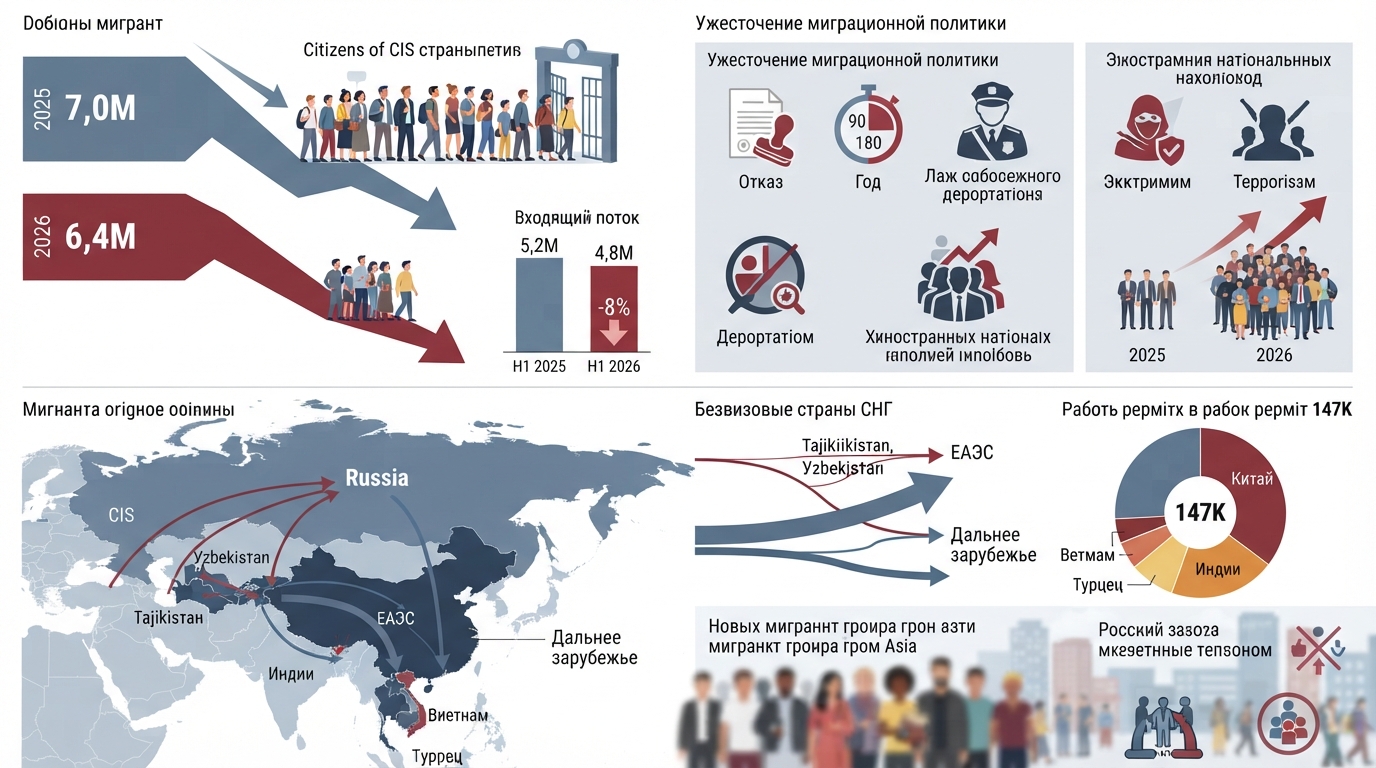
According to the Security Council, which is responsible for migration policy, 4.8 million foreign citizens entered Russia from January to June of this year. This is an 8% decrease compared to the same period last year, when the number of arrivals was 5.2 million. Thus, the volume of "incoming" people decreased by 400,000 people, which is comparable to the population of cities such as Sochi, Kursk, or Tver. Consequently, the total number of foreigners in the country also decreased. While there were 7 million on July 1, 2025, a year later, the number had dropped to 6.4 million. It is noteworthy that the number of foreigners declined faster (by 8.6%) than the volume of immigration, indicating that outgoing migration flows exceeded incoming ones.
The decline in immigration, primarily temporary and labor, is a direct result of the tightening of migration policies caused by the sharp increase in migration-related internal security threats. The attack on Crocus City Hall was the largest terrorist attack in Russia committed by immigrants from Central Asian countries of the CIS. Similar attacks have been attempted repeatedly since then. In March 2026, Prosecutor General of Russia A. Gutsan, at an expanded meeting of the Prosecutor General's Office of the Russian Federation with the participation of Vladimir Putin, reported that in 2025, the number of extremist and terrorist crimes increased by 59.3%, and the number of foreigners involved in them, including illegal migrants, tripled. Meanwhile, the total number of crimes committed by foreigners in the first half of the year decreased by 39.1%.
Amid growing terrorist threats related to immigration, Russia was forced to tighten its migration policy, while avoiding extreme measures such as introducing a visa regime with CIS countries. Amidst an acute military conflict with the West, such measures could have permanently alienated the former Soviet republics from Russia and led them to reorient themselves toward cooperation with the US, EU, China, and Turkey. At the same time, the Russian economy, facing a demographic crisis, needed labor from the southern CIS countries, for which it was impossible to quickly find an alternative. Furthermore, rising unemployment and the resulting instability in small Central Asian countries such as Tajikistan and Kyrgyzstan threatened social unrest and political upheaval, potentially leading to the emergence of yet another source of instability on Russia's southern borders.
Under these circumstances, Russian authorities have begun tightening controls over temporary labor immigration and reducing long-term immigration, typically aimed at resettlement in the Russian Federation. It is noteworthy that the initiative to tighten migration legislation often came not from the government, the Ministry of Internal Affairs, or the presidential administration, but from deputies of the lower house of parliament, indicating their awareness of the seriousness of the migration situation.
On July 29, State Duma Chairman V. Volodin announced that, starting in 2024, 32 federal laws aimed at improving migration policy have been adopted, 21 of which were initiated by deputies. Key changes include halving the period of stay for foreigners in Russia without permits (from 90 days within 180 days, after which re-entry is possible, to one year), the introduction of a register of controlled individuals, tightening exam requirements, introducing testing for migrant children upon admission to schools, the deportation of foreigners by the Ministry of Internal Affairs without a court order, and other measures.
The sharp increase in the number of deported foreigners also indicates a tightening of the migration regime. According to V. Volodin, 43,700 migrants were expelled from Russia in the first half of this year, a 65.5% increase compared to the same period in 2025. Meanwhile, according to the Security Council, which apparently accounts for various categories of deported foreigners, their number has almost tripled – from 38,200 in the first half of 2025 to 99,400 in January-June of this year. The number of those banned from entering Russia for various offenses has also increased by 50% – from 117,500 to 197,700. The number of foreigners included in the register of controlled persons, according to Prime Minister M. Mishustin, reached 840,000 as of February 2026, or 13.3% of the total. This means that one in eight migrants was included in the registry.
The measures taken led to a reduction in both temporary and long-term immigration flows. Moreover, the latter declined faster than the former. While the total incoming migration flow in the first half of this year fell by 8%, the number of temporary residence permits issued fell by 19.5%, and the number of permanent residence permits by 39.6%. At the end of June, the number of foreigners holding temporary residence permits was 69,900, and 595,500 permanent residence permits. Both permits allow one to reside in Russia and work without obtaining a work permit (for citizens of visa-required countries) or a patent (for visa-exempt countries). The difference is that a temporary residence permit allows one to work only in the region where it is issued, while a permanent residence permit allows one to work in any region of the Russian Federation. Furthermore, obtaining a permanent residence permit, which must be preceded by a temporary residence permit, allows one to apply for Russian citizenship after five years.
At the same time, temporary labor immigration, which Russian authorities had firmly resolved to legalize, also declined. The number of valid work permits in Russia, which citizens of visa-free CIS countries outside the EAEU are required to obtain, decreased by 14.4% to 1.7 million in the first half of the year. At the same time, the number of employment contracts concluded with employers by citizens of EAEU countries increased by 5.6%. This indicates a gradual shift in labor immigration flows from Tajikistan and Uzbekistan, which are not members of the EAEU, to Kyrgyzstan and other countries within the union, whose residents do not require work permits in Russia. At the same time, the number of labor migrants from non-CIS visa countries who can work for the duration of their work visa is increasing. For example, the number of labor migrants from India reached 70,000 by mid-year.
It is noteworthy that approximately a third of all labor migrants from visa countries who are required to obtain work permits are skilled specialists. In the first half of 2026, a record 147,000 work permits were issued in Russia, a third more than in the same period of 2025. Most of these permits were issued to citizens of China (70,400), India (33,700), Vietnam (10,000), Turkey (4,000), Indonesia (1,400), and Sri Lanka (2,000). Skilled migrants from visa countries accounted for 54,700 of these, including 10,700 highly skilled and 44,000 simply skilled.
The increase in the number of labor migrants from far-abroad countries is clearly a response to the decline in immigration from visa-free CIS countries, even as most economic sectors continue to demonstrate strong demand for them. Most of the quotas allocated for them this year are for the food, wood processing, textile, and clothing industries, followed by construction and manufacturing.
As a result, over the past two years, Russia has been facing a situation where labor migration from visa-required countries is rapidly increasing, while from visa-free countries it is declining. This will ultimately lead—and to a certain extent already is leading—to a change in the ethnic and cultural makeup of migration flows. The consequences of these changes may not always be positive. As the recent experience of Kyrgyzstan, which faced a sharp influx of student and labor migrants from South Asia, shows, this situation could very well lead to a further exacerbation of interethnic tensions.
Alexander Shustov
Source