

Close race as Iceland votes on whether to restart talks on joining EU
Turbulent international affairs have brought the vote forward, but the campaign has focused more on Iceland's vital fishing industry.
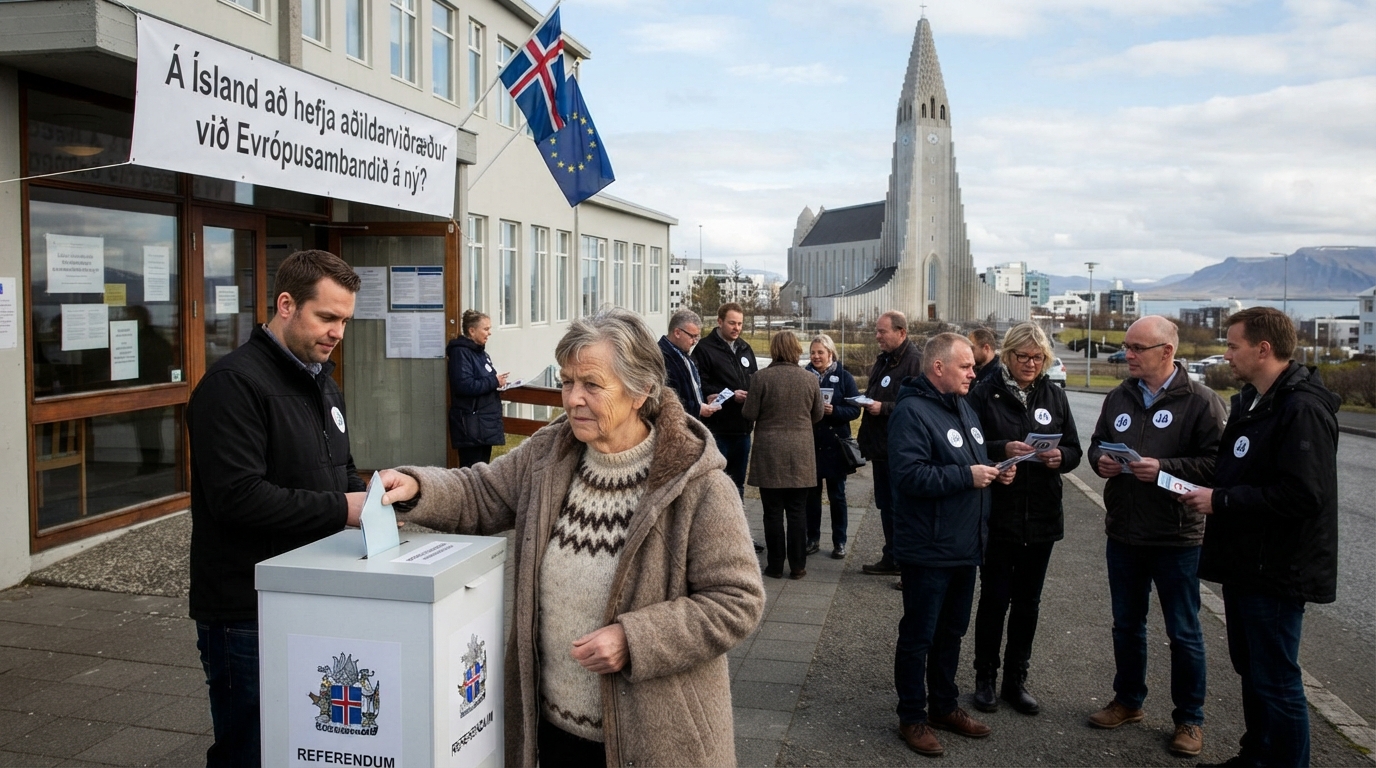
Iceland is holding a referendum to determine whether to resume discussions about joining the European Union, 13 years after negotiations were halted. The outcome is highly uncertain, with recent opinion polls showing a razor-thin margin. The latest survey indicated the "No" campaign slightly ahead with 51.6%, while a previous poll had favored the "Yes" side.
Prime Minister Kristrún Frostadóttir's center-left administration had already planned a referendum, but escalating international tensions prompted her to accelerate the timeline. The core of the debate, however, has centered less on Iceland's security as a NATO member and more on its vital fishing industry and national sovereignty.
Voting is scheduled from 09:00 to 22:00 GMT on Saturday, with results anticipated in the early hours of Sunday. Iceland, with a population under 400,000, saw over one in five eligible voters cast ballots during early voting, according to public broadcaster RUV. The ballot question asks: "Should Iceland resume accession negotiations with the European Union?"
While Iceland is already integrated into the EU's single market and Schengen border-free zone through the European Economic Area, full EU membership would bring it into the customs union and eventually introduce the euro. Iceland's initial application to join the EU was well underway when talks paused in 2013. European Commission officials suggest that if resumed, negotiations could conclude within one to two years. Of the 35 "chapters" of talks, covering areas from fisheries and economic policy to freedom of speech and movement of goods, 27 had commenced and 11 were provisionally completed.
A "Yes" vote would not finalize EU membership but would endorse moving towards an accession agreement. Any such agreement would then require approval in a second referendum, parliamentary consent, and constitutional amendments. All 27 EU member states would also need to ratify the deal. The "Yes to See" campaign group advocates for Icelanders to explore the terms of a potential deal to make an informed final decision. Conversely, a "No" vote would not preclude future discussions about EU membership.
Sovereignty has been a pivotal issue in the pre-referendum discourse. Iceland achieved full independence from Denmark in 1944, and its fishing and marine industries account for nearly 40% of its exports. "No" campaigners express concerns about losing control over Iceland's valuable fishing grounds under the EU's Common Fisheries Policy, vowing to never share their waters. Although Brussels has hinted at potential exemptions for Iceland, this remains the most significant potential hurdle to any agreement. Many Icelanders recall the "Cod Wars" with the UK in the 1970s, which Iceland won, and fisheries have historically been the primary impediment to Iceland's EU accession.
Following the 2008 financial crisis and the collapse of Iceland's banking system, Reykjavik initiated accession talks in 2009, only to suspend them in 2013. Iceland is now one of Europe's most prosperous nations. Eirikur Bergmann, a professor of politics at Bifröst University, told the BBC that "many people attribute this to Iceland's independence." A recent Icelandic trade union survey indicated the country was more expensive than the next 10 most expensive nations globally. Despite having the fifth-highest GDP per capita worldwide, interest rates remain high at 8%, and inflation has reached 5.6%. "Yes" campaigners argue that the economic advantages of EU membership would help reduce these rates.
Iceland, a founding member of NATO, lacks a military and relies on allies for defense. A bilateral US defense agreement has been in place since 1951. The "No" campaign asserts that Iceland's security is rooted in both NATO and the US, and EU membership is not a substitute for NATO. Iceland has been a staunch supporter of Ukraine following Russia's full-scale invasion, and officials have noted Russia's increased maritime maneuvers near the island with apprehension. However, concerns have also arisen from US President Donald Trump's expressed interest in acquiring Greenland, and his confusion of it with Iceland has caused alarm. This year, the EU and Iceland signed a security and defense partnership, with EU officials stating that the EU "offers an anchor in a community of values, prosperity and security."
A televised debate preceding the referendum featured Prime Minister Kristrún Frostadóttir leading the "Yes" campaign and Guðrún Hafsteinsdóttir, chair of the opposition Independence Party, heading the "No" campaign. Kristrún emphasized Iceland's existing integration with the European Union, stating that membership would be "one of the biggest risk-reducing steps we can take." She also clarified that a "Yes" vote did not guarantee membership and that a "No" vote would be respected. Guðrún, conversely, stressed that the vote was not about Iceland's cooperation with Europe, stating, "We already do, and we want that to continue." Instead, she framed the referendum as a decision on whether Icelanders wished to cede "decision-making powers" to Brussels regarding fisheries, agriculture, and natural resources.
Despite geopolitics being the catalyst for the government's push to resume EU talks, it has received limited attention during the campaign. Hallgrimur Oddsson, director of the EU-Iceland think-tank European Currents, noted, "It's lower on the agenda than many would think."