

Citroen revives the 2CV for an electric age
The French firm is reinventing the classic model as carmakers come under pressure from Chinese rivals.
Citroen revives the 2CV for an electric age
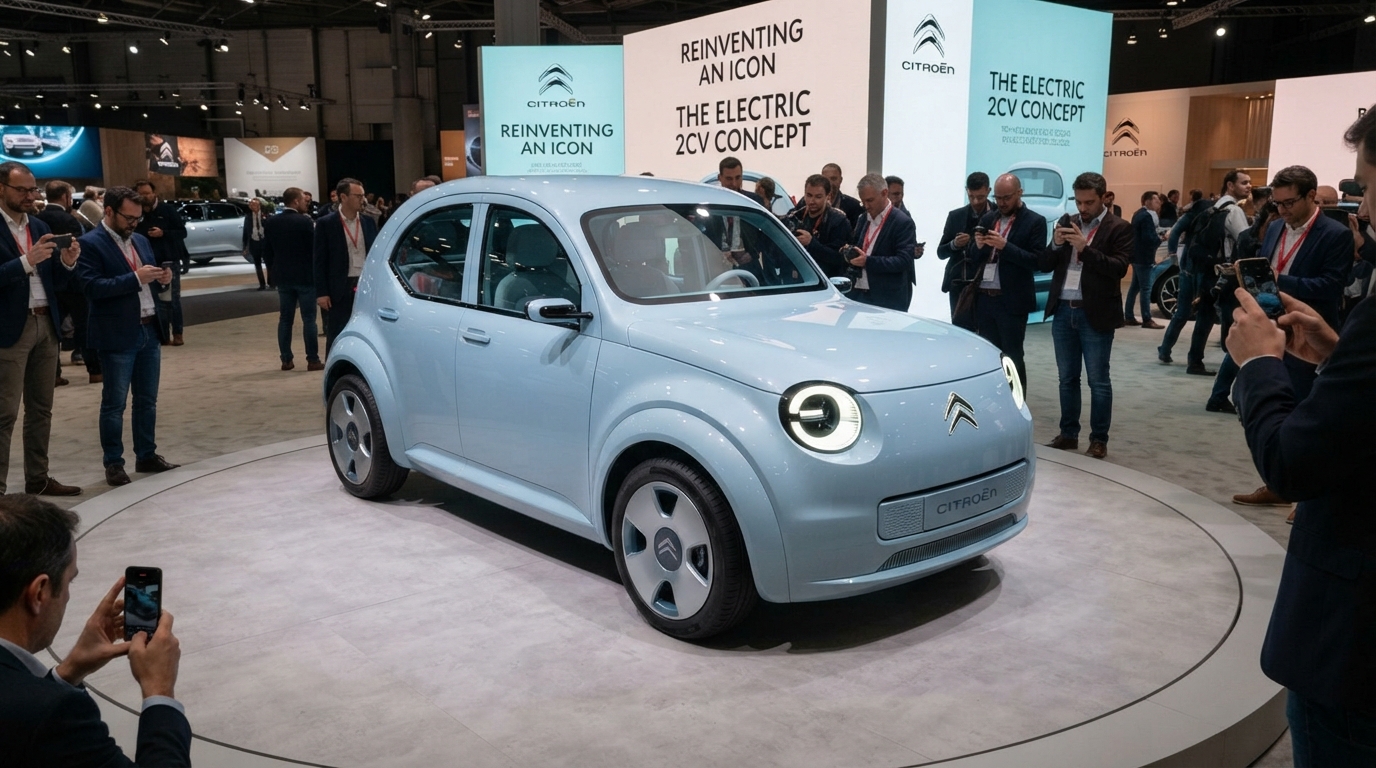
French carmaker Citroen has revived its 2CV name in an effort to lift electric car sales in a challenging market.
The new model, shown at the Paris Motor Show, is a compact city car with retro-inspired styling that recalls one of the company’s best-known designs.
Presented as a "concept car" to signal Citroen's future direction, it is not yet ready for sale, but the intention is to have a version in showrooms by 2028.
As they contend with intensifying competition from Chinese manufacturers, Citroen and other European brands are leaning on their heritage as a way to market modern vehicles.
Citroen chief executive Xavier Chardon called the new car "a modern, ingenious and refreshing response to the mobility challenges of tomorrow".
The original Citroen 2CV was introduced in 1948, as Europe was rebuilding after the devastation of World War Two. It was conceived as an inexpensive, sturdy means of transport for French farmers and rural communities.
The car featured high wheel arches and soft suspension, allowing it to cross a ploughed field or rough roads - and, as legend has it, without cracking a tray of duck eggs.
Its tall roof meant drivers could wear a hat behind the wheel. It was straightforward to drive and easy to fix.
The model became so successful that it stayed in production for more than 40 years. Over time, it evolved from a practical countryside vehicle into a cult favourite, especially among hippies and counter-culturalists.
Now, Citroen hopes to use that legacy to market an electric small city car that is expected to cost less than £15,000.
The appearance of the new 2CV may still change as Citroen continues developing its design. Even so, it already carries many styling cues from its famous predecessor.
The high, flared wheel arches, the tall curved roof and the eye-like headlights all echo the original "deux chevaux" or "two horses".
By using memories of an old car to promote a new one, Citroen is taking a familiar route.
VW famously revived the Beetle in the late 1990s, but with limited success.
BMW's Minis have always featured styling meant to evoke the very British original. Fiat has been selling a retro-styled Fiat 500 for the past two decades.
However, the retro-nostalgia trend has gathered pace recently, as carmakers search for ways to persuade sceptical consumers to buy electric cars.
Citroen's French rival Renault has been at the forefront. It began with the Renault 5 E-Tech, which visually mirrored the distinctive boxy look of the original Renault 5, once a constant presence on French roads. It has since brought back the Renault 4 and Twingo brands too.
VW has the distinctive ID-Buzz minivan, a nod to the classic T2 Transporter, while Ford is developing a new EV that is widely expected to be named the Fiesta.
Rachel Burgess, senior editor of Autocar magazine, believes it is a strategy that makes complete sense.
"It's a brilliant differentiator from all-new car brands", she says. "An older audience might remember the originals and feel warmly towards them, and a younger audience might find an appeal in the retro aspect."
Discovering new ways to make cars attractive has become more important than ever as European manufacturers face rising competition from Chinese brands.
"Many in the industry believe the big automotive players in Europe…face a very serious existential threat from aggressive Chinese manufacturers," says David Leggett, automotive editor at Global Data.
In this difficult business climate, heritage and nostalgia may become powerful tools for more established brands, believes automotive researcher and author Dr Paul Nieuwenhuis.
"In a world where a wave of credible decent quality Chinese EVs are hitting Europe, linking European designs back to their history while using the latest powertrain technology is something the Chinese cannot do," he says.
"The Chinese can establish new design trends, but there is limited history there."
But Leggett says Citroen will need more than nostalgia alone to make its new car a hit.
"A reimagined Citroën 2CV should give a big nod to its ancestor - especially on price and design simplicity as well as visual cues," he says.
"But it also needs to be a credible modern electric car in terms of functionality and features, with widespread appeal."