

Why Jaguar Land Rover has decided change is needed
Job cuts come as JLR faces falling sales and intense Chinese competition while trying to switch to electric vehicles.
Why Jaguar Land Rover has decided change is needed
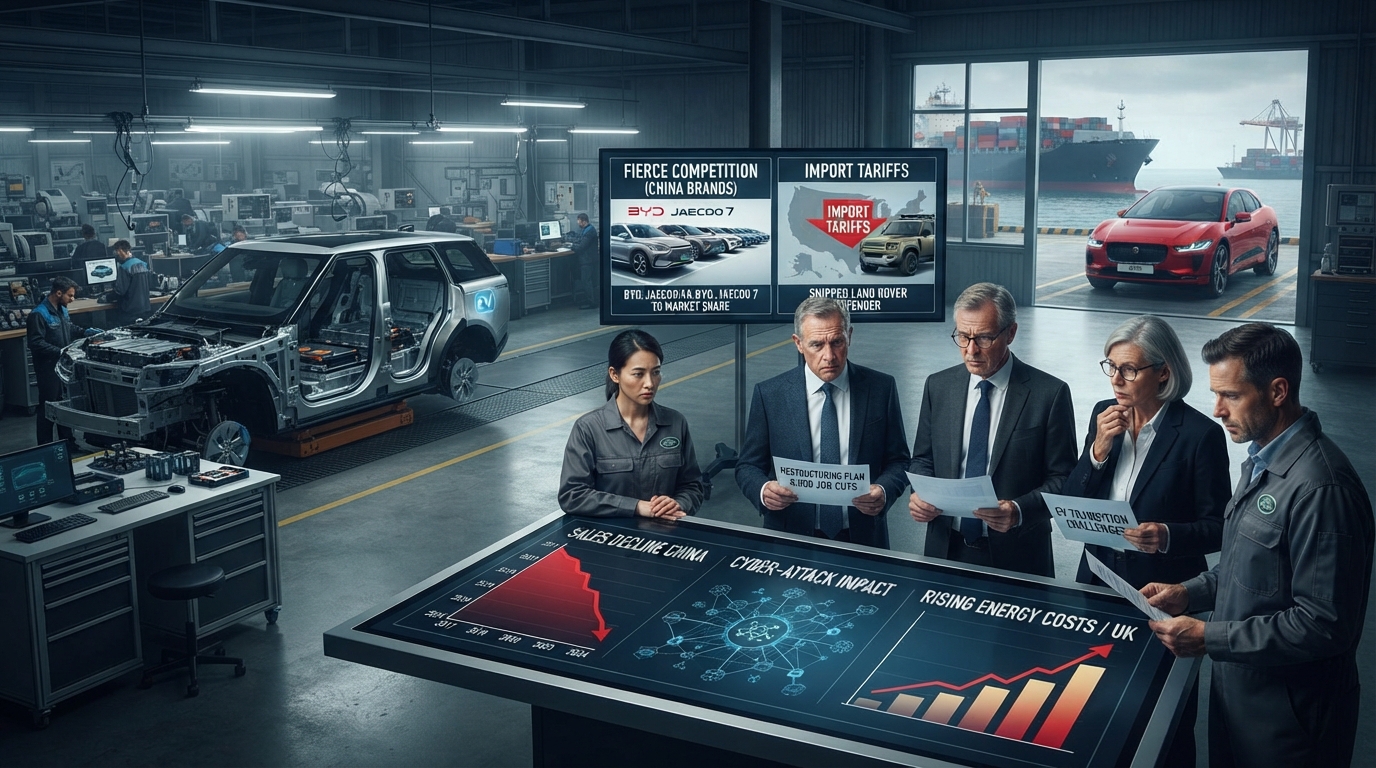
Jaguar Land Rover’s move to cut 4,000 jobs follows a period in which the carmaker has been on a very difficult journey.
Sales have declined across all of its key markets, while the company has also been coping with the fallout from a crippling cyber-attack that halted production last year.
At the same time, it has poured billions into trying to reshape itself for an electric future, where it is likely to encounter fierce competition from fast-growing Chinese brands.
Executives have now concluded that a major restructuring is required.
China is one of JLR’s biggest worries. Not long ago, it was viewed as a huge opportunity for western carmakers, with rapidly growing middle classes appearing to have an endless appetite for premium foreign-branded vehicles.
JLR, like other European marques such as BMW, Audi and Mercedes Benz, was eager to satisfy that demand, especially when the European market was highly saturated and growth was difficult to come by.
Now, the picture is very different. Over the past decade, domestic Chinese carmakers have expanded rapidly, strongly supported by their government, which has been determined to establish China as a major force in electric vehicles.
That has produced an intensely competitive market, where local manufacturers have quickly improved the standard of technology and the pace of development.
Together with a slowdown in the Chinese economy, this has made China a far tougher market for European brands.
JLR’s sales in China dropped from a peak of 146,000 cars in 2017 to only 62,400 in the last financial year. Meanwhile, competition and a new luxury car tax have squeezed profit margins.
The result has been a steep decline in revenue from the region. JLR is not the only company affected; Volkswagen Group, for instance, has also seen its earnings in China hammered – a key reason behind its decision to cut 100,000 jobs by the end of the decade.
The condition of the Chinese market has had another effect on European carmakers, including JLR. Confronted by brutal competition, they have been pushing harder overseas.
Firms such as BYD and Chery have been rapidly increasing their share in the UK and Europe – with the Jaecoo 7 the third best-selling car in this country over the first half of the year.
Analysts say established brands will struggle to keep up with newer rivals, who can price cars more cheaply and bring them to market faster.
The US is another important market for JLR. In the year to the end of March 2025 it sold more than 120,000 cars there. By the following year, that number had slipped to just under 100,000.
Some of that may be linked to the cyber-attack, which paralysed JLR’s production in September 2025 and disrupted operations through the end of the year. It affected JLR globally and cost the company £1.9bn.
But sales and profits were also damaged by the introduction of US import tariffs, and the later uncertainty surrounding those tariff levels. As automotive analyst Matthias Schmidt puts it, the company is "seeing a head-on hit each time a Land Rover rolls off a ship onto US soil".
JLR is now considering a partnership with Stellantis to produce new Defender-badged vehicles in the US. These models, which would be designed specifically for the US market, would not face tariffs.
There is also the issue of energy costs, which weigh on JLR and its competitors. Carmakers and their suppliers are industrial businesses that consume large amounts of energy, and UK prices are among the highest in Europe.
According to Prof David Bailey of Birmingham Business School, "electricity is a fundamental input into modern industrial production".
"If producing a car in Britain is structurally more expensive because the energy required to manufacture it is substantially more expensive, Britain is effectively imposing a competitiveness tax on its own industry."
All of these pressures have come while JLR has been investing heavily in a new generation of electric vehicles. The first results of the £15bn programme were unveiled last week, with the official launch of the first electric Range Rover.
That was relatively uncontroversial – but so far the relaunch of Jaguar as an all-electric brand has been anything but. In late 2024 the company stepped straight into the centre of the culture wars with a divisive advertising campaign that some viewed as overly "woke". The first actual car is due to make its public bow on 6 October – and it will be a pivotal moment for the company.
It is easy to understand why JLR chief executive PJ Balaji believes action is needed to reduce costs and make the company leaner. That is bad news for workers, with thousands of jobs set to go and compulsory redundancies not being ruled out.
But the carmaker’s suppliers are also under pressure.
"JLR has been pushing hard for cost savings", one leading supplier told the BBC. "But those suppliers are also facing high energy costs and high employment costs…there's huge anxiety right now."