

"Cities are designed for people, not for robots" — Lead Designer of New Tashkent Hakan Agca
"New Tashkent must become a fully fledged city with its own life," believes Hakan Ceyhan Agca, the lead designer of the New Tashkent master plan. At Tashkent Design Week, the founder of the British architectural firm Cross Works explained how the project team plans to achieve this. Overview by Gazeta.
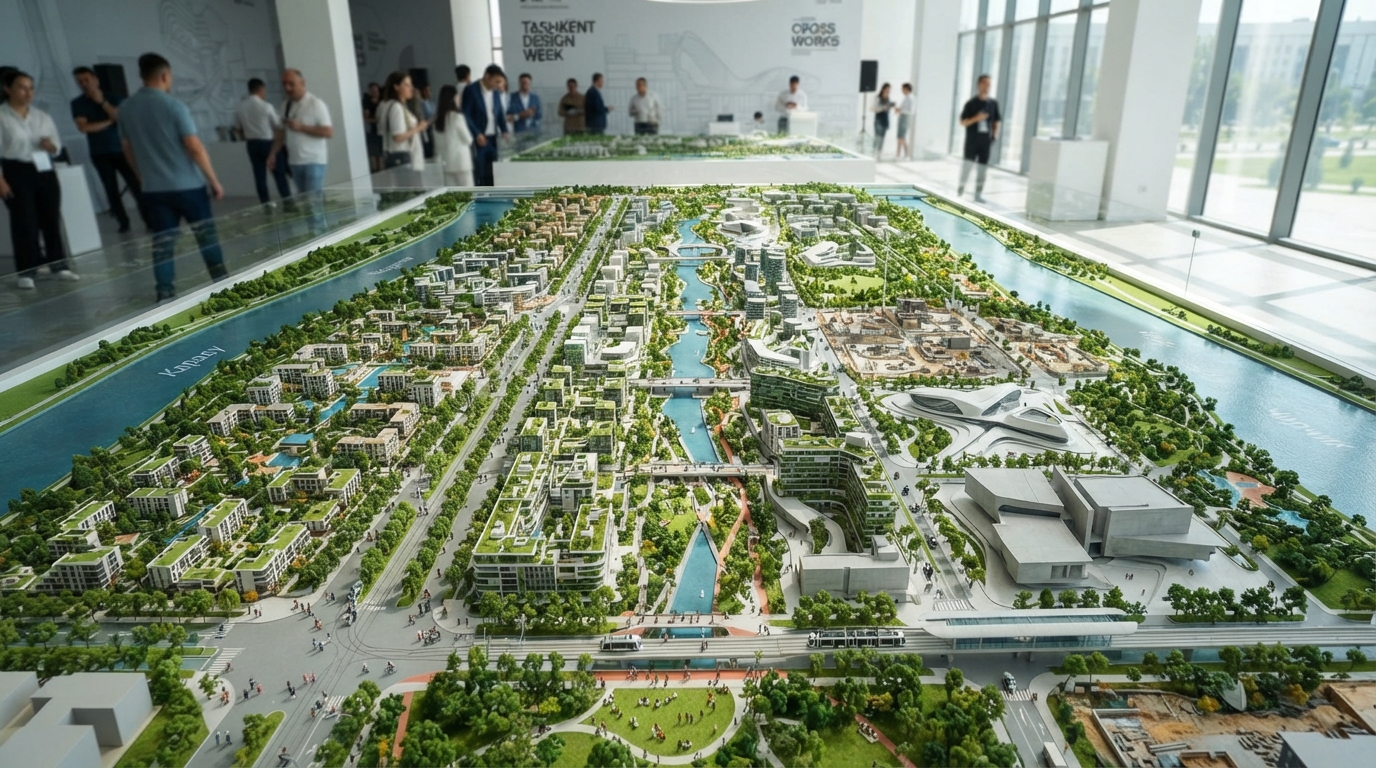
“Cities are designed for people, not robots” — Hakan Agca, lead designer of New Tashkent
Hakan Ceyhan Agca, founder and managing director of the British architecture and technology firm Cross Works, as well as the lead designer of New Tashkent, spoke on October 27 at Tashkent Design Week about the development of the master plan for the project under construction.
According to him, New Tashkent should become not just a territory with residential quarters and administrative buildings, but a full-fledged city with a life of its own.
“When we work on such large-scale projects, (...) it is very important to remember that we are designing cities for people, not for robots. This lies at the heart of everything we do,” the speaker said.
Hakan Agca explained that New Tashkent is designed to help address the challenge of systematically expanding the capital amid a demographic surge. According to him, “over the next 100 years, the population of Tashkent and New Tashkent could increase to 5–6 million people.”
If land for urban development is not allocated in time and construction plans are not prepared, this could lead to the emergence of informal settlements, the speaker noted. As examples, he cited slums in Delhi, favelas in Rio de Janeiro, and gecekondu in Istanbul — unauthorized residential areas whose problems authorities have to solve years later.
According to the presented project, New Tashkent should connect the capital with the territory beyond the Chirchiq River and eventually become part of the expanding urban agglomeration. Its first district is already in an active phase of construction.
“This is one of the fastest-implemented construction projects in the world, and I think all residents of Uzbekistan should be proud of this. Of course, with a high speed of construction, it is necessary to maintain quality. I think right now this is one of the main priorities of the New Tashkent Directorate,” the architect noted.
When developing the concept for New Tashkent, the Cross Works team used the water level difference between the Qarasu and Chirchiq rivers to create a canal system.
“The level of the Qarasu is slightly higher than the level of the Chirchiq, so the water flows down. This allows us to create a sequence of canals and turn the city into an Amsterdam or Copenhagen of Central Asia,” Hakan Agca said.
The project involves integrating transport infrastructure, including roads, metro, and tram lines, as well as creating green spaces. Wide avenues and different types of streets have been designed: primary, secondary, and local roads, as well as streets intended exclusively for pedestrians.
According to the presented data, about 28% of the territory is planned to be set aside for open spaces.
According to the developers’ concept, this will allow New Tashkent to become one of the greenest cities in the world.
Climate was a distinct factor in the design process. Unlike regions where architects can focus predominantly on hot weather, in Tashkent it is necessary to take into account both high summer temperatures and winter cold.
“I live in London. There it rains for about 11.5 months a year, and it is very hot for about two weeks. Tashkent, on the other hand, has all the seasons. This makes the city a genuinely interesting place to work,” Agca noted.
According to him, the company has experience working in Saudi Arabia, but there one does not have to worry about the cold, as design is done taking into account only the heat.
According to Agca, international experience is important when creating new cities, but the architectural appearance of New Tashkent should ultimately be shaped by local specialists. He drew a parallel with the history of Ankara, whose master plan was developed at the time by German architect Hermann Jansen, while specialists from Europe were brought in to design public buildings.
“When Atatürk, the founder of the Republic of Turkey, decided in 1923 to move the capital of Turkey from Istanbul to Ankara, he decided to involve international architects and use some of their ideas. In essence, what President Mirziyoyev has done today is fundamentally no different. Of course, those architects subsequently went home. They did not stay to build the city,” he said.
Hakan Agca emphasized that in the case of New Tashkent, Cross Works intends to transfer experience and create conditions for local architects to participate in further work. The company has offices in London and Riyadh, and recently opened an office in Tashkent to recruit staff so that “buildings are designed by people from Uzbekistan.”
To regulate the architectural appearance of buildings, the team developed guidelines based on five principles: scale, proportions, architectural expression, openness, and materials. They are effectively meant to serve as a guide for local architects and developers, rather than prescribe a single external look for all buildings.
In addition, the developers created a digital twin — a virtual model that reflects the state of the territory and updates as construction progresses. Such a tool allows design solutions to be aligned with the progress of the master plan implementation.
The architect devoted a separate part of his speech to the role of cultural facilities in urban development. He cited the Guggenheim Museum in Bilbao, Spain, as an example. According to Agca, the construction of the museum was a major factor in transforming the former industrial city, which faced unemployment and social problems.
“It is culture that ultimately shapes the soul of a city,” the architect noted.
When developing architectural guidelines for New Tashkent, the team provided requirements for residential, commercial, and public buildings; however, cultural facilities require a separate approach. They must not only fulfill their direct function, but also shape the character of the urban environment.
In this regard, Hakan Agca noted the contribution of the architectural firm Zaha Hadid Architects, which developed the project for the Alisher Navoi International Scientific Research Center. He also mentioned the National Museum of Uzbekistan under construction, designed by Japanese architect Tadao Ando.
In the speaker's view, the decision to provide for cultural facilities at the design stage will prevent a situation where a city is first built up with residential quarters and then requires large-scale renovation to establish its own identity. Agca added that the combination of diverse functions in New Tashkent will allow for the creation of a full-fledged urban environment where people can not only live, work, and study, but also comfortably relax and spend time.