

China's 135-meter giant is paving the way underwater
In China, a giant tunnel boring machine measuring 135 meters in length is clearing the way for a railway under the sea. Operators are remotely controlling the complex, named "Yunzhou," from a land-based center. Cameras and sensors continuously monitor its operation and send notifications about potential malfunctions to specialists' smartphones.
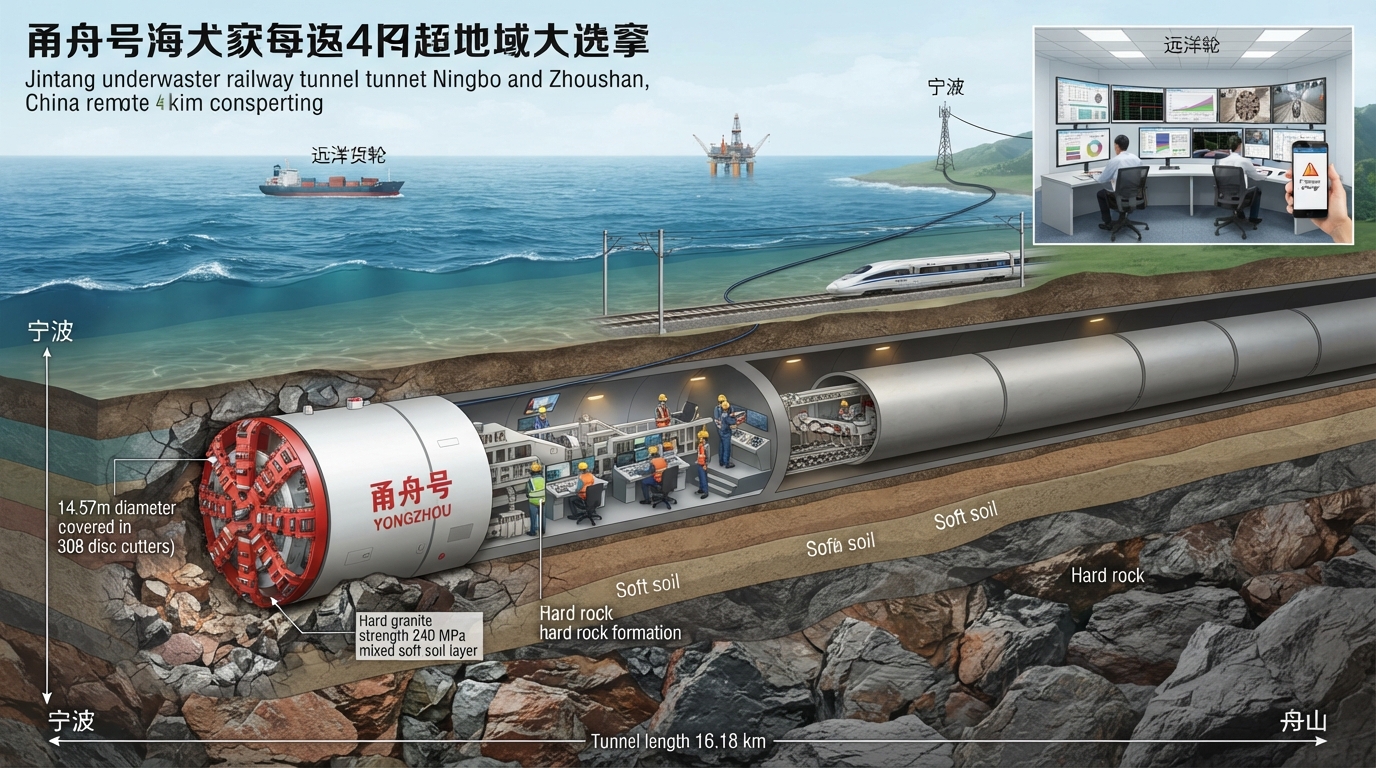
China's 135-meter giant is carving a road under the sea
The "Yongzhou" complex is working on the construction of the Jintang subsea tunnel, which connects the cities of Ningbo and Zhoushan in China's Zhejiang province. This structure is described as the world's longest underwater high-speed railway tunnel.
The total length of the tunnel is 16.18 kilometers. Of this, 11.21 kilometers will be excavated using special tunnel boring machines. The complexes moving toward each other from both sides are set to meet at a designated point beneath the seabed.
Working from the Ningbo side, "Yongzhou" has so far excavated a distance of more than four kilometers. This means that nearly 83 percent of the excavation work assigned to this machine has been completed.
The complex is currently approaching a section of the route at a depth of nearly 93 meters. As it moves forward, the geological conditions are becoming more complex, making excavation work increasingly difficult.
Operators control the machine from a command center located on land, several kilometers away from the excavation site. At the same time, specialists inside the complex monitor the operation of the equipment on-site.
The remote control system connects the surface center with the machine's underground operating systems. Cameras and sensors monitor the status of the rotating cutterhead, cutter wear, and excavation metrics in real time. This allows engineers to identify malfunctions as soon as they arise.
The monitoring system also sends alerts directly to specialists' smartphones. For example, if an abnormal change in the cutterhead's torque is observed, if tunnel lining segments shift, or if pressure in the oil system and seals changes, the responsible personnel receive immediate notifications.
"Yongzhou" was specifically designed for the complex geological conditions of this route. Its excavation diameter is 14.57 meters, and 308 cutters are mounted on its rotating front part. The complex began operation in May 2024.
Nearly 70 percent of the route on the Ningbo side consists of strata unfavorable for excavation. In some areas, the machine has to cut through solid hard rock, and in other areas, through soft ground. On some sections, its cutterhead encounters both soft ground and extremely hard rock simultaneously.
The strength of the rock reaches up to 240 megapascals. According to the source, this is more than eight times higher than the strength of ordinary concrete.