

Central Bank of Uzbekistan intends to expand reserve investments beyond US Treasuries
The Central Bank intends to gradually expand the list of assets in its international reserves — through sovereign and subnational bonds and other instruments, and not just US Treasury securities. Currently, securities account for only about 2.4% of reserves, while gold accounts for about 90%.
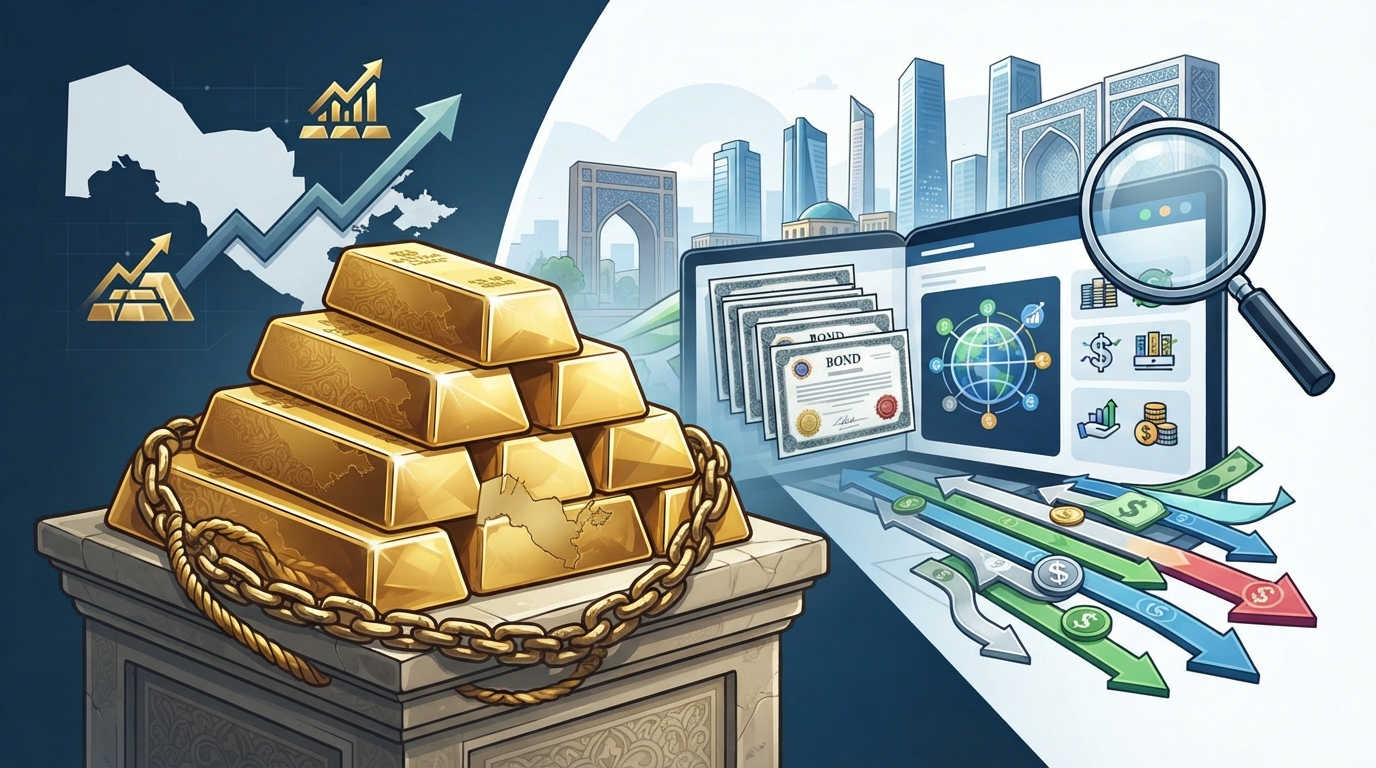
Central Bank of Uzbekistan plans to expand reserve investments beyond US government bonds
The Central Bank of Uzbekistan intends to gradually expand the list of assets in which the country's international reserves are placed. This was announced on September 18 at the International Portfolio Asset Management (iPAM) Forum in Tashkent by the Deputy Chairman of the Central Bank, Abror Mirzo Olimov, reports a "Gazeta" correspondent.
According to him, as of the beginning of September, the Central Bank held approximately 439 tons of gold.
"The structure of our international reserves, one could say, is highly unusual compared to other central banks. As of the beginning of September this year, we held approximately 439 tons of gold, the market value of which was about 65 billion dollars. This is approximately 90% of our international reserves," he said.
Abror Mirzo Olimov emphasized that the high share of the precious metal cannot be explained solely by the investment decisions of the Central Bank.
Uzbekistan mines about 120 tons of gold annually, and the Central Bank has a priority right to purchase it.
"The large share of gold in our reserves is not simply the result of a decision by reserve managers, nor is it the result of strategic asset allocation. First and foremost, it is a consequence of the structure of our economy, the domestic gold production ecosystem, and, of course, the historically established accumulation of reserves," explained the deputy head of the Central Bank.
According to him, over the past five years, the country's international reserves have almost doubled — from approximately 35 billion dollars in 2021 to more than 72 billion dollars. Over the same period, gold reserves grew from 360 to 439 tons, and the share of gold in reserves increased from approximately 60% to 90%.
The growth in the share of gold, as noted by the Central Bank representative, is due to two reasons: an increase in the physical volume of the metal and a rise in its global price.
"It is the combination of these two factors that led to the share of gold in international reserves increasing to approximately 90%," he said.
At the same time, Olimov expects that the role of gold in the international reserves of central banks around the world will continue to grow. According to him, in the last four years, central banks have purchased more than 1,000 tons of gold annually — about twice as much as in previous decades.
"The question is no longer whether gold should be part of reserves. There is another, more complex question: what share of gold in reserves is optimal, and how should this gold be managed? And, I think, the most important question is — what happens when gold begins to make up a significant share of international reserves?" noted the deputy head of the regulator.
Despite the unusual asset structure, Uzbekistan's international reserves significantly exceed adequacy indicators, the deputy chairman of the Central Bank stated.
According to his data, their volume is approximately 3.4 times higher than the minimum benchmark of the International Monetary Fund, allows for covering about 14 months of imports, and is 4.4 times higher than the country's short-term external debt.
"For us, the main question of reserve management is no longer simply about accumulating a large buffer. The question is how to manage such a volume of reserves," Olimov stated.
In managing international reserves, the Central Bank adheres to three key priorities. Safety and capital preservation come first, liquidity second, and yield only third.
"Our goal is not to maximize profit or yield. It is about improving risk-adjusted returns within clearly defined safety and liquidity constraints."
The deputy chairman of the Central Bank also spoke about the connection between purchasing domestically mined gold and monetary policy.
Local producers mine and refine gold, after which the Central Bank purchases it for the national currency. The purchased gold is automatically included in international reserves.
At the same time, settlements with producers in soums increase the volume of liquidity in the economy. To sterilize it, the Central Bank uses monetary policy instruments, open market operations, and the foreign exchange market.
"That is why, in our case, reserve management, gold accumulation, and domestic liquidity management are closely interconnected," he said.
Abror Mirzo Olimov drew attention to the specific understanding of reserve diversification in Uzbekistan.
"When we talk about diversification, for us it usually means buying other types of assets. But for many central banks, diversification, on the contrary, means buying gold," he pointed out.
According to the deputy chairman of the Central Bank, as international reserves grow, the regulator's approach is gradually changing:
"For many years, Uzbekistan naturally focused primarily on accumulating reserves. But as their volume increases, our focus is gradually shifting from accumulation to portfolio management."
Since 2020, the Central Bank has been cooperating with the World Bank under the Reserve Advisory and Management Partnership (RAMP) program.
The regulator has also begun investing part of its international reserves in fixed-income instruments. Initially, the volumes of such investments were small, but they are gradually increasing, Abror Mirzo Olimov noted.
"Now we already have fixed-income securities in our portfolio, and we also have an external manager. We continue to work in this direction," Olimov said.
Gold will remain the country's strategic reserve asset; however, as the portfolio grows, the Central Bank intends to expand the list of other investments.
"This means that we plan to go beyond US Treasury bills and invest in other types of highly liquid assets. These could be sovereign bonds, sub-national government bonds, and other fixed-income instruments," Olimov noted.
At the same time, the Central Bank does not intend to increase risks just for the sake of expanding the range of assets.
"We do not view diversification simply as adding new types of assets. Before taking on more risk, it is necessary to have the appropriate institutional capacity — to be able to understand these risks, measure them, and manage them," stated the deputy head of the Central Bank.
In 2026–2027, the Central Bank, together with international financial institutions, is working on strategic asset allocation, investment policy and strategy, as well as the development of an independent risk management system.
According to Abror Mirzo Olimov, there is no universal optimal reserve structure for all countries.
"A gold-producing economy, such as Uzbekistan or some of our neighboring countries, will naturally have a different reserve structure than an import-oriented economy, a financial center, or an exporter of other commodities," he explained.
The structure of international reserves must take into account the country's liabilities, the need for foreign exchange interventions, the structure of the domestic market, the acceptable level of risk, and institutional capabilities, the regulator's representative emphasized.
The securities portfolio grew by only 3.4 million dollars — to 1.766 billion dollars. For comparison, during July, the portfolio shrank by about 1.1 billion dollars, or almost 40% — from 2.86 billion to 1.76 billion dollars. This happened for the first time since securities appeared in the structure.
As of September 1, Uzbekistan's gold and foreign exchange reserves exceeded 72 billion dollars, and the securities portfolio within them stood at 1.77 billion dollars, having increased by only 3.4 million dollars over August. This is about 2.4% of the total volume of international reserves. For comparison, back at the beginning of July, the volume of securities was 2.86 billion dollars, but during that month, the portfolio shrank by almost 40% — to 1.76 billion dollars.