

Central Bank of Uzbekistan considers transferring part of its reserves to external management
The Central Bank intends to expand the structure of its reserves by asset classes, currencies, and counterparties, as well as move towards external management of a portion of its portfolio. The head of the Central Bank, Timur Ishmetov, noted that the regulator is also considering transferring a portion of its assets to external management.
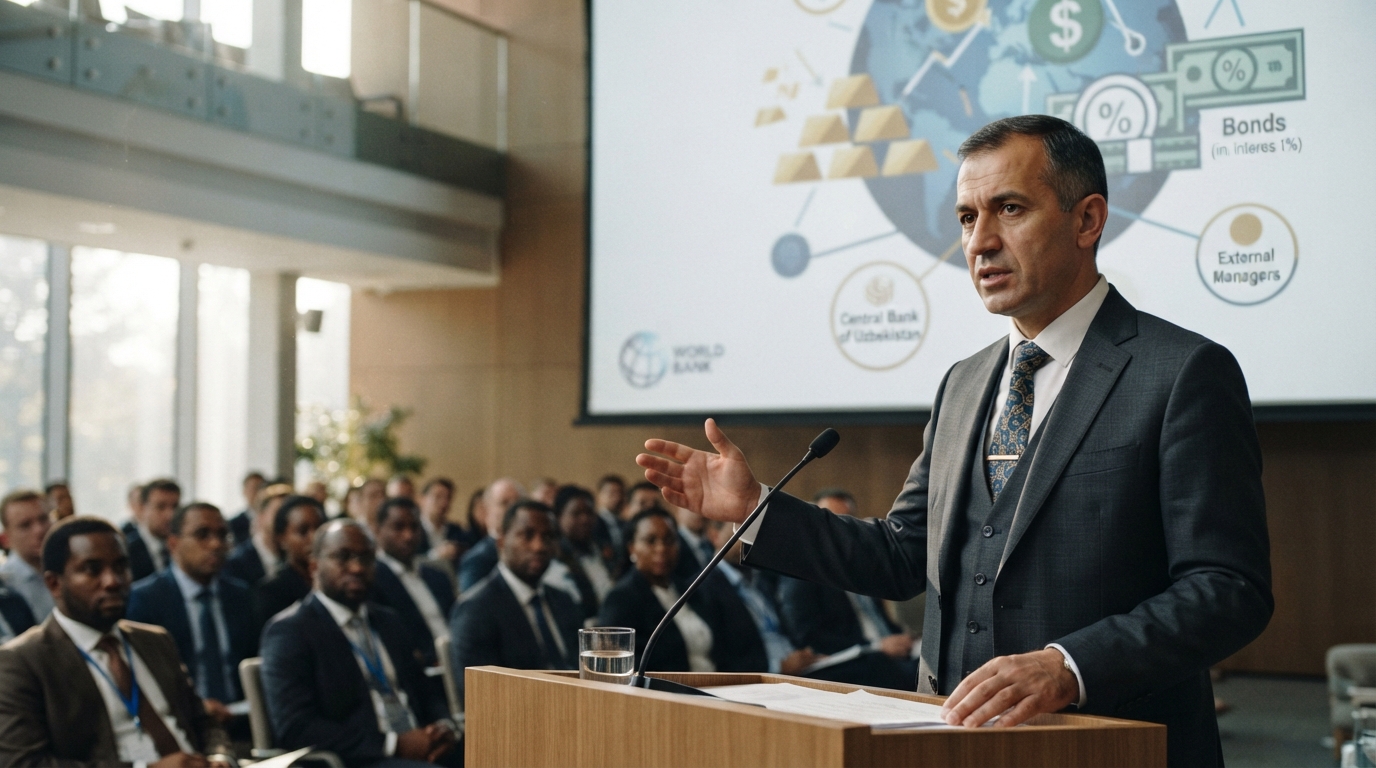
Central Bank of Uzbekistan considers transferring part of reserves to external management
The Central Bank of Uzbekistan plans to further diversify its international reserves — by asset classes, currencies, and counterparties. This was announced by the Chairman of the Central Bank, Timur Ishmetov, on September 18 at the first International Public Asset Management Forum in Tashkent, Gazeta's correspondent reports.
The forum is attended by 77 delegates from 35 organizations — asset managers, central banks, state institutions, international financial organizations, and bodies that develop international standards.
As Ishmetov noted, the management companies represented at the forum collectively control assets worth more than $36 trillion, while central banks and state institutions manage official reserves of approximately $3.4 trillion.
According to Timur Ishmetov, Uzbekistan's gold and foreign exchange reserves exceeded $72 billion as of September 1, providing import coverage for more than a year.
He also reported that in the first half of 2026, the Central Bank increased its gold reserves by approximately 50 tons. According to World Gold Council data cited by Ishmetov, this was the second-largest increase among the world's central banks.
"Two features distinguish our balance sheet. We are a gold-producing country, and gold has long constituted a significant share of our reserves. In addition, by international standards, we are a relatively young reserve manager," he said.
The Central Bank of Uzbekistan joined the World Bank's Reserve Advisory and Management Partnership (RAMP) program in 2020. In 2024, the regulator purchased US Treasury bonds for the first time, which Ishmetov called an "important step in portfolio diversification."
The Central Bank also confirmed the continuation of its cooperation with the World Bank on international reserve management issues.
"We built this system deliberately and without trying to take shortcuts, guided by three well-known principles: safety, liquidity, and return — in that exact order," the Central Bank Chairman stated.
According to him, what matters is not only the structure of the portfolio itself, but also the institutional capacity to manage it. "A portfolio can be restructured in a week. An institution cannot."
Ishmetov named the further expansion of the reserve structure as the next stage.
"Our direction of travel is further diversification: by asset classes, by currencies, by counterparties. And we do not intend to make these decisions relying solely on our own judgment," he said.
He identified the transition to external management for a portion of the assets as one of the directions. According to him, this will allow the Central Bank's portfolio managers to work alongside leading international specialists directly in the markets, and then transfer the acquired experience back into the organization.
The head of the Central Bank dedicated a significant part of his speech to the changing role of gold and the dollar in global reserves.
He referenced the latest World Gold Council survey, according to which 89% of central banks expect global gold holdings to rise, and 45% plan to increase their own gold reserves. Furthermore, three-quarters of respondents expect the dollar's share in global reserves to decline over the next five years.
According to Ishmetov, by the end of 2025, the value of gold in central bank reserves exceeded the value of the US Treasury bonds they held.
"The growing role of gold reflects its appeal as a long-term store of value, a portfolio diversification tool, and an asset that carries no sovereign issuer credit risk," he said.
At the same time, the head of the Central Bank emphasized that changes in the markets do not make reserve management any simpler.
"Changing conditions do not provide simpler answers. They make the questions themselves more significant," he said.
According to Ishmetov, three key questions are currently relevant for the Central Bank:
"We have views on all three questions. But there are no definitive answers to any of them. I prefer to say this at the beginning of the forum, rather than pretend at its conclusion that we have such answers," he stated.