

“Central Asia is becoming more predictable” — senator Sodiq Safoyev
Central Asia is becoming more predictable amid global instability, senator Sodiq Safoyev said. He called for Consultative Meetings to be elevated to a new institutional level. According to him, further rapprochement between the countries of the region requires strengthening trust and shared values.
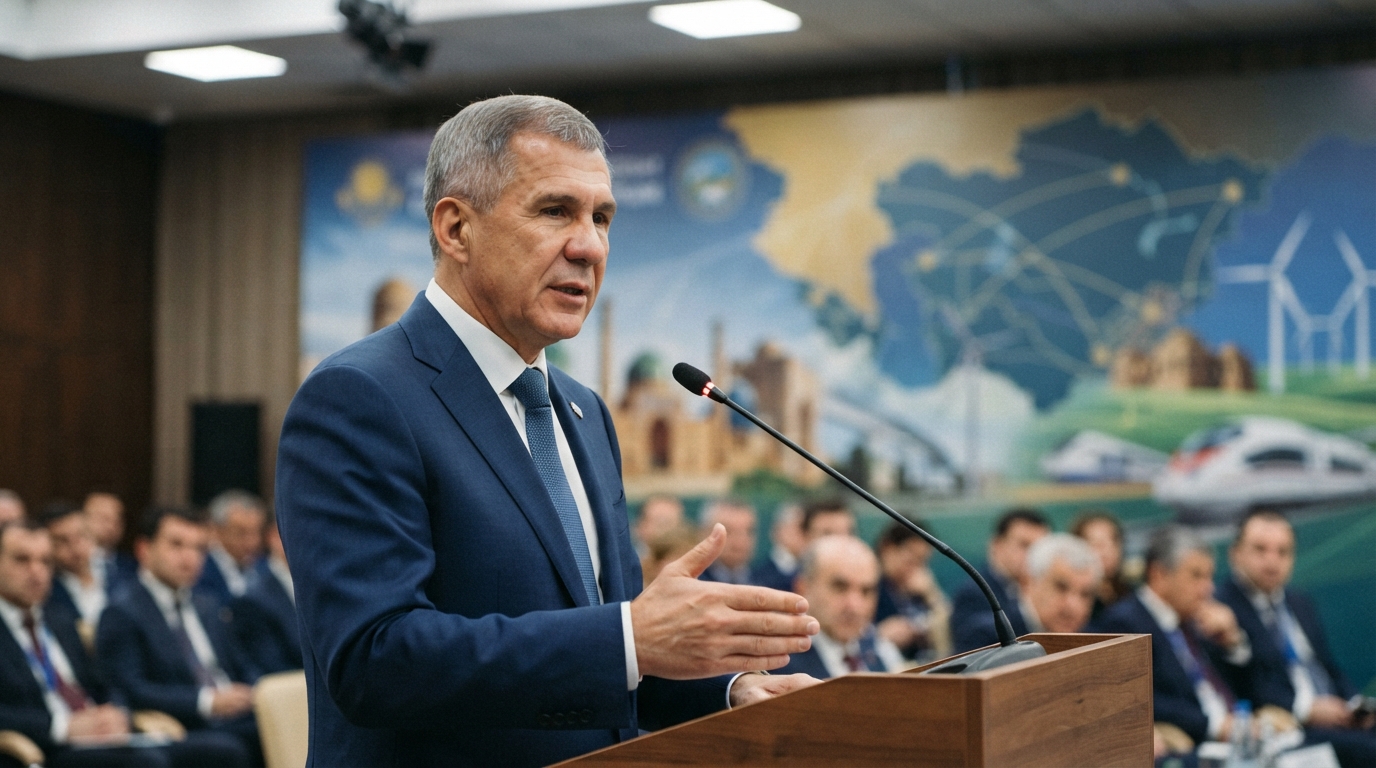
“Central Asia is becoming more predictable” — senator Sodiq Safoyev
First deputy chairman of the Senate of the Oliy Majlis of Uzbekistan Sodiq Safoyev spoke on 1 October in Baku at a regional forum of the CAMCA (Central Asia, Mongolia, Caucasus, Afghanistan) network, which brings together the countries of Central Asia and the Caucasus, as well as Mongolia and Afghanistan.
He said that, in the midst of the international crisis, Central Asia is turning into a more predictable and attractive region, though he added that further progress depends on stronger cooperation, regional identity and trust.
Discussing Central Asia’s role, Safoyev said the idea of the region as a crossroads is nothing new.
“For Central Asia, perhaps it’s a destiny to be in a crossroads. From time immemorial, it has been a region connecting different macro-regions, a region which has changed so many times its borders, composition, predominant faith, languages,” he said.
At the same time, he argued, the world itself is now at a crossroads: “What we’re observing today is something unusual worldwide. And of course, Central Asia and the CAMCA region are centrally located and under the effect of the main trends worldwide. And if we are trying to make an analysis of current ongoing or unfolding events in the CAMCA region and its future, we might consider it within the framework of the general context.”
Safoyev said the world is experiencing polycrisis, meaning several catastrophic events happening at once, and said he had never seen such a situation in his lifetime.
“Crisis follows another crisis: bloody wars, sanctions, disruption of the chain of supply, etc. And mistrust among the leading actors. And acceptance of using the force, which is, to my mind, very insane. Last year, the world’s spending on the armaments was $2.7 trillion, while 1 billion people worldwide were living in miserable conditions,” Safoyev stressed.
In his view, this shows that the global order is changing.
“Which doesn’t mean the ignorance of international law, fragmentation, and I define it as a main crisis is that the world is not getting less connected. Globalization is not abolished. There is no process of deglobalization. But at the same time, trust and mutual understanding among the nations and major actors are going away. It’s very dangerous combination.”
“It is manifested in the disregard for international law and fragmentation. At the same time, the main crisis is that the world is not becoming less interconnected: globalization has not been cancelled, and there is no process of deglobalization. However, trust and mutual understanding between states and key players are disappearing. This is a dangerous combination: interconnectedness is growing while trust is disappearing.”
The senator emphasized the need for collective action and joint efforts to deal with global challenges.
“But at the same time, the ability of major international agencies and institutions like the United Nations and others to address these challenges is at a critically minimal level. The unfortunate point is that this crisis will not be over tomorrow or in the coming years. We are just entering a long period of world transformation. And for us, the CAMCA region, we should know about that. And there must be a joint response of the countries of this region,” he said.
Safoyev said that despite the gloomy global outlook, opposite trends are visible in Central Asia and the wider CAMCA region.
“Astonishingly, the CAMCA area and Central Asia have some reverse tendencies. I talk about the decline of multilateral diplomacy, but in the CAMCA area, multilateral diplomacy is enhancing year by year. It’s very interesting that before, Central Asia was defined in many definitions, mainly due to its proximity to major regional or global powers. Today, more and more, Central Asia is not just a post-Soviet area, not ‘another stans,' not something in between, but the region linking major markets, major powers.”
He also spoke about the idea of landlocked, saying Central Asia is gradually shifting from a landlocked region into a land-linked one, meaning a region connected to other spaces.
“Look to the family of the transatlantic community, the Islamic world, the Arab world, etc. Everywhere, we are observing fragmentation. But in the CAMCA region, there are going to be some gravitating forces bringing us together.”
Safoyev connected these developments, in particular, to the transformation of Uzbekistan’s foreign policy under president Shavkat Mirziyoyev.
“In Central Asia, we’re today seeing a very strong tendency to consolidate cooperation. I’m not talking about integration. Maybe today we should restrain from using the word ‘integration'; it’s too strong. But stronger and deeper cooperation is going on,” he said.
In his view, this makes the region more predictable.
“One point which the world is missing today is predictability. And if we’re talking about geopolitical uncertainty in the world, today we might be more optimistic about the CAMCA region and Central Asia. This means Central Asia is becoming more attractive worldwide,” Safoyev explained.
He also referred to the decision to admit Azerbaijan as a full participant in the Consultative Meetings.
“I think that it’s a time to transform the Consultative Meetings of Central Asian head of states to kind of maybe council or another institution, which will not just be a consultative meeting, but something beyond that,” he said.
The senator also noted that two years ago, the leaders of Azerbaijan, Kazakhstan and Uzbekistan held a summit in Baku that formed a “solid geostrategic triangle”.
On integration, Safoyev said it must first of all be voluntary.
“Forced integration, when someone forces you to join some kind of formation, is never durable and never sustainable. You must gain politically and economically from joining some kind of formation. Secondly, and first of all, coming back, it must have a well-defined goal of integration,” he said.
He said benefits matter, but the key elements of any integration are shared values and common principles:
“Any economic gain or political or security matters cannot replace this most important ingredient. Creating these shared values is perhaps the most important challenge for CAMCA and the Central Asian region.”
He suggested calling this “regional identity”. At the same time, he said this identity does not need to be created, because it already exists thanks to the region’s rich history; it needs to be strengthened and reinforced.
Speaking about values, Safoyev gave a personal example:
“Here in Baku, I feel myself like at home. Being in the streets, talking to the people on the streets. It’s the same way of thinking, the same mentality. Likewise, being in Almaty or Dushanbe or Bishkek, or in Ashgabat and Georgia. I always feel myself among those who are close to me by their way of life, hospitality, cherishing the same values, like respect for the elders, respect for your neighbors, respecting your neighborhood.”
Discussing closer ties between Central Asia and the South Caucasus, Safoyev pointed to the importance of the Middle Corridor, also known as the Trans-Caspian Corridor. He said that if the corridor becomes fully operational, it is expected to transport 11 million tonnes of cargo from the Far East to Europe.
“When the program of building the Middle Corridor and then the railroad connecting China, Kyrgyzstan and Uzbekistan is completed, the time of delivering cargo from Nanjing in China to Duisburg in Germany will diminish to one week or 10 days,” he said.
According to the senator, Central Asia and the South Caucasus will once again become the center of a transit route supporting long-distance trade, which is a major driver of rapid development.
Safoyev recalled that the Silk Road was above all a long-distance trade route and became a major factor in the growth of science, education, statehood and the economy in medieval Central Asia.
“We're talking about the revival of a huge region once again. I think that I’m far away from being in the position of geographical determination, but connectivity is very important. But here is one important point. We should invest not only in the infrastructure of railroads, we should invest in the infrastructure of trust and mutual understanding. Because it’s not only about the railroads, it’s about the system of laws, tariffs, norms, regulations and so on,” he stressed.
He also cited the idea of American scholar Francis Fukuyama that one of the most important features of a modern state is trust: when business trusts the government, the government trusts business and businesses trust one another.
“I think that for modernizing countries of the CAMCA region, creating an infrastructure of trust between each other, overcoming some rudiments of prejudices, maybe unhealthy competition, is most important,” the first deputy chairman of the Senate said.
Turning to the region’s priorities, Safoyev first pointed to investment in education and the future.
“We must enhance and strengthen our partnership among universities, academia and make sure that students know each other not from a distance, not from the books, but looking each other in the eye.”
He also said human capital development is one of the main growth challenges facing the region’s countries today.
“There are some challenges of growth as well. For me, first of all, it is capacity building, the creation of a generation of new public officials, government officials who know the modern economy, modern governance systems, modern management systems, and are qualified enough to fit the requirements of the new age,” he said.
The senator noted that over the past 10 years, the number of universities in Uzbekistan has tripled. “But the creation of the university doesn’t mean that we have already created a school able enough to compete with the best world universities. It will take time. Because a university never emerges from scratch and immediately,” he clarified.
Safoyev also underlined the importance of direct ties between citizens and people-to-people diplomacy. He said ties between civil societies and NGOs should be strengthened, while cultural exchanges and tourism should be expanded. He also mentioned the idea of joint tourism products linking Azerbaijan and Central Asia, Georgia and Uzbekistan, and other destinations.
He also introduced a term he has recently been using often — expert diplomacy.
“We know traditional diplomacy, we know parliamentary diplomacy, people’s diplomacy, but today we must more and more apply expert diplomacy. And CAMCA is about such expert diplomacy,” he said.
“Today, the world is too complicated to entrust it to the people from the foreign ministries and governments. It’s too complicated. There must be a link between expert societies, and expert societies not of one country, but an interdisciplinary and international expert society of our region, which might intellectually support the further development of the CAMCA area,” the senator said.
The next CAMCA Regional Forum will be held in Tashkent in early June 2027.