

"Central Asia has become a more predictable region" — Sadyk Safayev
Central Asia is becoming a more predictable region against the backdrop of global instability, Senator Sadyk Safayev stated. He called for bringing the Consultative Meetings to a new institutional level. According to him, further rapprochement among the countries of the region requires strengthening trust and shared values.
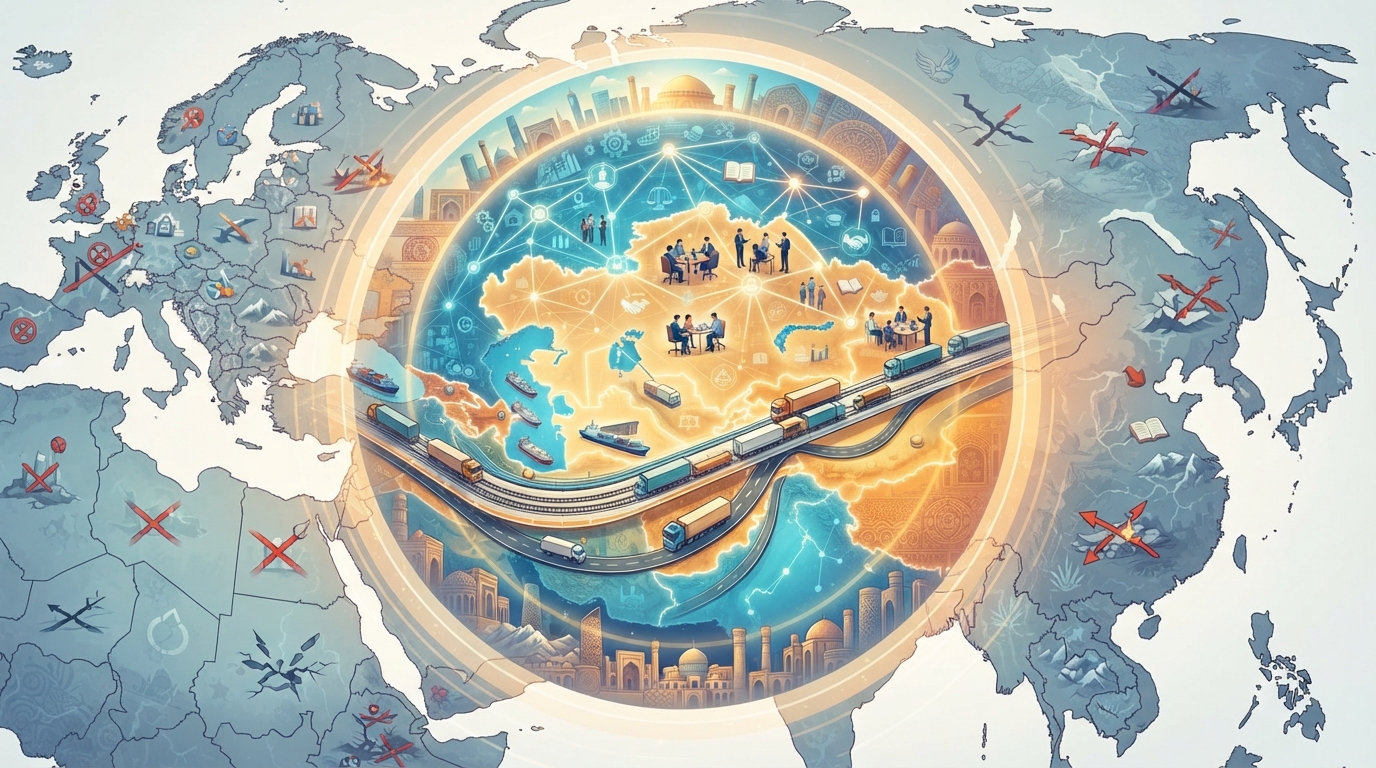
"Central Asia has become a more predictable region" — Sadyk Safayev
First Deputy Chairman of the Senate of the Oliy Majlis Sadyk Safayev spoke on October 1 in Baku at the Regional Forum of the CAMCA (Central Asia, Mongolia, Caucasus, Afghanistan) Network, which unites the countries of Central Asia and the Caucasus, as well as Mongolia and Afghanistan.
He stated that against the backdrop of the international crisis, Central Asia is becoming a more predictable and attractive region, but for further development, it needs to strengthen cooperation, regional identity, and trust.
Speaking about the role of Central Asia and the region, Sadyk Safayev noted that the concept of Central Asia as a crossroads is not new.
"Being a crossroads is perhaps the destiny of Central Asia. Since ancient times, this region has connected different macro-regions. It has changed its borders, structure, dominant religion, and languages many times," he noted.
However, today, according to him, the world itself is at a crossroads: "What is happening in the world today is unusual, and Central Asia and the CAMCA region, being in the center of this space, are experiencing the impact of the main global trends. Therefore, the analysis of current and unfolding events in the region, as well as its future, must be viewed in a broader global context."
According to Sadyk Safayev, the world is in a state of polycrisis, that is, the simultaneous occurrence of several catastrophic events. He noted that in his life he had never observed such a situation.
"One crisis follows another: bloody wars, sanctions, disruption of supply chains, and other shocks. Added to this is the mistrust between the leading global players and the increasingly widespread acceptance of the use of force, which, in my opinion, is an extremely alarming phenomenon. Last year, the countries of the world spent 2.7 trillion dollars on armaments, while 1 billion people worldwide live in difficult conditions," Sadyk Safayev emphasized.
According to his assessment, this testifies to the transformation of the world order.
"It manifests itself in the ignoring of international law and fragmentation. At the same time, the main crisis lies in the fact that the world is not becoming less interconnected: globalization has not been canceled, there is no process of deglobalization. However, trust and mutual understanding between states and key players are disappearing. This is a very dangerous combination: interconnectedness is growing, while trust is disappearing."
In his speech, the senator noted the need for collective action and joint efforts to confront global challenges.
"But at the same time, the ability of such major international organizations and institutions as the UN to respond to these challenges is at a critically low level. Unfortunately, this crisis will not end tomorrow or in the coming years. The world is only entering a long period of transformation, and the countries of the region must have a joint response," he said.
Sadyk Safayev noted that despite the bleak picture of global development, opposite trends are observed in Central Asia and the broader CAMCA region.
"While the decline of multilateral diplomacy is occurring in the world, in our region, multilateral diplomacy, on the contrary, is strengthening year by year. If previously Central Asia was defined in different ways, mainly through its proximity to major regional or global powers, today the region is increasingly perceived not just as a post-Soviet space, not as 'just some other -stans', and not as something intermediate, but as a space that connects major markets and major players."
The senator also dwelt on the concept of landlocked and emphasized that Central Asia is gradually transforming from a landlocked region into a land-linked region, that is, into a region connected to other spaces.
"If fragmentation is observed in the transatlantic community, the Islamic world, the Arab world, and other spaces, in the CAMCA region, on the contrary, forces of attraction are appearing that bring countries closer together."
Sadyk Safayev linked these processes, in particular, to the renewal of Uzbekistan's foreign policy under the leadership of President Mirziyoyev.
"Today, there is a steady trend towards the consolidation of cooperation in Central Asia. But this is not necessarily about integration. Perhaps today we should refrain from the word 'integration' because it is too strong. However, deeper and closer cooperation is indeed developing," he noted.
This, in his assessment, makes the region more predictable.
"Predictability is precisely what the world lacks today. If in the global context there is more and more talk about geopolitical uncertainty, then regarding Central Asia and the CAMCA region, there are more reasons for optimism. This means that Central Asia is becoming more attractive to the world," the representative of Uzbekistan explained.
He also recalled the decision to accept Azerbaijan as a full participant in the Consultative Meetings.
"I think the time has come to transform the Consultative Meetings of the Heads of State of Central Asia into some kind of council or other institution — not just a consultative platform, but something more," he said.
The senator also mentioned that two years ago, the heads of Azerbaijan, Kazakhstan, and Uzbekistan held a summit in Baku, which created a "strong geostrategic triangle."
Speaking about integration, Sadyk Safayev emphasized that first of all, it must be voluntary.
"Forced integration, when someone forces a country to join any association, is never strong and sustainable. A country must receive political and economic benefits from participating in one format or another. In addition, integration must have a clearly defined goal," he said.
The senator noted that benefits are important, but the main element of any integration is shared values and shared principles: "No economic benefits, political issues, or security issues can replace this main element. The creation of such shared values is the most important challenge for the CAMCA region and Central Asia."
He proposed to designate this by the term "regional identity." At the same time, this is not about creating it from scratch, since it already exists thanks to the rich history of the region, but about reinforcing and strengthening this regional identity.
Speaking about values, Sadyk Safayev gave a personal example:
"Here in Baku, I feel at home: on the streets, in conversation with people, I feel the same way of thinking and the same mentality. I feel the same way in Almaty, Dushanbe, Bishkek, Ashgabat, and Georgia. I always feel among people who are close in their way of life, hospitality, and respect for shared values — respect for elders, neighbors, and their environment."
Speaking about the convergence of Central Asia and the South Caucasus, Sadyk Safayev noted the importance of the Middle Corridor (also known as the Trans-Caspian Corridor). According to him, if the corridor starts operating at full capacity, it is expected that 11 million tons of cargo will be transported along it from the Far East to Europe.
"After the completion of the construction of the Middle Corridor, and then the railway connecting China, Kyrgyzstan, and Uzbekistan, the delivery time of cargo from Nanjing in China to Duisburg in Germany will be reduced to one week or 10 days," he noted.
According to the senator, Central Asia and the South Caucasus will again become the heart of the transit route ensuring long-distance trade, and this is the main harbinger of rapid development.
Sadyk Safayev recalled that the Silk Road was primarily a route of long-distance trade, which became the main factor in the flourishing of science, education, statehood, and the economy in medieval Central Asia.
"Today we are talking about the revival of a huge region. I am far from the position of geographical determinism, but connectedness is of great importance. But it is also important to understand that the countries of the region need to invest not only in railway infrastructure, but also in the infrastructure of trust and mutual understanding, that is, in the system of laws, tariffs, norms, rules, and other elements of cooperation," he emphasized.
The senator recalled the thought of the American scholar, Francis Fukuyama, that one of the most important distinguishing features of a modern state is trust: when business trusts the state, the state trusts business, and businesses trust each other.
"And for the modernizing countries of the CAMCA region, creating an infrastructure of trust among themselves, overcoming the remnants of prejudice and, perhaps, unhealthy competition is an extremely important task," said the first deputy head of the Senate.
Speaking about the priorities of the region, Sadyk Safayev primarily highlighted investments in education and the future.
"It is necessary to strengthen the partnership between universities and the academic community, as well as to ensure that students get to know each other not from a distance and not only through books, but directly, looking into each other's eyes."
He also noted that training of personnel is one of the main growth problems that the countries of the region face today.
"We need to raise a new generation of civil servants who understand the modern economy, the modern system of governance and management, and are qualified enough to meet the demands of the new era," he noted.
The senator mentioned that over the past 10 years, the number of universities in Uzbekistan has increased threefold. "But creating a university does not mean that we have already created a school capable of competing with the world's best universities. This will take time. Because a university never arises from scratch and all at once," he specified.
Sadyk Safayev also emphasized the importance of direct ties between citizens and public diplomacy. According to him, it is necessary to strengthen ties between civil societies, NNOs, and develop cultural exchanges and tourism. He also mentioned the idea of joint tourism products that could combine Azerbaijan and Central Asia, Georgia and Uzbekistan, and other destinations.
Safayev also proposed a new term that he has been using often lately — expert diplomacy.
"Along with traditional diplomacy, parliamentary diplomacy, and public diplomacy, today it is necessary to increasingly develop expert diplomacy. CAMCA is precisely an example of such expert diplomacy," he noted.
"The modern world is too complex to trust it only to ministries of foreign affairs and governments. A connection is needed between expert communities, and not of one country, but an interdisciplinary and international expert community of the region, which could intellectually support the further development of the CAMCA space," the senator said.
The next CAMCA Regional Forum will be held in Tashkent in early June 2027.