

Column: What the world map might look like through the eyes of Uzbekistan's diplomacy
What should the map of the world look like from the perspective of Uzbekistan's diplomatic interests? International relations specialist Yuriy Sarukhanyan suggests abandoning the usual division into geographical regions and building a custom system of foreign policy priorities.
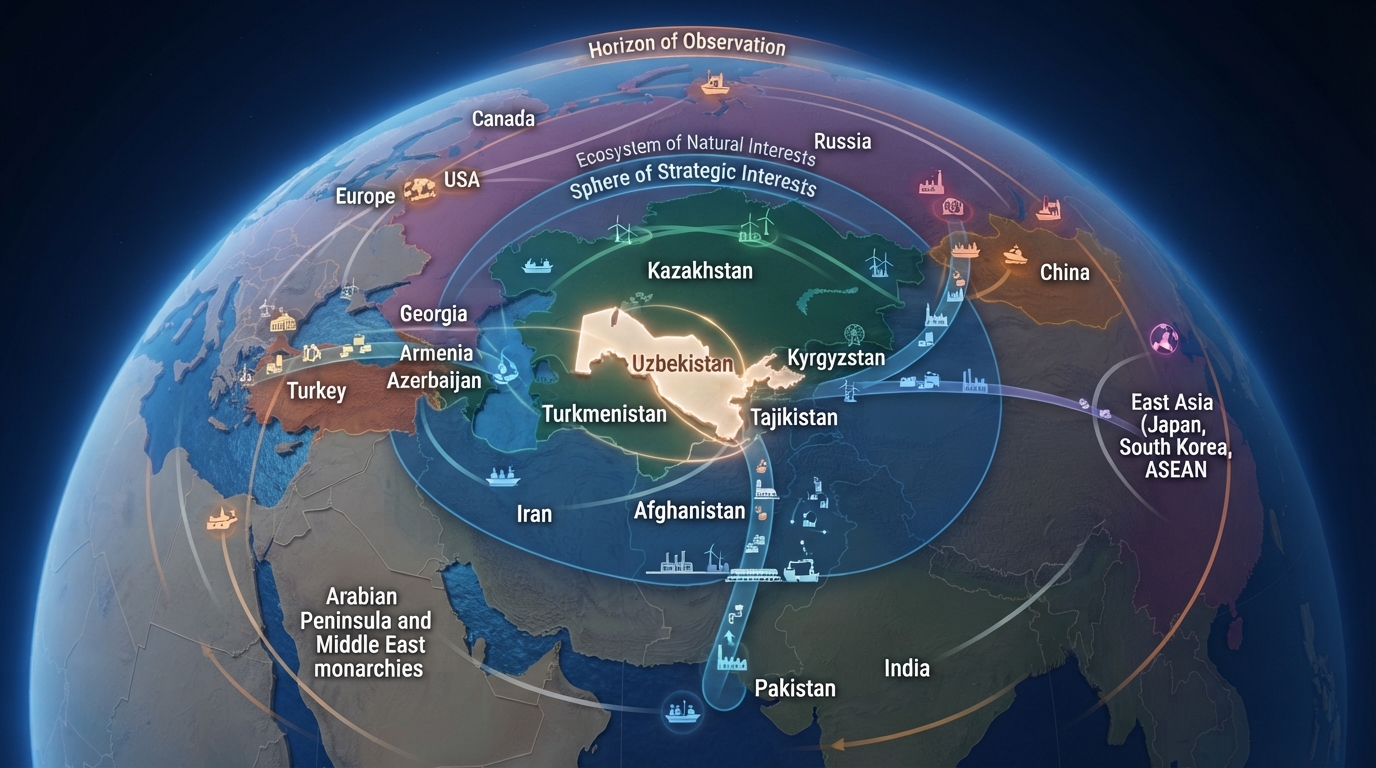
**Column: What the World Map Could Look Like Through the Eyes of Uzbekistan's Diplomacy**
In its foreign policy rhetoric over the past 35 years, Uzbekistan has changed its perception of Central Asia several times. First, attempts were made to create an integration union of Central Asian states, then Russia was included in this process, after which it stalled. In the last few years, Tashkent has been saying that Afghanistan is also part of the region, and last year it supported the inclusion of Azerbaijan in the Central Asian dialogue platform.
In the 2012 Foreign Policy Concept, the text of which is not publicly available and only excerpts are known, the region is designated as a priority. At the same time, the definition of the region itself is not provided there.
It is precisely the lack of a clear answer to the question "What is Central Asia?" that many specialists use as an argument in favor of expanding the dialogue format with new participants. "Nowhere is it recorded that this is only a region of five republics. Why not add someone?"
Reflecting on this, I wondered: how does Uzbekistan see the surrounding world in general? This is not about generally accepted geographical concepts, but about the perception of neighboring regions through the prism of its own position and national interests. Thus arose the idea to speculate on what the world map should look like through the eyes of Uzbekistan's diplomacy.
In international relations, geography does not coincide with school textbooks. It is influenced by changes in political and economic borders, the emergence of integration zones and alliances, and logistical and infrastructural projects.
This is clearly visible in the structures of ministries of foreign affairs. Let's take Central Asia. In the Russian MFA, the Central Asian five is part of the Third CIS Department. The US State Department views us as part of a larger region called "Central and South Asia." The Chinese MFA has a Department of European-Central Asian Affairs. And the French MFA has placed us in the Caucasus and Central Asia Department of the Continental Europe Directorate. These four examples show how differently different countries perceive our region. And in exactly the same way, they "see" the rest of the world in their own way.
Now let's move on to Uzbekistan. In the structure of our MFA, there are the following "geographical departments": Department for Cooperation with the Countries of Central Asia, Department for Bilateral and Multilateral Cooperation with the CIS Countries, Department for Cooperation with the Countries of South Asia, the Near, Middle East and Africa, Department for Cooperation with the Countries of the Asia-Pacific Region, Department for Cooperation with European Countries and EU Institutions, Department for Cooperation with the Countries of the Americas.
This shows what kind of world map our foreign policy agency holds in its mind. First, it sees the space of Central Asia, then the space of the CIS, and only then the large spaces beyond the first two.
Central Asia as a separate direction is good. With the caveat that it is still not established what exactly this region represents. Viewing the CIS as a separate space is, in my opinion, already an outdated approach. Firstly, this structure exists more by inertia — due to the emergence of the EAEU and the reduction in the number of participants. Secondly, such an approach reproduces the external perception of the region as part of the former Soviet space. As for the remaining regions, their classification is based to a greater extent on a traditional geographical approach.
That is, Uzbekistan's diplomacy looks at the world more as if it were standing in front of a world map on a wall. But I want to try to look at the world through the eyes of Uzbekistan in 3D mode, moving away from generally accepted geographical definitions.
So, Uzbekistan has stepped away from the map on the wall and immersed itself in a geographical 3D reality. What should it pay attention to first of all? To begin with — Kazakhstan, Kyrgyzstan, Tajikistan, and Turkmenistan. These are countries close to Uzbekistan not only geographically, but also mentally, culturally, socio-politically, and civilizationally. Uzbekistan has consistently defined Central Asia as a priority direction of its diplomacy. But it is time to make a few adjustments.
First, we need to secure the name "Central Asia" for our Central Asian five. To do this, it is necessary to find a consensus with the other four states and stop attempts to add anyone from the outside to the region. There are many tools for official consolidation. For example, a declaration of the five countries could be adopted stating that they identify themselves with the region called "Central Asia," and an appeal could be made to international organizations and countries not to use other names and not to consider any other countries as part of the region.
Second, we still treat Central Asia as an object of our foreign policy. The region indeed must remain a priority. At the same time, Uzbekistan, as is well known, is one of only two doubly land-locked states in the world. And the distribution of resources in our region is structured in such a way that one country cannot manage them unilaterally without affecting its neighbors. For example, about 80% of Uzbekistan's water resources are formed outside the country, which makes effective water use practically impossible without coordination with neighbors. Therefore, Tashkent should perceive the entire region as its natural habitat. In other words, in the basic settings of its diplomacy, Uzbekistan must already think broader than its own geographical borders.
Glaciers of Central Asia.
Tashkent does not hide its leadership ambitions in shaping the regional agenda. But leadership in international relations is not so much a privilege as a responsibility. Approaching Central Asia as a natural habitat should mean for Uzbekistan more active participation in regional issues, facilitating the resolution of disputes between neighbors, readiness for compromises in bilateral disputes, and providing assistance when necessary. We have already observed some of these elements. For example, when Tashkent helped resolve the conflict between Kyrgyzstan and Tajikistan in September 2022. Or when it made compromises during discussions on territorial issues and the use of border water resources with Kyrgyzstan.
This is precisely how Uzbekistan's new approach should differ from the previous one, when it tried to fence itself off from its neighbors, believing that the more border posts and the tighter the control of the national border, the safer. In our case, this is not so. The security and economic development of Uzbekistan depend on the security of external borders and the sustainable development of the entire region.
But it is important to emphasize something else. A natural habitat does not mean claims to dominance in the region, control over neighbors, or any expansionist ambitions. Therefore, communication with neighbors must be structured in such a way that they do not feel threatened. It is necessary to explain that such an approach is due to the special geographical status of Uzbekistan and the characteristics of the region itself. And also by the fact that without the four neighboring countries, with which we share a common historical experience, a common heritage, and with which we speak "the same language," it is difficult for us to ensure sustainable economic development and security.
Thus, Central Asia for Uzbekistan is a natural habitat in which its vital interests are concentrated. And this space requires active participation in regional political, economic, social, and cultural processes. In this direction, Uzbekistan's diplomacy must use the widest range of tools.
So, Uzbekistan has looked around and dealt with its natural habitat. Now it needs to look beyond Central Asia. Our region is a land-locked region. And this means that the further formation of the geography of Uzbekistan's diplomacy must proceed from which regions it and its natural habitat need for effective development.
This is the first outer level of diplomacy, which I call the circle of strategic interests. This is a large space around Central Asia, necessary for access to the world ocean, diversification of access to global markets, and the development of logistical and infrastructural projects. In addition, the security and stability of the states in this space are important, since their destabilization directly affects Uzbekistan.
I divide the circle of strategic interests into 3 subregions. I deliberately do not invent names so as not to confuse readers. For this column, they are not important — their functions are more important.
The first subregion unites Iran, Afghanistan, Pakistan, and India.
From the point of view of Uzbekistan's national interests, it is one of the most important — if not the most important.
Tashkent is already building special relations with them — at least at the level of statements. Uzbekistan is discussing the implementation of transport and logistics projects, including the Trans-Afghan Railway, obtaining access to the ports of Chabahar and Bandar Abbas in Iran, Karachi and Gwadar in Pakistan, building multimodal trade corridors to India, as well as through China to Pakistan.
Signing of the feasibility study for the Trans-Afghan Railway. Photo: Ministry of Foreign Affairs of Afghanistan
Last year, Uzbekistan, Afghanistan, and Pakistan signed a framework agreement on the development of a feasibility study for the Trans-Afghan Railway, and transport volumes along the already operating Uzbekistan-Afghanistan-Pakistan multimodal corridor have increased fivefold over several years. Chabahar, in turn, is viewed by Tashkent as one of the key links in transport connectivity with India. In addition, it is trying, within the resources available to it, to participate in the process of normalizing the situation in Afghanistan.
At the same time, at the moment, Uzbekistan's strategy is based on bilateral contacts. The situation in this subregion is changing very quickly, relations between countries are unstable, and conflicts periodically escalate on the borders. It will be difficult for Tashkent to implement something sustainable solely at the bilateral level. In this regard, Uzbekistan's diplomacy needs a separate strategy for this entire subregion, within which individual country strategies can already exist. This will allow for a better assessment of the feasibility of planned projects, existing obstacles, and ways to overcome them.
The second subregion unites Azerbaijan, Armenia, Georgia, and Turkey.
The intensification of relations with Azerbaijan is a step in the right direction. However, it seems to me that Tashkent is making a serious mistake by including Baku in the Central Asian dialogue format instead of promoting dialogue between Central Asia and the South Caucasus. Turkey can already be invited to such a dialogue between the two regions, because without Ankara, this direction of our foreign policy will not be able to function fully.
It is in this configuration that Uzbekistan should "see" the western borders of Central Asia. The South Caucasus is a key transit zone for Uzbekistan for trade with Europe, and Turkey is the main link for access to the Mediterranean Sea and European markets. The importance of this direction is confirmed by the high interest in the Middle Corridor. Tashkent noted a 26% growth in the transport of Uzbek cargo through the port of Baku alone and an increase in annual volume to over 1 million tons in 2024, with growth to 1.5 million tons projected for 2026.
Port of Alyat in Azerbaijan. Photo: president.az
The main, but not critical, problem of this subregion now remains the relations between Azerbaijan and Armenia. Therefore, it is in the interest of Uzbekistan to support peaceful dialogue between the countries in every possible way and call for the speedy signing of a peace treaty, the unblocking of old transport and communication infrastructure, and the launch of new ones.
The third subregion is represented by China, Russia, and Mongolia.
I will note right away that Mongolia is here because it is a natural part of it — it is surrounded by China and Russia. In addition, one should not underestimate the capabilities of this quiet neighbor. Accordingly, Mongolia will one way or another be one of the directions of Uzbekistan's foreign policy actions.
As for China and Russia, everything is quite simple here. These are the two largest and most ambitious neighbors of Central Asia, with which both Tashkent and the other capitals regularly align their foreign policy agendas. Both Beijing and Moscow have active geopolitical, integration, and infrastructure projects affecting our region — the SCO, the Belt and Road, the EAEU, and the CSTO.
SCO Summit, September 2026. Photo: presidential press service
For Uzbekistan, China and Russia are the two main trading partners. China plays an important role in transport and logistics projects, such as the Belt and Road or the China-Kyrgyzstan-Uzbekistan railway. Such projects pass through Central Asia and can complement the initiatives of the region itself. Russia is important both as a sales market, as a destination for labor migration, and as a transit state for trade with Europe, even if this component is currently unstable due to the war in Ukraine and international sanctions against the Kremlin.
So, unlike Central Asia, in the circle of strategic interests, the main focus of diplomacy should be directed toward trade and economic cooperation, infrastructure, and logistics projects. Since the processes occurring in this space directly — albeit to varying degrees — affect our country, serious political involvement is also required from Tashkent. Moreover, this activity must be pragmatic and directed only to those areas where the country has the resources to exert some influence.
In addition, Uzbekistan's diplomacy must pursue an appropriate personnel policy in relation to this space. The training of diplomats, analysts, and researchers should be largely oriented toward it. And our diplomatic missions in this space must be prioritized, and it is there — and not in the developed countries of the world — that the best personnel should work.
Having defined the space of strategic interests, Uzbekistan must look even further — beyond the horizon. These are territories that Uzbekistan, for one reason or another, must observe. There are no strategic or vital interests of ours there. And the events taking place there affect us through the specifics of the modern world economy, supply chains, interconnectedness, and so on.
This space is also of interest to us from the point of view of attracting investment, sales markets, cooperation in modern high-tech fields, training and advanced training of local personnel, as well as a destination for the labor migration of our citizens. Unlike the circle of strategic interests, it is not geographically inevitable for us, and the functions of individual countries may have alternatives.
Here, the subregions are heterogeneous, and not each of them represents an equally important interest for Uzbekistan's diplomacy.
The Europe, USA, Canada subregion.
Perhaps this is one of the most controversial decisions of this column. Therefore, it is worth explaining this choice in more detail.
To begin with, I will note that by "Europe" I mean both EU members and other countries of the continent, including Ukraine, Moldova, and Belarus. Candidate countries for EU accession or those considering such a possibility, including Kyiv and Chisinau, are actively reforming their institutional and legal framework of public administration to meet EU standards. And despite the emerging contradictions with Brussels, they continue to draw closer to European institutions and their standards. In the case of Minsk, the geographical factor should be taken into account. The country cannot be in the zone of strategic interests because it is not strategically indispensable for us, and its geographical position disposes to classifying it precisely here.
Signing of the Enhanced Partnership and Cooperation Agreement with the EU, October 2025.
The key players in this subregion who shape the agenda operate in similar socio-political realities, speak a similar political language, and share a similar set of basic political values. In addition, for them, Uzbekistan and other countries of the region do not belong to priority foreign policy directions — no matter how hard anyone tries to prove otherwise — which means they use comparable tools of cooperation.
The US, Canada, and most European countries are allies who, despite the differences that arise between them, continue to work together. For example, in building relations with our country, they are guided by the assessments of the same international NGOs and international ratings, and also often tie political demands in the form of ensuring human rights and freedoms, press freedom, and democratization to the economic agenda.
Now, against the backdrop of interest in critical minerals, competition with China, as well as the search for alternative transport and logistics routes due to the deterioration of relations with Russia and the war in the Middle East, the intensity of contacts between the Central Asian region and the countries of this subregion has increased. This is visible in the demonstrative courtesies of the parties toward each other. And although, in my opinion, this trend is temporary, it shows that under certain circumstances and at a certain stage of development of international relations, mutual interest can increase.
To the second subregion, I refer the monarchies of the Arabian Peninsula, Yemen, Syria, Iraq, Lebanon, Jordan, Israel, Palestine, and Egypt.
Uzbekistan should keep an eye on developments in this subregion for several reasons. First, it neighbors the southern and western subregions of the space of strategic interests and is important for accessing additional markets and engaging in global trade. Second, the confrontation in the zone of the Israeli-Palestinian conflict, as well as the destabilization of other countries in the region, from time to time escalates into acute escalation, which has a direct impact on Iran, Turkey, and the South Caucasus. Third, some countries, such as Saudi Arabia and the UAE, are actively participating in investment projects in Uzbekistan. As of October 2025, the official portfolio of joint Uzbek-Saudi projects reached 27 billion dollars, and the portfolio of projects with companies from the UAE by the end of 2025 reached 20 billion dollars.
Wind power plant of Saudi ACWA in the Bukhara region.
Finally, the third subregion of this space unites Japan, South Korea, and the ASEAN zone.
Despite their geographical distance, Tokyo and Seoul are important partners for Uzbekistan — especially in the field of attracting investment. For example, by the end of 2025, the portfolio of Uzbek-Japanese projects exceeded 20 billion dollars, and the volume of direct investments by Korean companies in the economy of Uzbekistan is over 8 billion dollars. In addition, both countries actively cooperate with Tashkent in implementing development assistance projects through their international cooperation agencies — JICA and KOICA.
Mobile tomography cabins from JICA.
Tashkent's contact with ASEAN countries is still uneven. Over the past few years, contacts with a number of countries have intensified. For example, negotiations on a free trade agreement have begun with Indonesia, and the development of a strategic and innovative partnership program has been announced with Singapore. The intensity of interaction still remains moderate, and the content of the negotiations largely boils down to statements of intent. But I attribute this more to as yet unused potential rather than a lack of interest.
In general, Uzbekistan should closely monitor developments in this space and use the opportunities that appear from time to time. And since the countries included in this space are of interest to Uzbekistan primarily from the point of view of attracting investment, accessing markets, technologies and knowledge, and developing human capital, the focus of foreign policy actions should be directed precisely at these components. Political involvement here is not as important as in the two aforementioned spaces. Therefore, the "political component" of interaction with the countries of this space should, first of all, facilitate the implementation of specific projects.
The third outer level represents a space that is not in the constant field of vision of Uzbekistan. I will clarify right away: "periphery" does not mean that the regions included in it are of little significance. It is just that, in addition to geographical distance and relatively low intensity of interaction, these directions are not indispensable for the security and economic development of the country. And the events taking place there have an indirect impact on the country.
To the space of the diplomatic periphery, I refer three subregions.
These are Africa (the Maghreb and Sub-Saharan Africa), the Caribbean and Latin America, and Australia and Oceania.
The fact that I called this the periphery of Uzbekistan's diplomacy does not mean that the country should not develop these directions. They need to be observed and activity should be increased situationally when it can bring some benefit. But they do not require such constant attention and such a volume of diplomatic resources as the previous spaces.
This is what the geography of Uzbekistan's diplomacy turned out to be. One can argue with my vision of spaces, subregions, and other aspects. But, it seems to me, the very process of Uzbekistan developing its own — not inherited and not borrowed from outside — vision of the geography of its foreign policy activity is important. Because without this, we will not be able to acquire a true geopolitical identity and build an effective foreign policy.