

"Cautious optimism" is paying off. How is Uzbekistan performing at the Chess Olympiad?
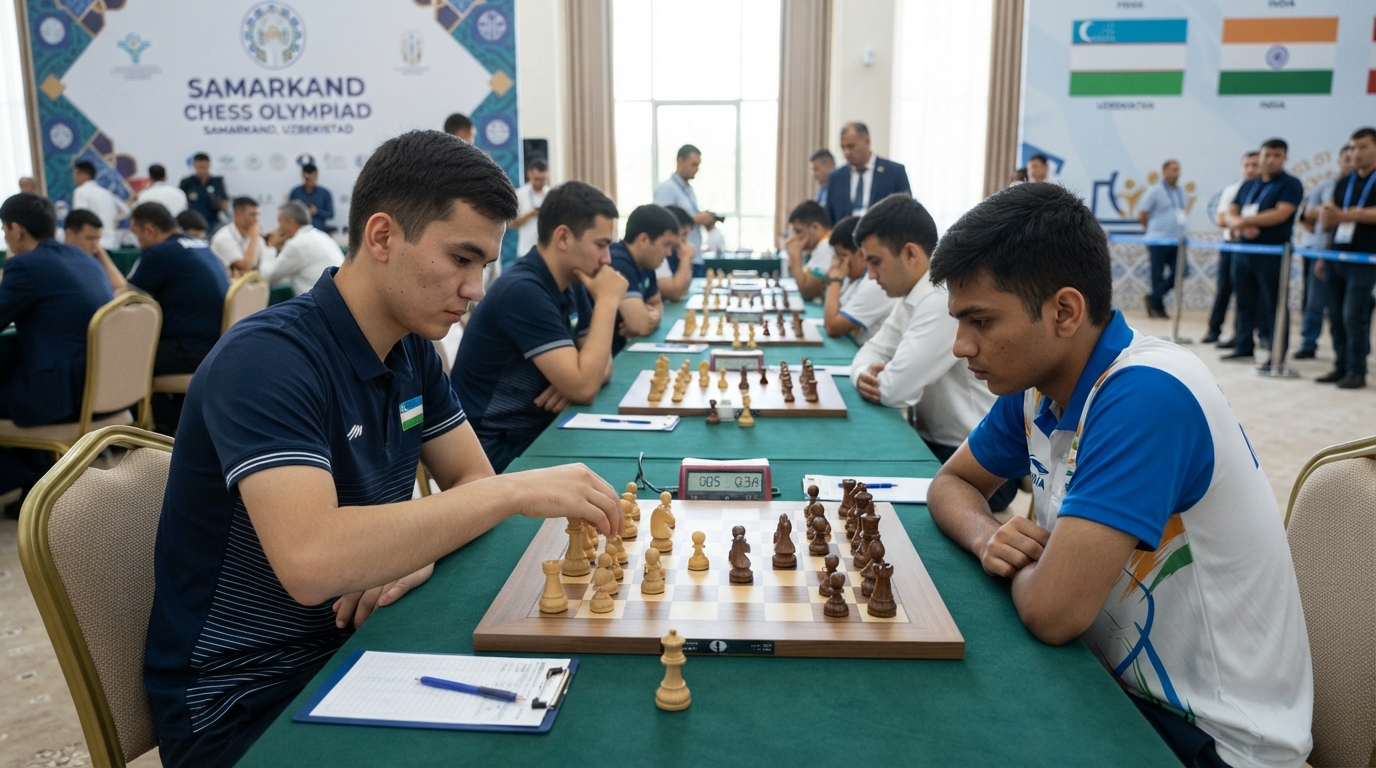
The Uzbekistan-1 men's team has won all 6 matches at the Chess Olympiad, becoming the sole leader. In the 6th round, the hosts defeated India. Ahead lies a match against China. How the country's three men's and three women's national teams are progressing — in the Gazeta review.
"Cautious optimism" is paying off. How is Uzbekistan performing at the Chess Olympiad?
In Samarkand, the international Chess Olympiad has reached its halfway mark. Both the men's and women's teams are fully justifying the fans' trust and continue to fight for the highest places.
After the sixth round, the Uzbekistan men's national team is the clear leader of the tournament. The team is represented by Nodirbek Abdusattorov (2762), Javohir Sindarov (2778), Nodirbek Yoqubboyev (2685), Shamsiddin Vohidov (2654), and Muhiddin Madaminov (2611) — all of whom are international grandmasters.
At this Olympiad, special attention is focused on Javohir Sindarov, who will play for the chess crown this year. Having rested in the first round, Sindarov scored 4 out of a possible 5 points after six rounds — three wins and two draws. Sindarov's preparation and participation in international tournaments, including the Chess Olympiad, as well as his work with coaches, are carried out with the support of the National Bank of Uzbekistan.
Javohir Sindarov.
Before the start of the competition, the coach of the main men's team, Rustam Qosimjonov, said he was in a state of "cautious optimism."
Serious tests for his pupils began in the third round — the Austrian national team was captained by the experienced Kirill Alekseenko, a participant in the 2020−2021 Candidates Tournament. In the match against them, classic team tactics worked: those playing with the black pieces held off the opponent, while those with the white pieces pushed for victory. As a result — two wins and two draws (final score — 3:1).
The next opponent was the Turkish national team, whose chances were rated much lower by many experts. In the fourth round, 15-year-old Yagiz Kaan Erdogmus, playing on the first board, had already scored 4.5 out of 5 points and entered the top 20 in the live ratings. He also gained the initiative in the game against Nodirbek Abdusattorov, but in a superior position, he opted to repeat moves.
Javohir Sindarov and Shamsiddin Vohidov secured draws with the black pieces, while Nodirbek Yoqubboyev, playing on the third board, found a worthy refutation to Vahap Sanal's risky idea (the opponent played inaccurately in the opening and lost a pawn) and achieved a confident victory, bringing the team a final win with a score of 2.5:1.5.
In the fifth round, Uzbekistan faced the Hungarian national team. Playing on the first board for the Europeans was top grandmaster Richard Rapport, known for his creative and non-standard style of play, while on the second board was his complete chess opposite — Peter Leko, whose defense is difficult to break through and who once contested the world crown against Vladimir Kramnik.
However, neither status nor experience helped the Hungarian chess players. After Abdusattorov and Yoqubboyev quickly reached confidently winning positions, Javohir Sindarov and Shamsiddin Vohidov could have offered draws to secure the team's victory. But they continued to play, defeated their opponents, and concluded the match with a resounding 4:0 score.
Shamsiddin Vohidov and Dommaraju Gukesh.
The Indian chess players, who are also among the main favorites of the Olympiad, were moving forward at a great pace. Although Arjun Erigaisi unexpectedly lost to the young Thai international master Prin Laohawirapap in the first round, the Indians played flawlessly after that, winning all of their first five matches.
The match between Uzbekistan and India in the sixth round also carried symbolic meaning: it brought together the winners of the last two Olympiads — Uzbekistan had won the tournament in Chennai in 2022, and India in Budapest in 2024.
The very beginning of the struggle showed that the match would be intense and difficult. Nodirbek Abdusattorov could not gain an advantage against Rameshbabu Praggnanandhaa, while Javohir Sindarov held a strategically complex position in his game against Arjun Erigaisi. Meanwhile, Shamsiddin Vohidov maintained balance against the reigning world champion Dommaraju Gukesh. All three games ended in draws, making Yoqubboyev's game against Nihal Sarin decisive.
Nodirbek Yoqubboyev.
Yoqubboyev's position was not superior to his opponent's, but in a sense, it looked safer. Perhaps this very circumstance prompted him to reject a simple continuation sufficient for a draw and opt for an objectively losing but double-edged path that allowed him to launch an attack.
By move 31, the situation became highly tense: Yoqubboyev had less than 10 minutes left, while Sarin, known for his fast play, had 38 minutes. However, the Indian grandmaster was the first to crack under this psychological pressure.
Sarin became overly complacent and put his king in danger: first he missed a winning chance, and then he overlooked a tactical blow. This brought victory to Yoqubboyev. Later, the Uzbek chess player himself noted that this phase of the game was extremely nerve-wracking for him.
Thus, the Uzbekistan national team won all six matches and did not lose a single individual game. The main rival — the champion of the previous Olympiad, India — was defeated, but it is too early to relax.
In the seventh round, the team faces China — they are also two-time Olympiad winners and a serious opponent of no less danger. During the first six rounds, they dropped team points only once — drawing with Armenia. Former world champion Ding Liren seems to be regaining his previous sporting form; yesterday he defeated German grandmaster Vincent Keymer, who is in the world's top 10 (the final score of the match was 3:1 in favor of China).
Ding Liren.
Wei Yi, a participant in the last Candidates Tournament, is also showing excellent play: he started with victories over three grandmasters, and after that held two games to draws with the black pieces against strong opponents.
Although Javohir defeated the Chinese grandmaster both at the World Cup and the Candidates Tournament (in April of this year, Sindarov won the Candidates Tournament and is now waiting for the match for the world crown against Dommaraju Gukesh), the balance of power in this matchup remains completely unknown.
Javohir Sindarov and Wei Yi at the Candidates Tournament.
Apart from China, Uzbek fans might be seriously concerned about two other opponents: one is Armenia, which has repeatedly compensated for its lower ratings with solidarity and high team spirit, and the other is the USA team — if they find their game and gain momentum worthy of their name.
The second national team of Uzbekistan is also recording high results. The captain is Pavel Eljanov.
Following the results of six rounds, they are in 13th place. Having lost only to the Germans, who are showing very strong play, the Uzbeks defeated all their other opponents, including the strong Spanish team.
On the first board, Jahongir Vohidov is putting up a worthy resistance against the strongest chess players of other countries, while Abdimalik Abdisalimov and Muhammadzohid Suyarov on the second and third boards can be called the main forces of the team.
The third team currently occupies 65th place — ten positions below their starting number. Saidakabar Saydaliyev (2475), Almas Rakhmatullaev (2418), Bahrom Bahrillayev (2412), Muhammadali Abdurahmonov (2390), and Asrorjon Omonov (2347) lost only to the teams of Germany and Australia, who were superior in rating. The draw recorded with the Austrian national team should be recognized as a great success.
Asrorjon Omonov is showing excellent sporting form, having won all five games he played.
The main women's national team of Uzbekistan also started the tournament very successfully. The captain is Nafisa Muminova.
The team won its first four matches and drew with the Americans in the fifth round.
Unfortunately, a heavy defeat against the Georgian team (0.5:3.5) pushed them back to 18th place. However, this team is traditionally one of the strongest in women's chess, and any opponent can lose to them.
If their current sporting form is maintained, the Uzbek female chess players are still fully capable of fighting for medals.
The second and third women's teams are located side by side in the standings — in 39th and 38th places. This is higher than their starting numbers, which is undoubtedly a good intermediate result.
The leader of the second team, Nilufar Yoqubboyeva, has scored 4.5 out of 5 points and is contending for a medal on her board.
September 22 has been declared a rest day at the Olympiad. The seventh-round matches will take place on September 23.
The tournament is being held under the Swiss system and consists of 11 rounds. In each team match, four chess players play, with one more serving as a reserve member. Two points are awarded for a team win, and one point for a draw.
Time control: 90 minutes for the first 40 moves, followed by another 30 minutes until the end of the game. Also, starting from the first move, 30 seconds are added to each player for each move.