

Favorites and dark horses. Who will fight for the gold of the chess Olympiad in Uzbekistan
The World Chess Olympiad in Samarkand will gather a record 400 teams. Uzbekistan approaches the home tournament as one of the favorites, with the USA, India, and China as its main rivals. "Gazeta" explains who is contending for the "gold" and what to expect from the country's three men's and three women's national teams.
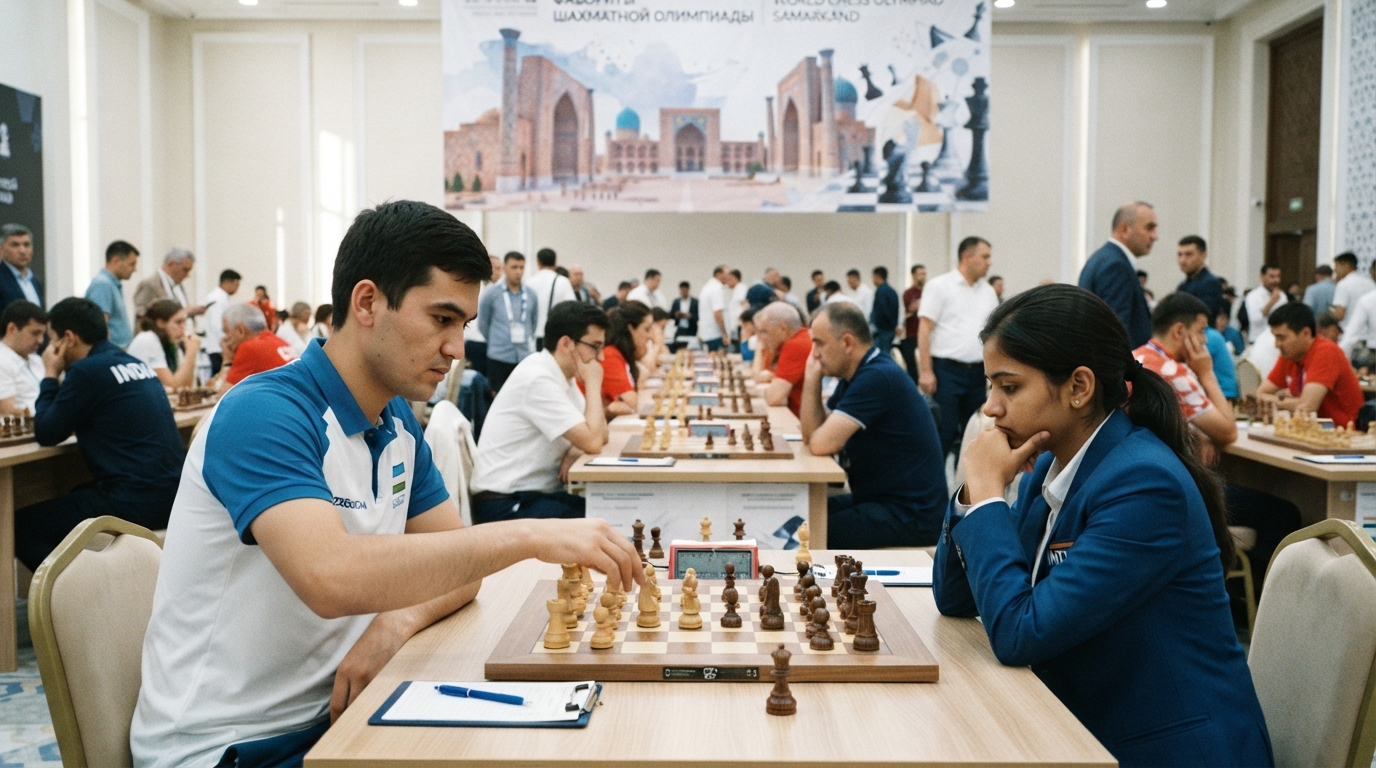
Favorites and Dark Horses. Who Will Fight for Gold at the Chess Olympiad in Uzbekistan
On September 15, the opening ceremony of the 46th World Chess Olympiad will take place in Samarkand, and the first round will start the very next day.
One of the key figures of the tournament for the hosts will be Javokhir Sindarov. The World Championship challenger approaches the competition as the number one player of the Uzbekistan national team and with a rating of 2778 — the second among all registered participants in the open section after the American Fabiano Caruana.
On September 13, it was Sindarov who was handed the Olympic flame in India: the torch was presented to him by the Acting President of the International Chess Federation (FIDE) Viswanathan Anand and the head of the All India Chess Federation Nitin Narang. The Uzbek grandmaster then traveled with it to Samarkand.
Sindarov's preparation and his performances in international tournaments, including the 2026 World Chess Olympiad in Samarkand, as well as his work with coaches, are supported by the National Bank of Uzbekistan.
"Gazeta" chess columnist Georgy Shvanov talks about the most notable teams of the tournament and the chances of the men's and women's national teams of Uzbekistan.
The Chess Olympiad is the main team competition in this sport. It is held every two years and gathers national teams from almost all over the world — in both the open and women's sections. Each team consists of four main players and one reserve.
Winners of recent Olympiads.
The time control will be 90 minutes for the first 40 moves, after which the player will receive an additional 30 minutes. Starting from the first move, 30 seconds are added after each move made. For a match victory, a team receives two match points, for a draw — one, for a loss — zero.
The team with the most match points after 11 rounds wins. In case of a tie, tie-break criteria are applied — the Sonneborn-Berger score (the sum of the scores of the opponents defeated plus half the scores of the opponents drawn), as well as the sum of the individual points of each team member.
The upcoming Olympiad will be the first not only for Uzbekistan, but for the whole of Central Asia. Previously, Samarkand hosted the World Rapid and Blitz Championships and the Grand Swiss tournament, but the Olympiad is larger in scale than even these prominent competitions.
The tournament will set a record: 400 teams will come to Samarkand — 208 in the open section and 192 in the women's. The previous record was set in Budapest in 2024 — 380 teams.
The first six rounds will take place daily from September 16 to 21 and will start at 15:00 Tashkent time. September 22 is a rest day.
From September 23 to 26, rounds 7 to 10 will take place, also starting at 15:00. The final, 11th round will be held on September 27 and will start earlier — at 11:00.
During these days, Samarkand will effectively become the chess capital of the world. The third FIDE Olympiad for People with Disabilities is already taking place here, featuring a record 41 teams. During the main Olympiad, the FIDE Congress and elections will also be held, and on September 24, a summit dedicated to chess education will take place.
At the last five Olympiads, only four countries won gold — and they occupy the first four places of the current starting list. China won in 2014 and 2018, the USA in 2016, Uzbekistan in 2022, and India in 2024. Currently, the USA is seeded first due to the average rating of its players, India is second, Uzbekistan is third, and China is fourth.
As the host country, Uzbekistan will field three teams at once. The second by rating is in 30th place on the starting list, and the third is 55th.
The first national team of Uzbekistan is represented by an almost optimal lineup. All its members are relatively young and have shown good results throughout the year. Nodirbek Abdusattorov traditionally plays particularly well for the national team: at the two previous Olympiads, he won the silver medal on board one. In Budapest-2024, he scored 9 points out of 11 with a performance rating of 2884.
Uzbekistan-1 — 3rd starting place, average rating 2720. Captain — Rustam Kasimdzhanov.
It is not yet known who will play on board one for the Uzbekistan national team — Javokhir Sindarov or Nodirbek Abdusattorov. Team captain Rustam Kasimdzhanov said in an interview with "Gazeta" that the final decision has already been made, but for now remains a "sporting secret."
"The lineups that are on the Internet are not yet by boards. The decision has already been made, but it is not being announced," he noted.
Mukhiddin Madaminov, for whom this Olympiad will be the first, will certainly be highly motivated. However, sporting form is an unstable phenomenon, and in a long team tournament, a great deal depends on it.
Additional intrigue is created by the potential meeting between Sindarov and the reigning World Champion Dommaraju Gukesh — his future opponent in the match for the chess crown. However, in India's preliminary registration, Gukesh is listed only on board four. Therefore, their Olympic duel will take place only if the Indians change the order of players before the final confirmation.
FIDE separately points out that Gukesh, who played on board one two years ago, has now ended up fourth in the Indian lineup (due to a lower rating compared to other representatives of India).
The USA is represented by three masters — Fabiano Caruana, Wesley So, and Levon Aronian — and two younger but already very strong players, Hans Niemann and Awonder Liang. Fresh blood will undoubtedly benefit the team, and the veterans still retain immense chess strength. Therefore, the Americans look like favorites not only by rating.
The prospects of the Indians are not so clear-cut. World Champion Dommaraju Gukesh, who showed a phenomenal 9 points out of 10 in Budapest with a performance rating of 3056, is going through a much less successful period and has dropped in rating. Vidit Santosh Gujrathi is also not showing his best form. The main "strikers" of the national team now look to be Arjun Erigaisi and Rameshbabu Praggnanandhaa. Nihal Sarin has also been on the rise lately.
Paradoxically, the optimal solution for the Indians might be to move the World Champion to board four — or even to the reserve bench. On board three, in this case, more freedom could be given to Nihal Sarin, while board one could be entrusted to Praggnanandhaa, who feels particularly confident in quiet positions. The stability of the entire team largely depends on the reliability of board one.
But such a decision would inevitably deal another blow to Gukesh's status. On the eve of the world crown match against Sindarov, this could be psychologically risky.
In China's performance, it will be interesting to follow the former World Champion Ding Liren. After losing his title, he did not show championship-level results for a long time. But in his case, this is easily explained by prolonged depression. At the last Olympiad, Ding effectively "closed" his board: he suffered only one defeat, while drawing most of his other games.
But recently, Ding has been appearing at the board more often, and there is reason to hope that the former champion's mental strength is recovering and he will again be able to surprise the chess world.
Closing the Chinese lineup is 17-year-old Kong Xiangrui with a rating of 2549. By modern standards of top-level chess, players of this age can already have much higher ratings. But it must be remembered that the ratings of Chinese chess players sometimes do not fully reflect their real strength (due to fewer international tournaments). Kong is fully capable of playing the role of a "dark horse" and bringing in important points in decisive matches.
The German national team has not stood on the Olympiad podium for a long time. But this time, its chances are higher than ever in recent years. Following team leader Vincent Keymer, a strong generation of German grandmasters has grown up, whom they call "princes" in their homeland: Matthias Bluebaum, Alexander Donchenko, and the brothers Frederik and Rasmus Svane.
The team has no obvious weak board, and Keymer himself is capable of playing on equal terms with almost any opponent's leader.
In France, the rising 19-year-old Marc'Andria Maurizzi could stand out. With the experienced Maxime Vachier-Lagrave on board one and the good form of the other participants, this could lift the French very high. The lineup also includes Etienne Bacrot, Maxime Lagarde, and Jules Moussard; France occupies tenth place on the starting list.
One of the most interesting "dark horses" looks to be Turkey. The team's average rating is around 2620: an indicator of a strong, but formally not yet elite national team. However, its potential is huge. Board one is occupied by 15-year-old Yagiz Kaan Erdogmus with a rating of 2716, followed by 17-year-old Ediz Gurel with a rating of 2643. The entire five-player squad consists of grandmasters.
The chances of the other national teams specifically for victory seem less serious. They will, of course, fight for podium places and may well end up on it. But the 11 rounds of the Olympiad are a specific test: here, one or two stars are not enough if the team cannot withstand the pressure on all four boards.
Pleasant surprises and individual successes can be expected from the national teams of Armenia and Ukraine, which are famous for their team spirit. The Armenians became silver medalists four years ago, and the Ukrainians won the European Team Championship. With a favorable combination of circumstances, the solid Serbian team, reinforced by Alexey Sarana and Alexandr Predke, could also rise high.
Uzbekistan-2 — 30th starting place, average rating 2532. Captain — Pavel Eljanov.
Uzbekistan-3 — 55th starting place, average rating 2424. Captain — Murtas Kazhgaleyev.
GM — Grandmaster, IM — International Master.
The second and third national teams of Uzbekistan, although far from the top ten in rating, are certainly capable of pleasing their fans. Both teams are young, and many members of the second team already have solid experience playing against strong grandmasters.
Jakhongir Vakhidov stands out in particular — one of the heroes of Uzbekistan's historic victory at the 2022 Olympiad. Back then, he scored 6.5 points out of 8 on board four with a performance rating of 2813 and received individual gold. In the final round, it was his victory over Max Warmerdam that helped Uzbekistan win the decisive match against the Netherlands.
The second national team is interesting for other names as well. Mukhammadzokhid Suyarov has already managed to prove himself against strong grandmasters, and Abdimalik Abdisalimov has long been playing at a level that allows him to fight opponents with significantly higher ratings.
The team is led by Pavel Eljanov — a two-time Olympic champion with Ukraine, who was previously among the top ten strongest chess players in the world. Eljanov also worked as a second for Boris Gelfand during his World Championship match. For a young second national team, such a captain is a major asset.
The third team brings together players for whom the Olympiad provides an opportunity to test themselves against international opposition of a completely different level. The lineup includes Saidakbar Saydaliev, Almas Rakhmatullaev, Bakhrom Bakhrillaev, Mukhammadali Abdurakhmonov, and Asrorjon Omonov. The captain is the experienced Kazakhstani grandmaster Murtas Kazhgaleyev.
Both the second and third national teams are fully capable of finishing significantly higher than their starting 30th and 55th places.
In the women's section, the circle of main favorites is somewhat different. The number one seed is the reigning champion India, followed by Georgia, China, Kazakhstan, and the USA. It will also not be easy for the favorites in matches against the traditionally strong national teams of Ukraine and Azerbaijan.
Kazakhstan deserves special attention. At the last Olympiad, the team won silver — the first medal in its history in the women's tournament. Since then, its young leaders have only grown stronger, so one can expect them to at least repeat this high result. Board one is Bibisara Assaubayeva, followed by Alua Nurman, Meruert Kamalidenova, Alnaz Kaliakhmet, and Zarina Nurgaliyeva.
But the first women's national team of Uzbekistan, which has the 13th starting number, also has very real chances to fight for high places. The team consists of Afruza Khamdamova, Gulrukhbegim Tokhirjonova, Umida Omonova, Nilufarkhon Imomkuzieva, and Guldona Karimova. The captain is Nafisa Muminova.
The debutantes of the national team, Nilufarkhon Imomkuzieva and Guldona Karimova, still lack Olympic experience, but both are already playing at a good level relative to most of their opponents and, thanks to their age, are capable of improving significantly.
At the same time, the core of the national team — Afruza Khamdamova, Gulrukhbegim Tokhirjonova, and Umida Omonova — is also very young, but already possesses serious international experience. At the last Olympiad, playing without Tokhirjonova, the team took 12th place. With her return, the lineup has objectively become stronger, although guaranteeing an improved result in such a tight tournament is, of course, impossible.
For the participants of the second and third national teams, the main task at the Olympiad is to gain experience and improve their play. Currently, they have the 43rd and 65th starting numbers, respectively. Any noticeable rise relative to these positions can be considered a good result. Experienced grandmasters Alexey Barsov and Marat Dzhumaev are working with the teams, so they have the opportunities for such a breakthrough.
The Olympiad rarely goes strictly according to the starting rating. One unsuccessful match can knock a favorite out of the fight for gold, while a series of successful ones can lift a team that no one expected to win medals. That is why over 11 rounds, what matters is not only the strength of individual chess players, but the ability of the entire four to maintain their level day after day.
Earlier, "Gazeta" reported in detail on the preparation of the Uzbekistan national teams for the Olympiad. We presented the lineups of the country's three men's teams and spoke with the captain of the women's national team, Nafisa Muminova, about the team's goals and chances for medals — "Deep down, everyone is thinking about a medal."
The captain of the first men's national team, Rustam Kasimdzhanov, in an interview with "Gazeta" also spoke about Uzbekistan's chances and the main favorites of the Olympiad, noting that he approaches the tournament with "cautious optimism."