

Burn in hell…
From November 15 in Uzbekistan, the price of liquefied gas for the population will increase from 2,000 to 5,000 soums per kilogram, or by 2.5 times
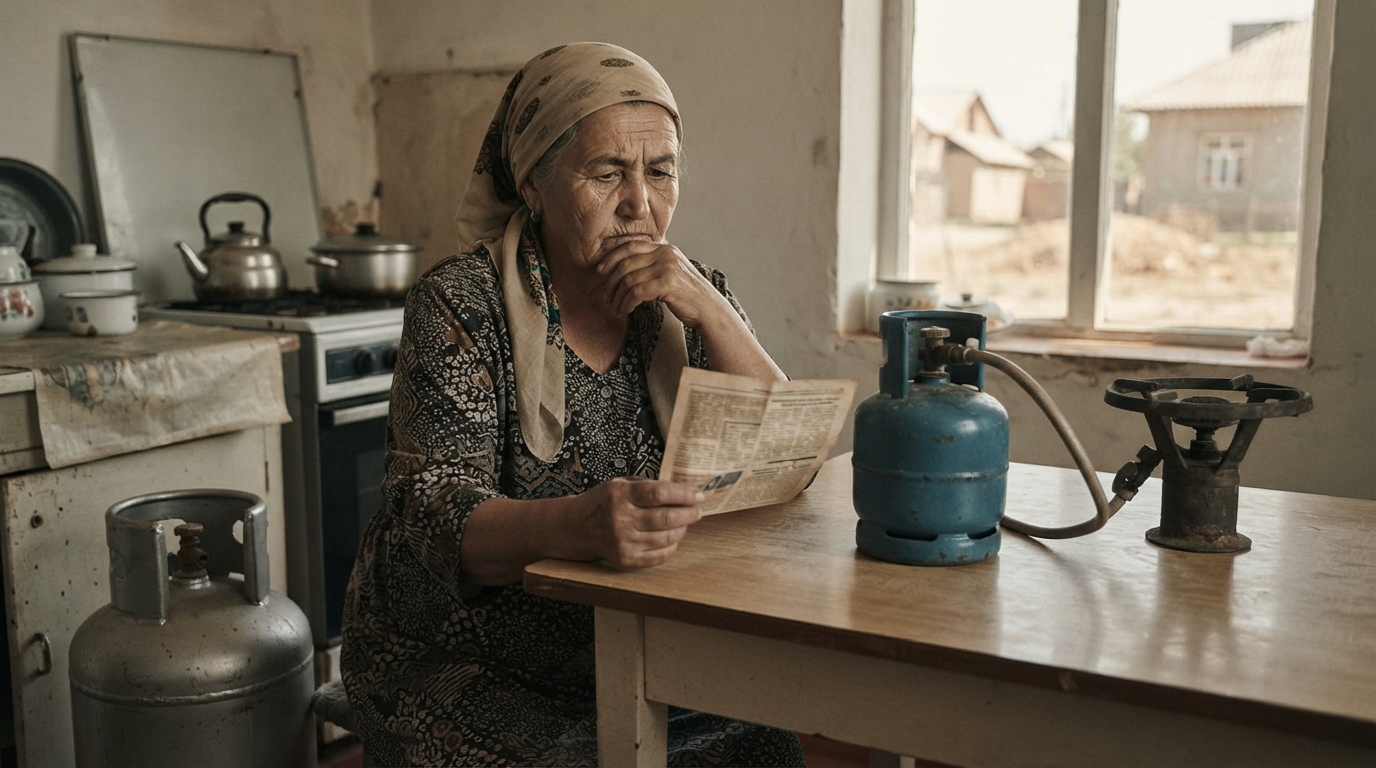
May You All Burn in a Blue Flame…
The story surrounding the new increase in liquefied gas prices in Uzbekistan is no longer just another episode of energy market reform. Like a drop of water, it reflects the state's attitude toward its own citizens, the practice of economic decision-making established in recent years, and, most importantly, the authority's perception of the people's place in this system. By all appearances, they have been assigned the role of a silent payer who does not need to be explained the reasons for what is happening, given the opportunity to express their opinion, or even attempted to be convinced of the necessity of another deterioration in their material situation. It is enough to adopt a decree, publish it, and accompany it with the usual discussions about market mechanisms, liberalization, social protection, and targeted assistance to the needy.
On October 31, 2026, the Cabinet of Ministers adopted Decree No. 602, according to which, as of November 15, the retail price of liquefied gas for the population increases from 2,000 to 5,000 soums per kilogram. In other words, the cost of fuel rises 2.5 times. For families who do not have access to mains gas and are forced to use bottled fuel for household needs, this is not an abstract economic category, but a very concrete increase in daily expenses. Moreover, we are talking about people among whom there are many rural residents, pensioners, and low-income families.
The government's explanation is traditionally built around the need to transition to market mechanisms. To ensure supplies, a specialized operator, LPG-Trade, is being created with the participation of JSC Khududgazta'minot, maximum delivery costs are being established, and the difference between the actual market value of gas and the price set for the population is expected to be covered from the state budget. Until May next year, the authorities intend to analyze the market and prepare proposals for further price liberalization.
All this may look quite convincing in cabinet documents, especially if one considers the economy exclusively as a set of formulas, balances, and calculated indicators. But behind these formulas, for some reason, the human being—for whose well-being, according to official rhetoric, the state conducts reforms—is constantly lost. And a logical question arises: why is it that every time a need is discovered to correct economic miscalculations, change the subsidy system, or bring prices closer to certain market benchmarks, it is primarily the population that has to pay for it?
The use of market mechanisms in itself is not something blameworthy. The economy cannot exist indefinitely on artificially maintained prices if such a system leads to shortages, inefficient allocation of resources, and the accumulation of budget obligations. However, liberalization should not turn into a universal excuse for any increase in tariffs and prices. A market implies not only pricing freedom, but also competition, transparency, responsibility of participants, consumer protection, and the presence of working mechanisms of public control. If the state retains the ability to unilaterally determine the rules of the game, leaving the citizen only the obligation to pay for the consequences of the decisions made, then calling what is happening a full-fledged market reform is, at the very least, unjustified.
It is particularly telling that such decisions in Uzbekistan are virtually not discussed with the population. People are presented with a fait accompli, after which an explanatory campaign begins, designed to convince them of the correctness of the decision already made. These are fundamentally different things. Public discussion implies the opportunity to influence the content of a document, propose an alternative, demand calculations, and point out the consequences for individual categories of citizens. Explanation after a decision has been made means that people's opinions no longer interest anyone: they are offered to familiarize themselves with what has been decided for them.
This is precisely where the line lies between a state that considers citizens full participants in public life, and an administrative system that perceives the population primarily as an object of management.
In this case, the section of the decree dedicated to social support looks particularly eloquent. The authorities provided for compensation of 3,000 soums for each purchased kilogram of liquefied gas, but no more than 20 kg per month. Thus, the maximum payment will be 60 thousand soums. Laughable, you must agree. And it is understandable: a well-fed person does not understand a hungry one.
Let's see what this means in practice. Previously, 20 kg of gas cost a family 40 thousand soums; now their cost will be 100 thousand. For those who receive the maximum compensation, expenses after the refund may indeed remain at the same level—40 thousand soums. But this applies exclusively to established categories of recipients and only within the provided volume. All other consumers will pay 2.5 times more. And if a needy family uses more than 20 kg, each subsequent kilogram will cost them full price.
Does anyone among those who prepared the document know how long these 20 kg will last? For those who are not aware, let's say—a maximum of one week, under the best-case scenario.
In other words, the state first sets a significantly higher price, and then promises to partially compensate it for certain categories of citizens. Moreover, the maximum assistance is limited to an amount that can hardly be called serious social protection in conditions of a constant increase in expenses for food, utilities, medicines, and transport. 60 thousand soums a month is not the kind of money for which one can confidently declare a solution to the problem of material availability of fuel. It is rather a symbolic gesture allowing an unpopular decision to be wrapped in socially attractive packaging.
There is another side to the issue. Why is support provided only after purchasing the gas? For a family experiencing a shortage of funds, even the need to first pay an increased price and then wait for compensation can become an additional problem. Not to mention that far from all truly needy citizens easily navigate electronic systems, social registers, and expense verification procedures. The state, which demands that a person independently prove their need and collect confirmations to receive a small payment, for some reason does not show comparable persistence when it comes to the need to justify another price increase to the same person.
However, the problem is much broader than a specific decree. In recent years, a persistent practice has developed in Uzbekistan where an increase in the cost of vital services and resources is presented as an inevitable consequence of reforms. Electricity, natural gas, utilities, public transport—almost every time, citizens are explained that the previous system was economically inefficient, that the state can no longer bear the corresponding burden, and that the transition to new prices is necessary for sustainable development. At the same time, the question is almost never raised as to why the population must pay not only for objective economic changes, but also for the consequences of long-standing managerial errors, inefficient spending of funds, lack of investment, and lack of proper control over state structures.
It is enough to recall the increase in electricity and natural gas tariffs in May 2024, when the base cost of electricity for the population grew by more than 50%, and natural gas by more than 70%. In May 2025, another revision followed, with the increase affecting both base tariffs and the cost of consumption above social norms. In 2026, the annual price revision mechanism continued to operate. Thus, we are talking not about a single decision, but about a consistent policy of shifting an ever-increasing share of expenses onto the shoulders of consumers.
At the same time, the authority prefers not to notice an obvious contradiction: if economic reform is indeed conducted in the interests of society, why does society learn about its consequences mainly from already signed documents? The authority, apparently, believes that it is enough to explain to people why they must pay more, and the matter will be settled. But an explanation does not replace consent, and the publication of a document is not proof of its public acceptability.
In the context of the above, it is also necessary to say that in Kazakhstan and Kyrgyzstan, officials are forced to take into account not only economic calculations, but also the very real reaction of citizens. There, public discontent is capable of becoming a factor that forces the authorities to revise even decisions that have already been made. Of course, this does not mean that Kazakhstan or Kyrgyzstan are models of flawless democracy, and that their political systems are free from authoritarian tendencies. However, the experience of these countries shows that the population is capable of acting as an independent political force whose opinion the authorities have to reckon with.
For example, in August 2026, residents of the Almaty region of Kazakhstan spoke out against an increase in the natural gas tariff by almost 48%, demanding a revision of the decision and an independent audit of price formation. The discontent received public expression, in particular in the form of a petition addressed to the government and the Ministry of Energy.
But the most famous example of how a mass reaction forces the authority to back down occurred in January 2022. At that time, the reason for the protests in the Mangystau region was a sharp increase in the price of automotive liquefied gas: from 60 to 120 tenge per liter. For those who have forgotten, let us remind you: the first rallies began in Zhanaozen, then the protests spread to Aktau and other settlements. People did not accept the officials' explanations about the transition to exchange mechanisms and demanded a return to the previous cost of fuel. The authorities initially tried to limit themselves to a partial price reduction, but the protesters did not agree to the proposed 85-90 tenge. As a result, the government commission announced a price reduction to 50 tenge per liter in the Mangystau region, and the president instructed the introduction of temporary state regulation.
This, in fact, is the fundamental difference between a society that implements mechanisms for the collective expression of its position, and a population that is offered exclusively to endure and adapt. In Kazakhstan, officials have learned well that even an economic decision made without proper regard for public sentiment can turn into a serious political crisis. Therefore, they have to think not only about how profitable another tariff change is for the state, but also about how it will be perceived by citizens.
The Kazakh experience, of course, should not be idealized. But it demonstrates a simple and obvious truth: an authority that does not want to hear the people in peaceful times risks hearing them when discontent can no longer be ignored.
In Kyrgyzstan, such public sensitivity has an even longer political history. Over the years of independence, the country has experienced several large-scale crises of power. Behind this lies not only the political struggle of individual groups, but also an ingrained perception that power is not the lifelong property of a ruler and his entourage. The society of this country has repeatedly demonstrated the ability to demand change and achieve the departure of leaders who have lost public trust.
We are talking primarily about the political relations between the state and society, about the extent to which citizens are capable of influencing decisions affecting their daily lives, and the extent to which officials understand that state power does not give them the right to dispose of people's fates without regard to their interests.
Uzbekistan, on the other hand, over the past ten years, despite loud statements about modernization and openness, has been moving increasingly noticeably in the opposite direction. Externally, the names of agencies change, new institutions are created, strategies and programs are adopted, and promises to place the human being at the center of state policy are regularly made. But behind this decorative modernization, a very archaic model of relations persists, in which the official still perceives himself not so much as a servant of the people, but as their master.
And if earlier such relations could be explained by the inertia of the Soviet administrative system, now they are acquiring the features of a kind of revival of feudalism, supplemented by modern means of control and administrative pressure. The people in this construct must be grateful for being given the opportunity to work and occasionally receive symbolic assistance from the state budget. And when they try to remind anyone of their own rights, the boundaries of what is permitted are quickly explained to them.
The expression "feudalism with elements of slave-owning" may seem excessively harsh, but it quite accurately conveys the internal feeling that arises among citizens when their interests are systematically sacrificed to administrative arbitrariness. All this strongly resembles an estate system in which rights and opportunities are determined by proximity to power.
In such an atmosphere, it is difficult to expect citizens to massively and openly express discontent with another price increase. People understand perfectly well that public defense of their interests can turn into trouble, and an attempt to organize a collective protest can lead to administrative or criminal prosecution.
The experience of neighboring states shows that society, even when facing serious economic difficulties, is capable of reminding the authority of its responsibility. Uzbekistan, however, has to solve a much more fundamental task—to restore normal relations between the state and the citizen, under which the latter will cease to be a petitioner, and the former will finally realize that its powers have a limit.
In the meantime, instead of the promised democracy, we are witnessing the gradual strengthening of an administrative vertical in which the opinion of the population matters only when it is required to demonstrate support for another initiative. And if this trend continues, talk of the human being as the highest value will remain beautiful formulas that have no relation to the daily life of the majority of citizens.
And another important circumstance that should definitely be mentioned. According to analysts' estimates, over the past ten years, the society of Uzbekistan has gone through three stages of perception of the authority's actions: hope, disappointment, irritation. What the fourth one will be is not so difficult to guess…