

Bought an apartment, started renovations — and learned about the prohibition. The story of another family that could be deprived of their home
"Gazeta" has learned of another family in Tashkent that risks losing their legally purchased home due to a foreign heiress who appeared after the deal was closed. "We expected the judicial system and the state to protect us. But now we feel no protection at all," said Adelina Baldina.
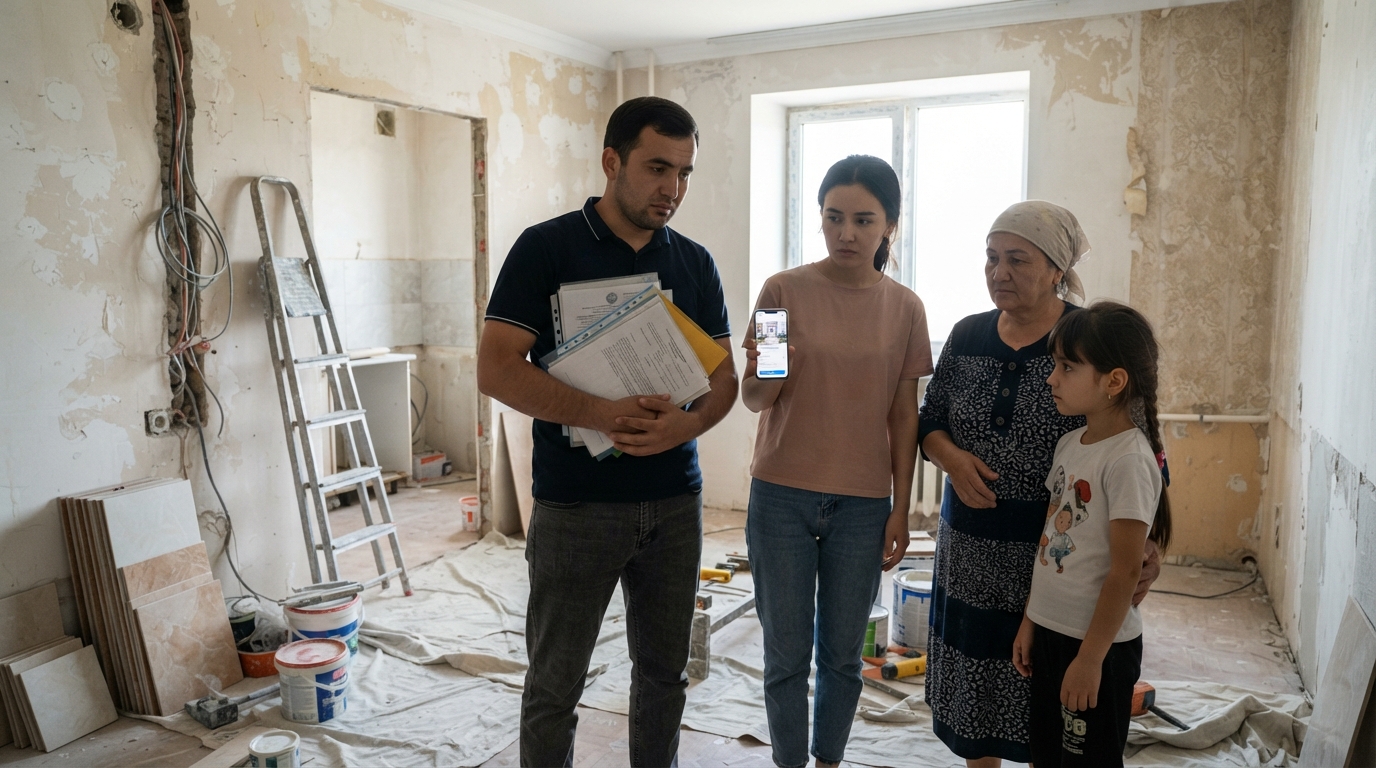
Bought an apartment, started renovation — and learned about the ban. The story of another family that could be deprived of housing
"Gazeta" has learned of other families in Tashkent who risk losing legally acquired housing due to foreign heirs who appeared after the deals were concluded. One such family agreed to tell us their story.
First story.
About Furkat Nurmukhammedov, who bought an apartment following all legal procedures, renovated it, and moved there with his family. After some time, a realtor acting on behalf of a foreign heir appeared and took the apartment through the court. Nurmukhammedov lost in all court instances and only has the last one left — the Supreme Court.
Second story.
About Anton Goryaev, who found himself in a similar situation. Before the purchase, the apartment was checked several times and was acquired in full compliance with all legal procedures. After Goryaev registered the apartment under his name in the cadastre authorities, registered his family there, and started renovations, a realtor acting on behalf of a foreign heir appeared. He imposed a ban on the apartment and obtained a court ruling declaring the purchase and sale agreement invalid. Now the family is litigating for the right to live in the bought apartment.
A resident of the capital, Adelina Baldina, faced the exact same problem.
Last year, the family sold their existing apartment to buy a new one for a family of five, including a retired mother and two minor children. The transaction, as required, was executed through a notary. But just a few days later, Baldina learned about a prosecutor's office ban and a dispute over the previous owner's inheritance. The woman told "Gazeta" how the family is trying to protect their right to it.
Before moving, we lived in the Darkhan 3 neighborhood in the Mirzo-Ulugbek district, in a three-room apartment with an area of about 60 sq. m. There were five of us in that apartment: my husband and I, two sons — the elder is 12 years old, the younger is 1.5 years old — and my elderly mother. Over time, our family lacked space, so in August 2025, we sold the apartment and began looking for a larger place to live. While we were choosing, relatives allowed us to live at their place while they were away.
In October, we came across an advertisement on OLX for the sale of an apartment in the C-1 neighborhood in the Mirzo-Ulugbek district. We contacted the seller, Elmira M., and viewed the housing. The total area of the apartment is 61.92 sq. m, the living area is 41.95 sq. m. The apartment was in a "wrecked" state, with old renovation, but it was more spacious than our previous one and suited us in terms of location. Everything suited us, and we decided to buy it.
Elmira showed documents issued in her name. She did not hide the fact that she bought the apartment at a "buyout price" and was reselling it at a markup. The amount of 85 thousand dollars at that time was an adequate market price taking into account the location and condition of the apartment. This money matched the amount received from the sale of our previous home. Elmira said that before buying, she checked all the documents and property rights of the previous owner.
Before the deal, we sent the documents to a familiar notary. He checked them and said everything was in order.
On October 14, 2025, we met with her at the notary's office, where the transaction was executed, having made sure once again that there were no bans or encumbrances on the apartment.
During the execution, the owner convinced us to specify the cadastral value of the apartment in the contract — 71.3 million soums (about 5,870 dollars on that date — ed.). She wrote a receipt for the amount actually received, and we filmed the transfer of money — 85 thousand dollars — on video ("Gazeta" has reviewed the video — ed.).
On October 15, 2025, the ownership right to the apartment was registered to me.
We believed the transaction was complete and immediately started renovations. We wanted to move there with the children as soon as possible. We couldn't live with relatives permanently.
About a week after the purchase, we asked the notary to check if the apartment had any utility debt. That was when it turned out that a prosecutor's office ban had been imposed on it.
At the time of the transaction, there was no ban in the registry, so we did not understand what had happened. The notary advised us to contact the prosecutor's office. There, they asked us how we were even able to buy the apartment if it was under a ban. We spent the whole day at the prosecutor's office, wrote an application, and began to clarify the circumstances.
During the investigation, we learned the history of the apartment. Its previous owner, an elderly man, left behind two apartments — in the C-1 and C-2 neighborhoods. We bought the first one, and another family bought the second one, facing a similar problem.
After the owner's death, a woman living in Russia who called herself his daughter finalized the inheritance through a representative by power of attorney. Later, she issued another power of attorney — this time for the sale of the apartment.
Then Elmira bought the apartment. According to the documents, she became the owner on the basis of a purchase and sale agreement dated October 10, 2025 — just a few days before our deal. We did not know the backstory of the apartment and believed there were no obstacles to the purchase: the seller was listed as the owner, and the notary checked the documents.
The application for the ban was received by the prosecutor's office on October 13, 2025 — the day before our deal, but the ban itself was registered only on October 16, 2025.
When we were registering the apartment, it was not yet in the registry. If the ban had been entered on time, the notary would have seen it, and the deal would not have taken place. In the extract from the cadastre, our ownership right was registered on October 15.
After our appeal, the prosecutor's office began checking the circumstances of the apartment's registration. First, it was sealed as possible abandoned property and they were going to transfer the documents to the khokimiyat. Then it turned out that the heiress in Russia had issued powers of attorney to different people — first for registering the inheritance, then for the sale. The verification materials were transferred to the District Department of Internal Affairs (RUVD). There, they began to sort out the history of the powers of attorney and transactions.
The person who participated in the registration of the inheritance was put on a local, and then an international wanted list.
At the same time, we became aware of a legal dispute over the inheritance. Another woman living in Poland claims the apartment. She also calls herself the daughter of the previous owner and contests the registration of the inheritance and subsequent transactions, including our purchase of the apartment. We do not know what the relationship between the women is and who ultimately owns the right to the inheritance. This must be established by the court.
From November last year to October this year, two proceedings took place in the Mirzo-Ulugbek Interdistrict Court for Civil Cases. Seven hearings took place in the first one. Initially, the judge left the lawsuit without consideration because the power of attorney under which the plaintiff's representative acted lacked the necessary attestations. We thought that the matter would end there. But later the documents were resubmitted — the power of attorney was already certified with an apostille, and the second trial began. Four hearings were held in it.
At the last hearing, which took place on October 23, the court ruled to invalidate all purchase and sale agreements for the apartment.
By court decision, the seller must return to us the amount specified in the contract — 71.3 million soums.
This is almost 14 times less than the amount we actually paid.
The court did not take into account either the receipt or the video recording, although Elmira's lawyer confirmed that we indeed paid 85 thousand dollars. We intend to hire a lawyer and appeal the court's decision.
While the proceedings are ongoing, two bans have been imposed on the apartment — by the prosecutor's office and the court. We sold our previous home and invested all the proceeds into the purchase. Now we are forced to attend court hearings, trying to defend our right to the apartment and prove that we bought it in good faith and did not know about the dispute over the inheritance at the time the deal was concluded.
We do not understand how much longer the proceedings will last and how they will end. We are very afraid of losing the apartment and do not know where we will live if the deal is finally declared invalid. For almost the entire year after the purchase, we had to live with relatives and acquaintances. Renovations in the new apartment were never finished: we sometimes spend the night there, but there are no conditions for permanent living yet.
We expected that the judicial system and the state would protect us, because we acted in good faith at all stages of the transaction. But right now we feel no protection at all.