

Borneo is burning - living on the frontline of Asia's toxic haze
Months of fires in Indonesia have cloaked Southeast Asia in haze and made hundreds of thousands of people sick.
Borneo is burning - living on the frontline of Asia's toxic haze
Firefighters have been battling the stubborn blaze for weeks now
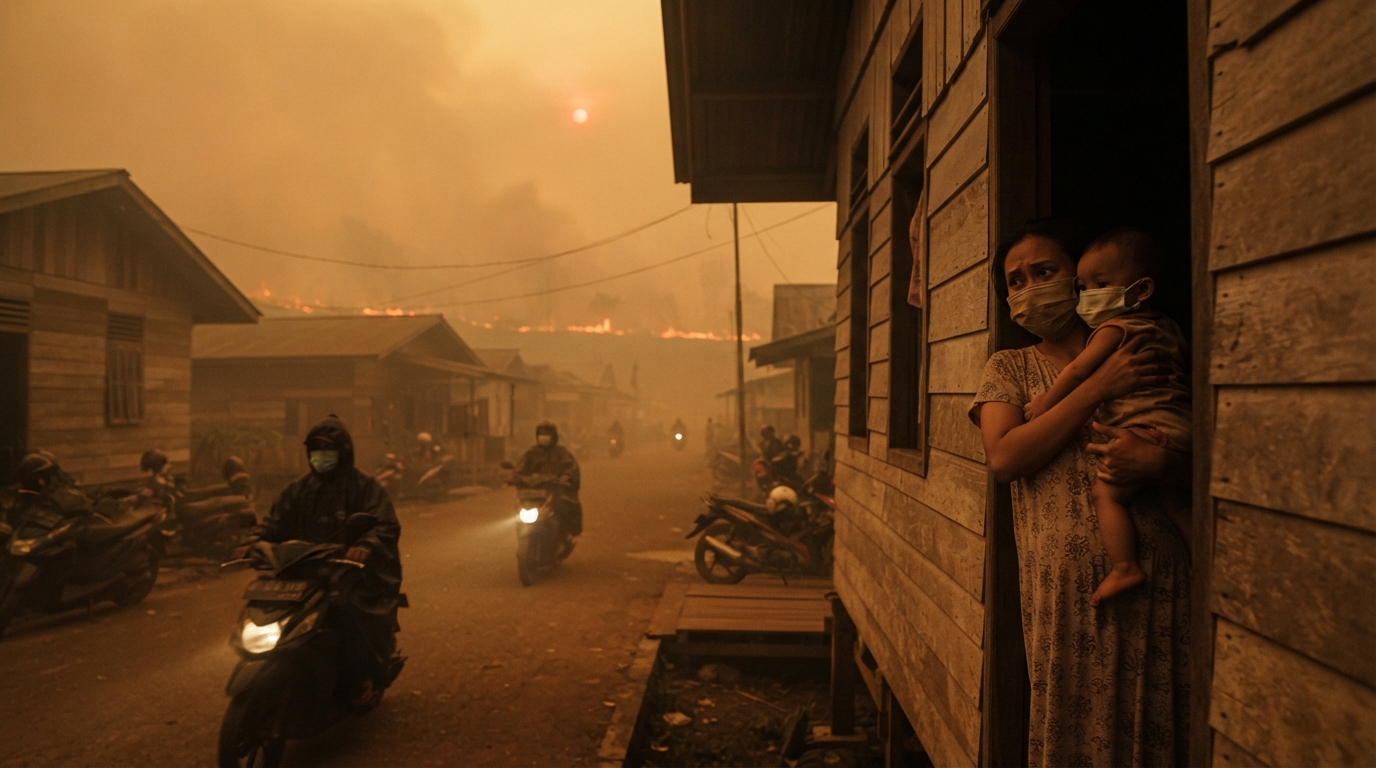
When sunlight falls on the smog hanging over Indonesian Borneo, everything takes on a rusty hue. Cars, houses and streets seem to emerge from, and then vanish into, a dull russet haze. Few words fit the scene better than "apocalyptic".
Yet it is at night, in the stillness and darkness, that mother-of-three Dianyra Eka Nastiti feels most afraid.
"Sometimes at night my baby's chest makes a rattling sound," she says. "She was hospitalised for bronchopneumonia when she was just a month and a half old, and every single night I worry: Will my child cough tomorrow?
"Those thoughts haunt me every night."
Dastiti lives in Palangkaraya, on the frontline of a months-long environmental disaster that has covered much of Southeast Asia in toxic haze.
Wildfires have burned through about 1.9 million hectares across Indonesia since the beginning of the year, according to the open-access satellite platform Nusantara Atlas – an area roughly equal to the US state of New Jersey, or the whole nation of Fiji. An estimated one million hectares went up in flames in September alone.
The poisonous impact is even wider. Vast stretches of smouldering forest, swamp and peatland have filled the air with microparticles and carbon monoxide, forming a harmful cloud that has blanketed Indonesia and spread as far as Singapore, Malaysia and the Philippines.
By mid-October, Indonesia's Health Ministry had logged more than 277,000 cases of chronic coughs and acute respiratory infections. More than 62,000 of those were infants and toddlers under five.
"The forest fires have had a huge impact, especially on everyone's health," says 22-year-old Natari Victoria, who was taken to a health centre in Palangkarya after coughing for more than a week.
"I have young cousins, including babies, who are coughing too. It's really taking a toll on them."
Dianyra Eka Nastiti is worried about how her children will recover
Smoke and haze from peat fires contain a complicated mix of pollutants that can seriously harm the human body.
These include tiny microparticles that can travel deep into the lungs and, in some cases, enter the bloodstream, leading to inflammation, chronic lung disease and a higher risk of premature death.
Another worry is the toxic greenhouse gases being released into the air.
"Here in Central Kalimantan, especially in Palangkaraya, the sky has turned yellow and hazy," says Riduan, head of the Palangkaraya Health Office. "So what are the residents actually breathing in? It's not fresh oxygen; it's carbon dioxide and pollutants. And what happens as a result? The body – specifically the brain – doesn't get enough oxygen."
Children, older adults and pregnant women are especially exposed to the dangers of haze, particularly during long periods of exposure, when the health effects can build up.
In places such as Palangkarya, the official advice is to stay indoors and avoid going out. But Dastiti says that is not realistic.
"I still need to buy vegetables, stock up on food, purchase school supplies, and take care of other necessities," she explains. "It's simply not possible, and I feel like the people who say things like that have no idea what is actually happening here."
Still, Dastiti's top concern is the health and wellbeing of her children. When the haze thickens, she quickly brings them inside.
"With conditions being so unsafe, I have no choice," she says. "Our young children should be at the park, playing with their friends and going to school. Instead, they are locked inside the house."
Lola Macitri, 37, who lives in the rural village of Ramang, 50km (31 miles) north of Palangkaraya, has also been confined indoors. As the smog has intensified over the past few weeks – shifting from dusty grey to amber yellow and, more recently, burnt orange – she and her family have spent most of their time inside.
Her children, like many others in Indonesia's more haze-affected areas, have been attending school online, she says, while she and other adults struggle to get through half a day's work in the poisonous air.
People have been turning up at hospitals after complaining of feeling sick from the toxic smog
Countless farmers, daily-wage earners and small vendors have likewise been forced either to give up their livelihoods or risk going outside. Beyond that, many have no option but to wait out the storm.
"If you ask whether we are afraid of the health risks, of course we are. But where else can we go?" says Macitri. "We just have to endure and stay strong through this situation, because there is simply no other option."
Public pressure on the government to do more to stop the fires is growing, with many criticising what they see as a badly inadequate response from the authorities.
Officials say they have used a range of measures to try to put out the flames and, with them, the smoke – from aerial waterbombing to experimental weather modification. Last week, the Indonesian government said it had sent more than 60,000 personnel to carry out a "land operation", claiming an 80% success rate in putting out new fires.
"At this point, I think we need to use every safe and effective option available to suppress the fires," says Dr Nisa Novita, a forestry expert and peatland researcher at Indonesian conservation NGO Yayasan Konservasi Alam Nusantara (YKAN).
"It's a bit like trying to save a sinking ship: we need to act urgently, use whatever tools can help, and prevent further damage while we still can."
But those resources are rapidly running out for responders on the ground.
For more than 100 days, Juni has been battling wildfires that show only the appearance of easing. On the surface, the flames are gone – but underground, smouldering fires continue to burn through a deep layer of carbon, vegetation and peat.
"It is truly exhausting," he says, describing how the constant smoke has left him short of breath, with a persistent cough and a pain in his eyes that will not go away. When asked what he needs, he says "air".
"The haze makes it hard to breathe," he explains. "We are just hoping for heavy rain."
Wildfires have been devastating Indonesia's Central Kalimantan region
Thousands of others across Indonesia and Southeast Asia have spent the past several months hoping for the same.
Seasonal wildfires are nothing new in Indonesia, but this year a so-called Super El Nino has intensified drought conditions and delayed the rainfall needed to put out peat fires. It has also made life far harder for those on the front line, like Juni, who have spent months fighting a fire front that seems impossible to stop.
Dr Novita says conditions on the ground have become much tougher even in recent weeks, as the prolonged drought makes water increasingly scarce.
Fauzi Rahman, another firefighter in Palangkaraya, pointed to this as one of the main challenges facing him and his colleagues.
"Peatland fires are hard to put out because they require a lot of water and a long time," he says. "On regular land we can clear 20 hectares in a single day, especially with a large team... On peatland, it can take months.
"We really have to inject water deep down, all the way to the bottom, which requires a huge amount of water. And right now, water is hard to find."
What worries Dr Novita even more is that her team has reported fires spreading into places with no previous fire history.
"So we're not only dealing with fires in the usual hotspots but also seeing them emerge in new areas," she says.
In Palangkaraya, people are becoming desperate for this apocalypse to end. But it will probably take a force of nature for that to happen any time soon.
Riduan, head of the Palangkaraya Health Office, tells the BBC that "hopefully, with all the extraordinary efforts from the community, the military, and the police working together, the fires can be put out".
"However, as of right now, the fires are still burning," he adds. "So what can we hope for? Our greatest hope is that Almighty God will bring us rain soon."