

Boardroom feud tests trusted Indian business empire
The dispute raises questions about the Indian conglomerate's governance, succession plans and future.
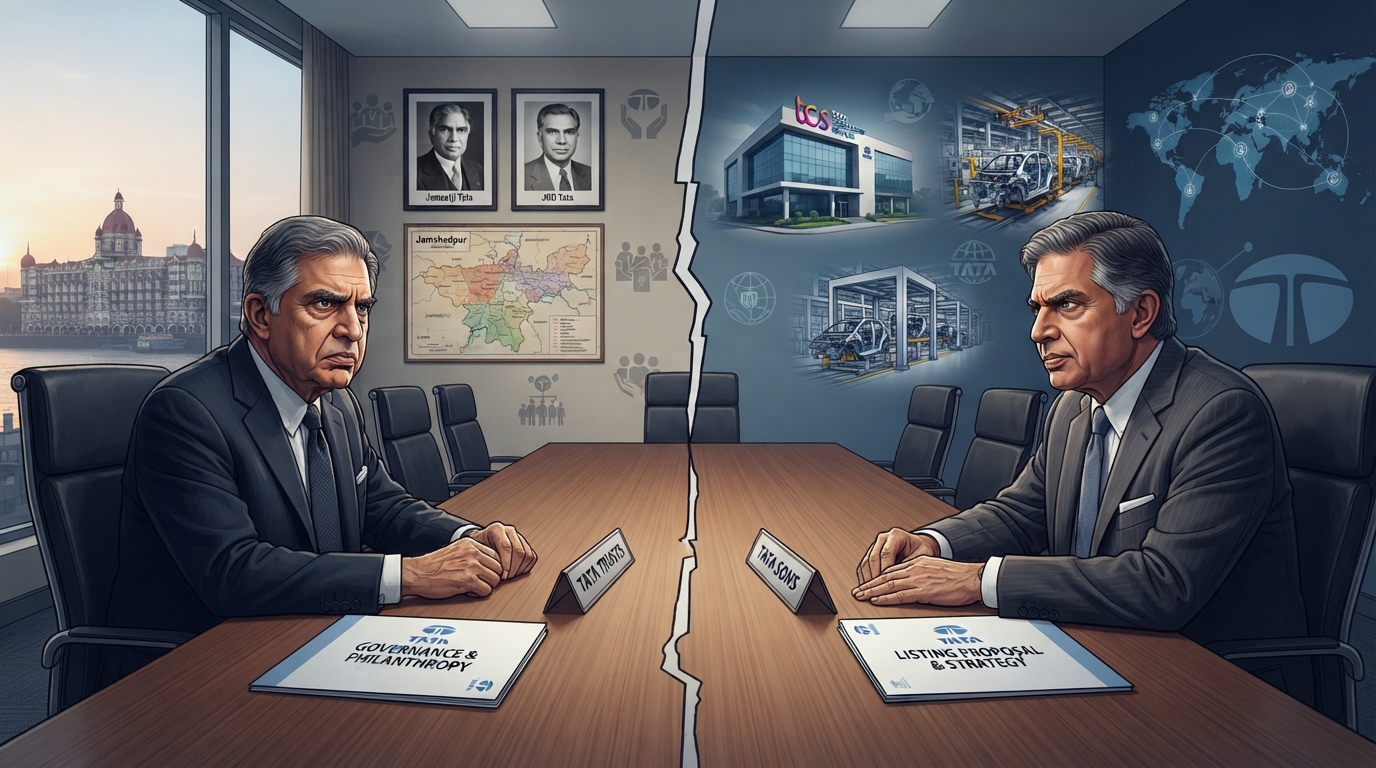
**Boardroom dispute puts trusted Indian business empire to the test**
**Noel Tata, chairman of majority shareholder Tata Trusts, has opposed the reappointment of N Chandrasekaran, chairman of Tata Sons**
Before sunrise in Mumbai, Mansi Kadam starts making vada pav, the savoury snack closely associated with the western Indian city, for the day’s customers. One ingredient is essential: Tata salt.
Asked whether she would ever think about changing brands, she echoes an old Hindi advertising jingle: “If it’s salt, it has to be Tata.”
She knows little about the events now unfolding in the boardroom of the Tata group, one of India’s oldest and most powerful business empires, whose businesses range from salt to software.
Yet her automatic loyalty raises a bigger question facing the group: can one of India’s most trusted brands stay shielded from a public struggle over power, governance and control?
A recent public rift between the board of Tata Sons, the Tata group’s holding company, and Tata Trusts, its main shareholder, has drawn attention to the conglomerate.
At the heart of the dispute are two matters: the proposed public listing of Tata Sons and the reappointment of chairman N Chandrasekaran.
Most of the Tata Sons board, including its largest minority shareholder, SP Group, backed the decisions.
But Noel Tata, chairman of majority shareholder Tata Trusts, has opposed both resolutions. He says a public listing would weaken the group’s philanthropic ethos and is likely to have both decisions overturned at the annual general meeting.
“When we say this is a governance crisis, it’s a misalignment of interests between the board [of Tata Sons] and the shareholders [Tata Trusts],” Shriram Subramanian, head of independent corporate governance firm InGovern Research, told the BBC.
He does not expect the brand’s image to be damaged right away, but he does raise concerns about the leadership’s ability to handle the challenges.
Tensions inside the Tata Group have been building since the death of former chairman Ratan Tata — Noel Tata’s half-brother, who named him as his successor after his death — in 2024. For many Indians, Ratan Tata’s philanthropy and leadership had become inseparable from the brand. His death prompted widespread mourning, and experts say it left a leadership gap in the group’s public image.
According to the group’s website, the Tata group has led India’s most valuable brand list by valuation consultancy Brand Finance since 2018.
Tata Sons, the business entity, is described by the group as the “fastener keeping the many disparate elements of the whole together”.
Tata Trusts, which represents seven philanthropic trusts holding the majority stake in the group, is widely seen as its moral compass, steering the businesses on social impact and philanthropy.
For many Indians, the two entities together represent what most companies cannot buy: trust.
Now that these entities are on opposing sides, that trust is under pressure.
“Once upon a time, there was a unified audience which said the Tatas are good people with good governance. Today, the opinion is divided,” said Harish Bijoor, business and brand strategy consultant.
Although most consumers seem unaffected, the dispute has split other stakeholders, including business partners, investors and employees. Some see it as corporate power politics, others as a real governance debate, but few agree on who is right, Bijoor said.
“This conflict has brought the Tatas into conversations everywhere, which is not good as they have always liked to be out of it,” he said.
The group has traditionally preferred to stay low profile on philanthropy and conflict resolution.
Founded by Jamsetji Tata in 1868, the Tata group expanded under JRD Tata, who turned it into a professionally managed conglomerate. Ratan Tata later pushed its global ambitions through acquisitions.
The Tata group, with a combined market value of more than $260bn (£195.6bn) and hundreds of thousands of employees in more than 100 countries, is no stranger to controversy.
The conglomerate has faced protests over industrial projects, scrutiny of its Indian telecom business during a spectrum allocation controversy, a high-profile dispute with Japan’s Docomo and, more recently, questions about Air India’s performance.
Some of its business decisions have also attracted attention, especially Tata Steel’s troubled Corus acquisition, though other overseas bets such as Tetley and Jaguar Land Rover succeeded and helped broaden the group’s global reach.
Its biggest controversy came in 2016, when the Tata Sons board abruptly removed Cyrus Mistry as chairman and brought back Ratan Tata as interim head. Mistry, heir to the SP Group, had been selected by a team led by Ratan Tata himself. The dispute led to a long legal battle that ended in 2021 with the Supreme Court ruling in the Tatas’ favour.
Last month, journalist Sucheta Dalal wrote in her Moneylife magazine column that the Tata group has “weathered serious governance storms” and enjoys “special privileges available to no other business group [referring to a tax exemption granted to Tata Trusts for holding shares in Tata Sons]” because of a reputation built over decades.
Most Tata watchers agree.
In an email interview, Morgen Witzel, a fellow at Exeter Centre of Leadership who wrote a book on the brand in 2010, pointed to several examples of the group’s connection with people.
In Jamshedpur in Jharkhand state, where the group established India’s first integrated steel plant and an industrial city, it provides healthcare and education to people in hundreds of villages. Watchmaker Titan supports employees who want to leave and start their own businesses. Tata Motors in Pune has supported thousands of female entrepreneurs, he noted.
“It is the concatenation of all of these things that builds trust because people see that, by and large, Tata is there to serve their needs rather than just take their money,” Witzel said.
But while the group has survived other storms, this time the split is internal.
The boardroom struggle has increasingly spilled into public view, with Tata Sons and Tata Trusts exchanging legal notices and conflicting statements.
Venu Srinivasan, vice-chairman of Tata Trusts and a nominee director on the Tata Sons board, has called for an investigation into alleged governance lapses at some trusts. The trusts deny any lapses.
Noel Tata has put forward two proposals to prevent a listing of the company.
First, he wants the Tata Sons board to buy back part of SP Group’s minority stake as a “fair and equitable solution” to the latter’s demand to monetise its holding. Second, he proposes restructuring Tata Sons by merging two of its businesses with itself, which would alter how India’s central bank classifies it and could help the group avoid a listing.
It is unclear whether he can succeed, given that unlike Rata Tata, he has not yet consolidated power.
“Ratan Tata’s larger-than-life image is, to some extent, the reason behind the current conflict. Everyone was deferential towards him and his successor was known only after his death through his will,” says Subramanian.
If Ratan Tata had handled the succession himself, the transition would have been smoother, he says.
Brand expert Bijoor says the Tata group should prepare a “white paper” on how the conflict ultimately unfolds. “They stood for transparency, and they must never shed that.”
How the influential group handles these tensions may provide a preview of its future. The result will be closely watched across corporate India, where Tata’s governance and business practices have long been seen as a benchmark.