

Blogger, audience, and responsibility: likes are not the measure of truth
Turning a person's pain into content and legally protecting them are not the same thing.
**Blogger, Audience, and Responsibility: Likes Are Not the Criterion of Truth**
Lately, I have read many posts about bloggers, various events related to them, different situations, and people's destinies, and I have also expressed my opinion on these topics as much as possible. But if I calculate, in fact, all of these articles revolved around one big topic: freedom of speech, influence, and responsibility. In our society today, blogging has gone far beyond the level of simply running a personal page. The audience of some bloggers is larger than the circulation of some newspapers, and even larger than the audience of some TV channels. In just a few minutes, it is possible to influence the thinking of hundreds or thousands of people.
Therefore, the approach of "I only expressed my opinion" does not always release one from responsibility. Because behind every word spoken in public, there is a consequence. A blogger can openly point out the mistake of an official or a government agency. They can discuss a court decision, criticize a law, or protect the public interest. This is natural. But there is a big difference between criticism and accusation. Saying "In my opinion, this decision is wrong" is one thing; passing judgment by saying "this person is a criminal" is another. That is, even having a million subscribers does not turn them into a judge. A person's guilt or innocence is not determined by likes, reposts, comments, or public outrage. For this, there is evidence, a process, and a court. Similarly, a blogger is not a lawyer either. It is easy to go to a person facing a legal problem, turn on the camera, and say, "I will resolve this matter," "I will get the court decision overturned," or "If we bring this to the public, everything will change." However, court decisions are changed not by posts and discussions on social networks, but by the procedural order established by law. There is appeal, cassation, revision, and furthermore, there are other legal mechanisms provided by law.
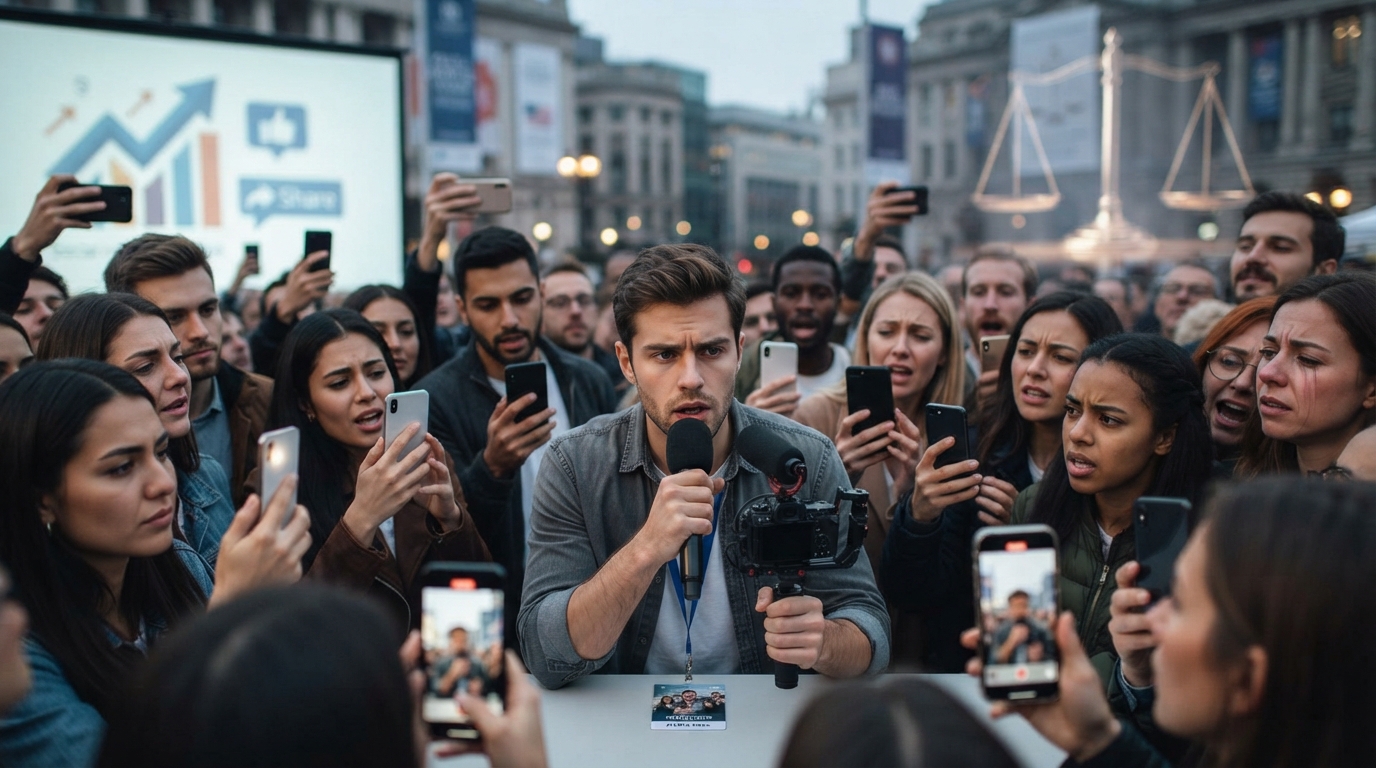
Turning a person's pain into content is not the same as protecting them legally. Most dangerously, sometimes a person's tragedy becomes a tool for someone else to gather an audience. First, a sensational headline, then an appeal to emotions, followed by a call to "demand justice," and thousands of comments, hundreds of shares...
But after some time, when the story is no longer interesting, that victim may be left alone with their problem again. Meanwhile, the blogger moves on to the next topic. There is another important issue here: having many subscribers does not automatically make a person a lawyer, doctor, economist, expert, or political scientist. However, on social networks, we often see the opposite picture. Whoever has a large audience, their word is accepted as the truth. In reality, truth is determined by evidence, not by the volume of the voice. Therefore, one of the important tasks of a blogger is to separate fact from opinion, that is, they must know the difference between "it has been established" and "in my opinion."
There is also a big difference between "committed a crime" and "is suspected of committing a crime." Every word we write, our opinion, and our text can affect a person's honor, reputation, work, family, and entire life.
At the same time, it is also incorrect to bring the issue only to the point of "bloggers should be careful." A blogger in the public eye must be responsible, but the state must also act within the framework of the law. Freedom of speech is not a privilege granted to a blogger. It is one of the society's opportunities to exercise control over the state.
Often, content prepared without provocations and shouting struggles to attract public attention. If you look closely, it raises the very same issue, just without a loud voice. That is, a journalist or blogger who adheres to ethics is not showing weakness or cowardice. A tough question can also be asked calmly. In demanding answers from an official, specific facts and evidence are more effective than shouting.
If the facts are in place, sometimes a single, simple, and calmly asked question can reveal a lot.
Another thing, a professional journalist or blogger goes to an interview prepared: they know the official's powers, familiarize themselves with the documents, check the numbers, know the law well, and then ask questions. It is difficult to evade such a question.
Another issue is the audience. We often think that the blogger influences the audience. But over time, the audience also changes the blogger: which post got more likes, which statement spread more, which topic caused more scandal? The algorithm also encourages this.
Then, the line between providing information and attracting attention gradually begins to disappear. As a result, tension, rather than analysis, begins to win. The word "perhaps" does not appeal to the audience, while the statement "everything is clear!" spreads quickly. The blogger gradually begins to say not the truth, but what their audience wants to hear. This creates unique closed circles in the information space. People with the same opinion validate each other. A different opinion is perceived as hostility. The view of "our person" or "their person" prevails, rather than evidence.
Political influence can also be added to this. Especially, the risk of a person making sharp calls from abroad is not the same as that of a blogger inside the country who feels the consequences of that call on their own skin. A person writing a post from abroad may not be held accountable, but a blogger inside the country will face a criminal case, court, fine, imprisonment, or other consequences if they commit a violation of the law. For this reason, before spreading any political, religious, or social call, one must also think about whose interest lies behind it.
In my opinion, today the problem cannot be divided only into two categories: "good blogger" and "bad blogger." The issue is much broader. The blogger, their audience, social network algorithms, money, reputation, political and social interests, human psychology — all of these are interconnected and influence one another.
As a lawyer, my attitude towards bloggers is far from the view that they should be restricted. On the contrary, for the development of society, bloggers are needed just like journalists. Only independent thought, criticism of authority, and public control — all of these must rely on facts, professional ethics, legal culture, and personal responsibility. Otherwise, freedom of speech can become a tool for violating another person's rights.
Freedom of speech is a great power. Therefore, today we should think more about the culture of distributing information, rather than restricting bloggers. Because the problem is not in the blogger themselves, but in how they use the opportunity in their hands. One must not forget that behind distributing a message without checking it, accusing someone without evidence, or bringing their personal life to the public, lies the destiny of a real person.
Caution and responsibility do not belong only to bloggers. A journalist, an official, and an ordinary person expressing their opinion on social networks are all responsible for their words. After all, where there is freedom of speech, there will be diversity of opinions, criticism, and debate. The important thing is that all of this should serve the search for truth, not the violation of someone's rights.