

"Bilateral Dynamics Plus Regional Coordination": Experts on the Prospects for Cooperation between Central Asia and the South Caucasus
Are the two shores of the Caspian truly becoming a single space? Experts interviewed by Gazeta believe that relations between Tashkent and Baku have already gone far beyond symbolic diplomacy, but the integration of Central Asia and the South Caucasus remains an emerging process.
"Bilateral Dynamics Plus Regional Coordination": Experts on the Prospects for Cooperation between Central Asia and the South Caucasus
Gazeta discussed the Treaty of Eternal Friendship, recently signed by the presidents of Uzbekistan and Azerbaijan, with experts. Political scientists shared their opinions on the significance of the new document, the possibility of creating a unified space between Central Asia and Azerbaijan, and the optimal format for relations with the South Caucasus.
**Treaties of Eternal Friendship: From Past to Present**
In the past, "treaties of eternal friendship" were often more emotional promises, an attempt to cement brotherhood after the collapse of the USSR without a solid economic foundation. However, the current treaty with Azerbaijan is not an advance payment, but a codification of existing realities.
The parties first created effective institutions, launched cross-border transport routes, linked their economies through multi-billion dollar joint projects, and provided each other with significant geopolitical support at critical moments. Only then did they sign such a treaty. This was not a spontaneous decision, but the logical conclusion of a systematic rapprochement between two key states of Central Asia and the Caucasus.
This document not only strengthened a high level of mutual trust but also imposed firm international legal obligations on the parties to non-aggression, neutrality, and non-participation in coalitions that could harm the security interests of Baku or Tashkent. Its purpose is to reduce the risk that major external powers could sow discord between the two republics or pit them against each other. In other words, against the backdrop of global crises, Uzbekistan and Azerbaijan are significantly more closely coordinating their positions on issues of stability and security in Central Asia and the South Caucasus.
Each state independently determines the framework for the development of relations. Often, the various statuses assigned to relations are an attempt to elevate them to a stated level—in this case, to the level of eternal friendship.
This can be compared to Chinese initiatives. Beijing likes to give its initiatives catchy names, such as "Belt and Road," "Community of Shared Destiny," or "Global Security Initiative." Such formulas attract attention and create a brand under which relations develop. I believe that the next meetings between Uzbekistan and Azerbaijan will be held under the "eternal friendship" brand, this will also create a different atmosphere.
In my opinion, the significance of the Treaty of Eternal Friendship cannot be reduced to political symbolism. It enshrines a qualitatively new level of interstate trust, which has been built consistently: strategic partnership, allied relations, the Supreme Interstate Council, and now—eternal friendship.
The document institutionalizes an unprecedentedly high level of allied relations, enshrining strong legal and political guarantees of mutual support. It lays out fundamental obligations for the parties to refrain from participating in any alliances or initiatives directed against each other's sovereignty, independence, and territorial integrity.
The historical experience of global diplomacy demonstrates the vulnerability of purely declarative formulations. But the current stage of the Uzbek-Azerbaijani partnership rests on a solid foundation. During the last summit, along with the Treaty, a program for increasing mutual trade to $1 billion by 2030 was approved, investment plans were adopted, and new projects were launched in banking, industry, raw materials processing, education, tourism, and agriculture. 280 enterprises with Azerbaijani capital have already been established in Uzbekistan, and a joint investment company is operating.
Therefore, I would view the Treaty primarily as a long-term political framework for an already established practical partnership. The strength of such documents is determined not by the title itself, but by the stability of political will, institutions, and mutual interests. Today, all three components are present in Uzbek-Azerbaijani relations.
This is a political statement that is based on tectonic shifts in the real economy. This is not simply a declaration of intent, but rather a statement of the formation of a new structure, which experts increasingly refer to as the "CA + Azerbaijan" macro-region after Azerbaijan officially joined the format of the Consultative Meetings of the Heads of State of Central Asia in 2025. As a result, interaction with Azerbaijan has begun to take on the characteristics of a unified trans-Caspian space with shared interests in security and development.
**The economic and logistical foundation of the macro-region rests on the following factors:**
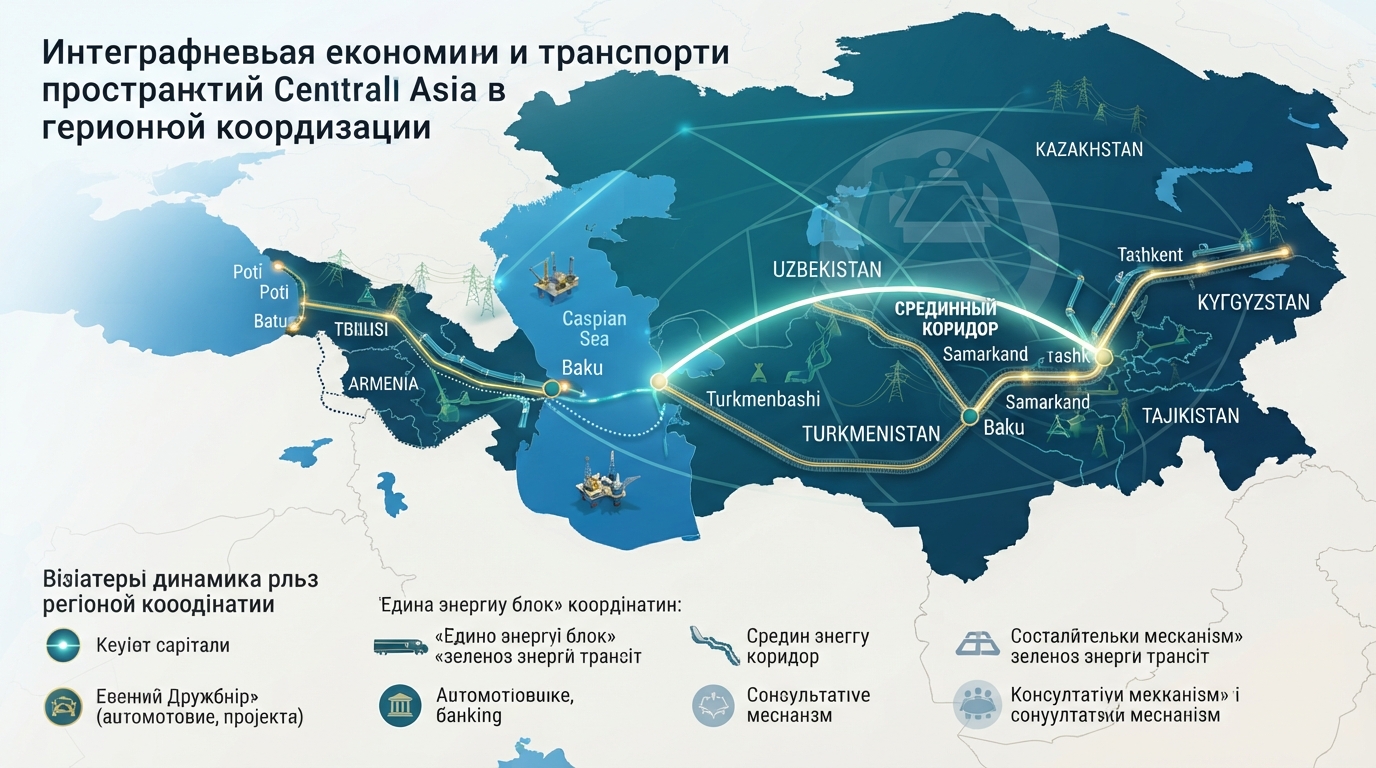
First, the Middle Corridor has evolved from a theoretical project into one of the key transport arteries for the region's economies. Azerbaijan's ports (Baku/Alat) provide Central Asia with additional access to western destinations, and without cargo from Central Asia (and China), Azerbaijan's transit infrastructure is diminishing.
Second, projects to interconnect energy systems, transit green energy, and jointly develop hydrocarbons in the Caspian Sea are transforming the region into a single energy bloc.
Third, the creation of joint investment funds, significant investments in the automotive and textile industries, and even the entry of a leading Azerbaijani bank into the Uzbek market demonstrate that a unified business space is emerging.
At the same time, for the macro-region to function as a single economic entity, consistent, clear, and stable tariffs for shipping across the Caspian Sea are essential. This process is currently in the development stage. The growth of cargo traffic from China and Central Asia requires the creation of unified service standards, the synchronized expansion of terminals on the Caspian Sea, and joint management of the ferry fleet shortage.
**Single Space: Challenges and Opportunities**
What do we mean by geopolitical and geoeconomic? Are the security challenges common to Azerbaijan and the Central Asian countries? Speaking of geopolitics, I wouldn't say they are common to all six countries.
If we're talking about the transport sector, then yes, perhaps we can develop a unified approach. But, it seems to me, the recent power outages in Kyrgyzstan, which affected four neighboring states, have demonstrated where space is truly interconnected. The same applies to water issues. Water shortages in one country can affect the flow of water resources to others and, consequently, the prices of basic goods. In other words, these are all indicators of a unified and interdependent space.
With Azerbaijan, Central Asia is still in the process of forming a common space, primarily in the transport sector.
This assessment certainly contains a political vision of the future, but it is already based on entirely objective processes. President Aliyev spoke about more than just geographic proximity. Over the past three years, he has made 14 visits to Central Asian states, and leaders of the region have visited Azerbaijan 23 times. This is an unprecedented level of interstate dialogue.
Most importantly, the economic geography of Eurasia itself is changing. Central Asia and the South Caucasus are becoming complementary links in East-West transport, energy, and trade chains. For the Central Asian states, the Azerbaijani route provides an additional outlet through the Caspian Sea to the Caucasus, Turkey, and European markets. For Azerbaijan, Central Asia is a growing market and a natural extension of the transit space to the East.
In this regard, Uzbekistan advocates for expanding transport connectivity, developing end-to-end production chains, digitalizing transportation, and developing long-term joint programs. This approach is consistent with the fundamental line of our foreign policy: not geopolitical competition, but the pragmatic unification of states' capabilities for the sake of common development. At a recent informal meeting of the leaders of Central Asia and Azerbaijan in Bishkek, President Shavkat Mirziyoyev directly proposed creating a sustainable architecture of interregional cooperation.
Therefore, I would speak of an emerging transregional interconnectedness space. Its significance is determined by the ability of our states to transform geography into an economic advantage.
**Combined Approach: Bilateral Ties and Regional Coordination**
In my opinion, it would be more effective for the countries of Central Asia to use a combined approach, combining strengthening bilateral ties with a gradual transition to a coordinated regional format.
A bilateral format is indispensable for the prompt resolution of specific economic challenges, where speed and flexibility are crucial. It allows the two capitals to directly launch joint investment funds, open production facilities, and develop industrial cooperation. In this case, countries can move forward rapidly at their own pace, setting a high bar and creating ready-made working models of cooperation for other partners.
At the same time, large-scale geopolitical and cross-border projects, such as the Middle Corridor or unified energy and digital highways, fundamentally cannot be implemented without a coordinated regional approach. Even the most effective bilateral agreements cease to function if infrastructure congestion, tariff hikes, or customs barriers arise in transit areas between neighboring countries.
To develop a regional consensus on these issues, it seems appropriate to establish a permanent secretariat for the Central Asia-Azerbaijan format. This will institutionalize multilateral dialogue and develop common regional standards in strategic areas—from energy and digitalization to cross-border infrastructure.
At the moment, each state in the region will develop its own approach to Azerbaijan, because we are, after all, five different countries. And I believe that in the short term, the bilateral format is working effectively. For example, the joint fund created by Azerbaijan and Uzbekistan. Funds are already being allocated for real projects under the fund. Furthermore, there are projects in construction, as well as in the oil and gas sector.
And it's better to develop the multilateral format with an eye to the future. Because our countries still need to learn to live and work together. And the example of cooperation with Azerbaijan clearly demonstrates this. The countries are trying to find a common format, taking different steps, making mistakes, but gradually learning.
I think that in the long term, such a regional approach will be important. At the same time, it's not yet worth viewing interaction with Azerbaijan and the South Caucasus solely through the prism of a regional approach. Countries in the region also view other states as part of a region-wide process—for example, Afghanistan and even, according to my information, Mongolia. Therefore, I believe this format will expand.
There's no need to choose one over the other. Strong regional cooperation is built on strong bilateral relations, and the most large-scale projects, in turn, require coordinated decisions from several countries.
Bilateral cooperation allows for faster progress—creating enterprises, investment mechanisms, and developing interregional ties. However, a transport corridor cannot be built solely by two countries. It requires coordinated tariffs, customs procedures, digital solutions, port and rail infrastructure. The same applies to energy, environmental protection, and industrial cooperation.
Therefore, the most promising model is "bilateral dynamics plus regional coordination." Moreover, Central Asia is approaching this stage significantly more consolidated. The Consultative Meetings have fostered a culture of ongoing dialogue, compromise, and shared responsibility. Azerbaijan's accession to this format in November 2025 was a logical continuation of this process.
Here, it is crucial to maintain an open, pragmatic, and non-confrontational nature of interaction. The rapprochement between Central Asia and the South Caucasus should not be directed against anyone, but rather at expanding the capabilities of all states in the region.
Prospects for the Central Asia-South Caucasus Format
Let's first consider the results of Azerbaijan's accession to the Consultative Meetings. Baku's participation in this format has not yet become full-fledged. The Consultative Meetings are still referred to as "Central Asia-Azerbaijan," the country is not yet featured on the meeting logo, and it does not participate in the C5+1 meetings. The only instance of Azerbaijan's inclusion in this format was the think tank meeting in Afghanistan.
The South Caucasus is broader than just Azerbaijan. The presence of Georgia and Armenia in the region, with their divergent geopolitical vectors, objectively complicates the formation of a unified pan-regional platform.
In my opinion, the current "Central Asia-Azerbaijan" format effectively addresses current tactical challenges. Baku is the undisputed economic and logistical leader in the South Caucasus. Azerbaijan's participation in the Central Asian format creates a stable institutional link between the two regions, as all end-to-end energy, transport, and digital routes in the Caucasus pass through Azerbaijani infrastructure.
However, in the long term, the launch of a full-fledged "Central Asia-South Caucasus" platform will become a historic necessity.
Today, the South Caucasus is a complex region comprising three states with different foreign policy orientations, where Georgia is already deeply embedded in transit processes via the Baku-Tbilisi-Kars railway.
A more coherent geo-economic space can be formed when Armenia is integrated into the common Eurasian network after the unblocking and launch of transport corridors. Yerevan's recent statements in favor of European integration inspire optimism, making Armenia a more predictable and promising partner for Central Asian capitals.