

Between dream and reality. What to expect from the Yonar installation exhibition at Barsakelmes this year
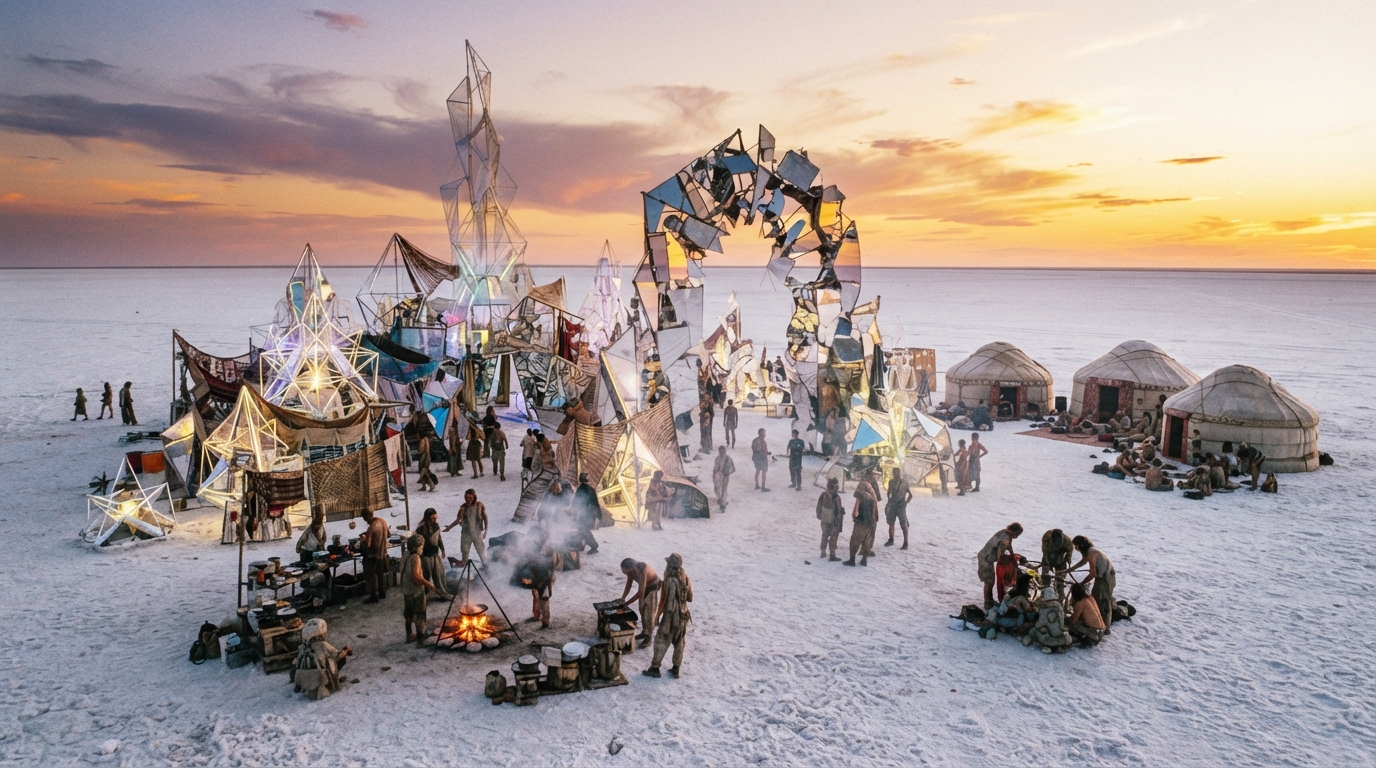
The Yonar installation exhibition, created by analogy with the American Burning Man, will be held on the Barsakelmes salt flat in Karakalpakstan. About 40 participants from different countries will set up camp here and create themed art objects that will "live" for only three days. A special feature of the project is the absence of spectators.
Between dream and reality. What to expect from the Yonar art installation exhibition at Barsakelmes this year
From September 17 to 19, the Barsakelmes salt flat in Karakalpakstan will host the Yonar art installation exhibition for the second time. It is organized by Otabek Suleimanov and Odil Mukhamedov — the creators of the "Stihia" festival of electronic music, art, and science — with the support of the Tourism Committee of Uzbekistan. This year's theme is dreams.
"We are interested in dreams, surrealism, strange images, the absurd, and generally everything that lies somewhere between reality and imagination. We think Barsakelmes itself is perfect for this," noted Otabek Suleimanov.
Installation of 2025.
Approximately 40 participants, including residents of Tashkent, Nukus, Muynak, Berlin, Vienna, London, Moscow, Almaty, Bishkek, and other cities, will "erect" White Salt City in the desert territory — a creative settlement where the exhibition participants will reside. For three days, they will cook food, hold music sessions and other activities, and create installations on the given theme. After the exhibition concludes, the art objects, just like last year, will be dismantled. This format resembles the annual Burning Man festival in the American Black Rock Desert, which inspired the organizers to launch their own project in Uzbekistan.
This year, the organizers received more than 70 applications for participation.
"We don't have a jury. Our entire team reviews the applications, and we try to accept almost everyone. We noticed an interesting thing: random people practically do not apply to Yonar — usually, a person already understands where they are going and why. Many applications this year were very well-developed," shared Odil Mukhamedov.
According to him, during the selection process, a person's contribution to the common settlement becomes decisive.
"This could be an installation, music, help with construction, cooking, a workshop, or generally some idea that they want to realize together with others," explained Otabek Suleimanov.
Installation of 2025.
There will be no spectators at Yonar this year, just like last year. Each participant is responsible for their part of the settlement's life and arrives on a self-sufficiency basis: they organize their own travel, accommodation, and meals, as well as bring the necessary things and tools. At the same time, part of the logistics and the creation of basic infrastructure are handled by the organizers.
"We provide the Nukus — Barsakelmes — Nukus transfer, accommodation in yurts with kurpachas, pillows, and blankets. We build temporary toilets, washbasins, and a communal kitchen, buy groceries for joint cooking, drinking and utility water, and provide the camp with electricity," continued Otabek Suleimanov.
For the authors, the expenses for the realization of art installations are covered.
"The very principle of Yonar remains the same: this is not a festival with spectators and organizers who do everything for you. The city is created by the participants themselves, and everyone is responsible for some part of it," said Odil Mukhamedov.
There will be no commercial trade or advertising presence of brands on the territory of Yonar. After the festival ends, the participants will dismantle the camp and art objects, collect and remove all trash, adhering to the "leave no trace" principle. The salt flat must remain exactly as it was before their arrival.
When asked what expectations the organizers have for the festival this year, they replied that they intend to leave and return.