

Before launching a reactor. How scientists test nuclear technologies and what Uzbekistan has to do with it?
Before Launching a Reactor. How Scientists Test Nuclear Technologies and Where Does Uzbekistan Fit In?
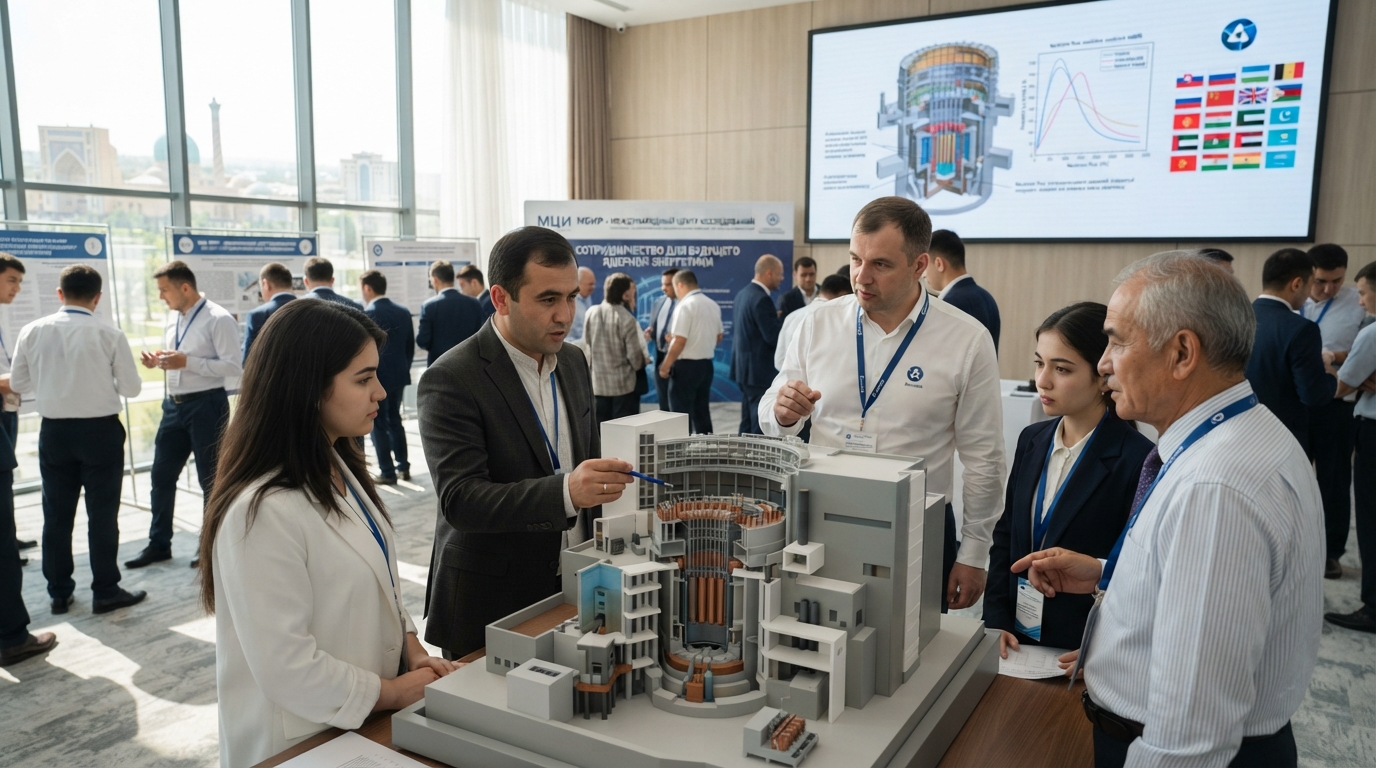
Will the fuel and materials of next-generation reactors withstand long years of operation, and how precise are the computer models calculating their behavior? These questions became part of an international discussion in Tashkent, where specialists from 18 countries discussed future experiments at the MBIR research reactor currently under construction in Russia. A Podrobno.uz correspondent discovered how research centers plan to cooperate, which technologies they intend to test, and what role Uzbekistan can play in these studies.
Processes inside the reactor are simulated using special software—so-called calculation codes. They allow predicting the behavior of fuel and structural materials, evaluating equipment performance, and performing calculations to assess the safety of designed facilities. However, even the most advanced models require verification: calculation results must be benchmarked against data from real-world experiments. Therefore, research reactors are essential not only for materials scientists who study how substances change under radiation exposure, but also for developers of software used for design and safety assessment. Experimental data makes it possible to refine calculations, test scientific hypotheses, and determine which solutions can be applied in practice.
One of the facilities designed to expand the capabilities of such research is the MBIR multipurpose fast neutron research reactor. It is being built in Dimitrovgrad, Russia. While construction continues, members of the International Research Center based on the MBIR Reactor (IRC MBIR) are shaping the program for future experiments and defining directions for international cooperation.
What technologies are going to be tested?
Promising reactors need fuel and structural materials capable of enduring long-term operation under harsh conditions, including intense neutron irradiation. To evaluate their properties and reliability, special tests must be conducted at research facilities.
Statistics from the International Atomic Energy Agency (IAEA) reflect the demand for such capabilities. As Pyotr Chakrov, head of the agency's Research Reactor Section, noted, 228 research reactors operate in 54 countries worldwide today, with another 16 facilities under construction. According to him, MBIR will become the fast-neutron research reactor with the highest flux, expanding irradiation testing capabilities.
One of the major research areas will be the development of fuel and materials for next-generation reactors. In particular, scientists intend to study solutions designed for longer operational cycles and increased resistance to severe conditions, including accident scenarios.
Another important topic is the reuse of spent nuclear fuel components. Stepan Kalmykov, Chairman of the Advisory Council of IRC MBIR and Vice-President of the Russian Academy of Sciences, explained that this approach allows for a more complete utilization of nuclear resources and a reduction in the volume of radioactive waste that ultimately requires disposal.
Certain elements of this cycle are already applied in practice. Andrey Shadrin, head of the radiochemistry department at the private institution "Science and Innovations" (part of the Rosatom State Corporation), stated that plutonium recovered from spent fuel of pressurized water power reactors is used in the manufacturing of mixed uranium-plutonium MOX fuel for the BN-800 fast reactor.
MBIR is expected to be used for testing structural materials and fuel, including options more tolerant to accident conditions. Such studies should help evaluate the characteristics of new solutions and verify their suitability for advanced reactor systems.
Other areas were also discussed in Tashkent: materials for future thermonuclear facilities, molten-salt technologies, and developments in small modular nuclear power. Each of these requires experimental verification—from evaluating the performance of new materials to confirming the operability of individual technical solutions.
Vasily Konstantinov, General Director of the "Leader of the IRC MBIR Consortium" organization, recalled that part of the research reactor's heat is designed to be used for power generation. According to him, MBIR "could become a prototype for a future power unit, demonstrating individual technical solutions."
Why are different countries joining the research?
It was precisely the need for experimental data that became one of the main topics of the third meeting of the IRC MBIR Advisory Council, which took place at the end of September at the Institute of Nuclear Physics of the Academy of Sciences of Uzbekistan (INP).
The meeting brought together more than 150 representatives from 72 organizations across 18 countries. Participants joined both in person and via video link. For comparison, the previous meeting in Dubna was attended by 87 experts from 41 organizations.
Scientists and industry representatives discussed which experiments are required by developers of new reactor systems, how to distribute research tasks, and how to organize joint work. While MBIR is under construction, members of the international center are defining the needs of scientific organizations and establishing the research tracks to be implemented once the facility is launched.
Evgeny Abakumov, Rosatom's Deputy Director General for Science and Strategy, proposed using MBIR as a platform for cooperation among calculation software developers. Under his vision, tools created by different scientific schools to simulate specific processes could be integrated and applied jointly.
This will allow comparing the results of different models against experimental data, refining calculations, and expanding research capabilities. Abakumov himself called the meeting in Tashkent proof that "the MBIR project is genuinely interesting to the international scientific community."
Different members of the consortium have their own reasons for joining the project, but their practical goals largely overlap. For example, the China Atomic Energy Authority views international cooperation as a way to organize research more efficiently.
Long Maoxiong, Deputy Secretary-General of the association, highlighted three main benefits of collaborative work: cost sharing, shorter research timelines, and the pooling of experimental data. For complex scientific projects, this is particularly important, as individual tests may require significant resources, specialized equipment, and the involvement of experts from various fields.
Nations developing their own nuclear programs and specialist training systems are also interested in participating. For instance, the Arab Atomic Energy Agency (AAEA), which unites 14 states, considers MBIR a base for research and workforce training.
In February 2026, the agency signed a strategic cooperation agreement with the "Leader of the IRC MBIR Consortium" organization. Salem Hamdi, Director General of the AAEA, noted that in cooperation with MBIR, Arab countries expect to develop research on fuel and materials for fourth-generation reactors, medical radioisotope production, and radioactive waste management technologies. Another area is the validation of calculation codes for regulatory bodies.
"The creation of a specialized Arab training center is a vital vector," Hamdi added.
Presentations at the meeting were also delivered by specialists from Vietnam, India, Brazil, Iraq, Jordan, and Syria.
Thus, the discussion encompassed not only technical tasks of future testing, but also personnel training, scientific data exchange, and the organization of international research.
Following the meeting, participants clarified the requirements of developers of new reactor systems. The next step is to prioritize research areas and prepare joint experiments.
Computer models need testing too
A dedicated place in the discussion was given to the verification of calculation codes—the software scientists use to simulate processes inside a reactor. Such tools allow evaluating material behavior, calculating equipment operating parameters, and analyzing the safety of designed installations even before their engineering solutions are implemented in practice.
However, the accuracy of calculations depends on how accurately the software describes actual physical processes. To achieve this, simulation results must be compared with experimental data obtained from research reactors. If discrepancies are found, the models are refined, and the calculations are re-verified.
Therefore, access to an experimental base is essential for several specialist groups at once: fuel and materials researchers, reactor technology developers, and software creators. International cooperation in this area allows pooling data gathered by various scientific centers and using it to benchmark calculations.
This is precisely the approach Evgeny Abakumov proposed to develop. In his view, MBIR can become a platform where developers of calculation software will work together on modeling specific processes and verify results using experimental data.
The meeting also addressed the capabilities of artificial intelligence. AI is expected to be used for material selection and the optimization of technological parameters. At the same time, AI—much like traditional calculation programs—requires reliable input data and verification of results. Experiments should help assess how well the solutions proposed by algorithms match the actual properties of materials and the operating conditions of reactor systems.
Thus, the future MBIR research program goes beyond testing fuel and materials. It is also meant to lay the groundwork for advancing the simulation methods used in designing and assessing the safety of new reactors.
What will this bring to Uzbekistan?
For the Institute of Nuclear Physics of the Academy of Sciences of Uzbekistan, participating in the project is an opportunity to expand existing research and gain access to additional experimental capabilities.
The INP is engaged in radiation materials science and the study of new fuel types. According to the President of the Academy of Sciences of Uzbekistan, Shavkat Ayupov, it was the prospect of expanding this work thanks to the high fast-neutron flux that prompted the institute to become one of the first to join the MBIR consortium.
This is not about replacing the existing scientific infrastructure, but rather supplementing it with the capabilities of the new installation. The Director of the INP, Academician Ilkham Sadikov, linked future research at MBIR to the institute's operating experimental base, including the modernized VVR-SM research reactor and an accelerator complex.
"Today's meeting clearly demonstrates that modern nuclear physics and reactor technologies know no borders. Integrating the capabilities of the MBIR reactor under construction with the existing infrastructure of the INP, including our modernized VVR-SM research reactor and accelerator complex, opens fundamentally new horizons for applied science in the macro-region.
We see immense potential in joint materials science experiments, calculation code verification, and radioisotope production. I am confident that combining our unique competencies and experimental facilities will form a solid foundation for ensuring nuclear safety and the sustainable development of peaceful atom technologies," the scientist said.
Thus, Uzbekistan's interest in MBIR spans several areas at once: materials and fuel research, calculation model verification, and radioisotope production. Collaborative work with foreign scientific centers also opens avenues for exchanging experimental data and expertise.
The importance of developing such an infrastructure was also highlighted by Mikhail Kovalchuk, President of the National Research Centre "Kurchatov Institute," who sent a greeting to the meeting participants.
In his address, he noted that the MBIR under construction and the operating PIK research reactor are two complementary installations covering the entire spectrum of neutron fluxes. According to him, for megascience-class facilities, the key priority is establishing a single comprehensive scientific program that will allow using their potential within coordinated research and international cooperation.
The greeting also mentioned the opening of a branch of the National Research Centre "Kurchatov Institute" at the Institute of Nuclear Physics of Uzbekistan. This represents another avenue of cooperation that could strengthen scientific ties and broaden options for specialist training.
For the country, developing a research base gains added significance against the backdrop of its own nuclear energy program: Uzbekistan is building its first nuclear power plant. As nuclear power expands, so does the role of specialists capable of assessing material properties, verifying engineering solutions, and taking part in research related to equipment safety and reliability.
"Uzbekistan is currently making a large-scale move toward nuclear energy, and the scientific and technical foundation laid by the Academy of Sciences will be embodied in its energy program," said Evgeny Abakumov.
What lies ahead?
The Tashkent meeting demonstrated that the MBIR research program addresses a wide spectrum of tasks—from testing fuel and structural materials to reusing spent nuclear fuel components, producing radioisotopes, and improving computer models.
Behind each of these areas are concrete solutions that scientists must verify and refine. Certain experiments are designed to determine how materials behave under intense irradiation and long-term operation. Others will provide data to benchmark calculation codes, assess safety, and advance new reactor technologies. Separate studies will involve training specialists and applying artificial intelligence to scientific research.
Once MBIR is launched, its high fast-neutron flux should expand irradiation testing capabilities. International partnership, in turn, will allow scientific centers to pool data and expertise from various research schools, share expenses, and shorten the time needed to tackle complex tasks.
For Uzbekistan, participating in the project offers a chance to complement the INP's existing infrastructure with new experimental capabilities and advance research that is in demand across nuclear science and industry.
This is the main purpose of a "reactor for new reactors": to create an experimental foundation that will help test scientific developments, refine computer models, and prepare solutions for the next generation of nuclear technologies.