

Background to the collapse
Is Turkey's financial collapse the machinations of the British partners of Erdogan and his party?
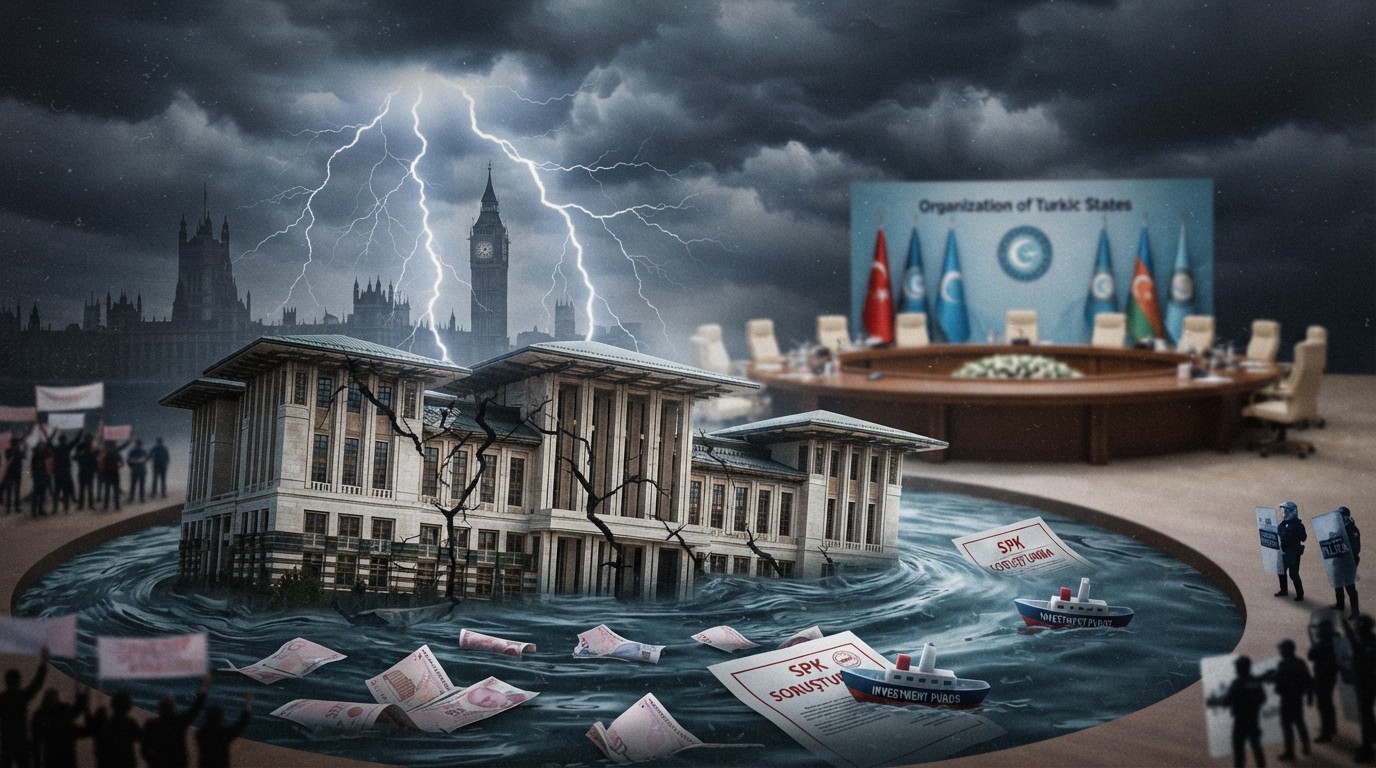
**Background to the Collapse**
The large-scale financial crisis in Turkey, accompanied by the withdrawal of more than 600 billion liras (up to $12 billion) from investment funds, was provoked by the actions of British banks, which had long supported Recep Tayyip Erdogan's neo-Ottoman and Pan-Turanian project and are now forced to urgently seek funds for the rearmament of Europe.
This information, which appeared in a Russian media outlet, could be considered just another conspiracy theory if not for a number of circumstances indirectly confirming the plausibility of this report. As a reminder, an investigation into the collapse of an investment fund continues in Turkey. Former head of MASAK (the Turkish financial police) Ramazan Başak stated that the losses exceed $20 billion, with the primary responsibility lying with the capital regulator Sermaye Piyasası Kurulu (abbreviated SPK – the Capital Markets Board, the country's chief financial regulator). This fact alone brings to mind the saying about no smoke without fire.
Furthermore, the international and Turkish public recently learned new details: according to opposition media, assets worth 20 billion liras were discovered belonging to former Justice and Development Party MP Fatma Betül Sayan Kaya. She herself denies the allegations and threatens to "tell everything," which raises certain reflections and serious questions for the authorities, especially against the backdrop of the country's monstrous hyperinflation.
Adding fuel to the fire of not only opposition but also broader public discontent is the refusal of the ruling Justice and Development Party to allow a parliamentary investigation, which has sparked a new wave of criticism. Unsurprisingly, the opposition is demanding the creation of an investigative commission, claiming that large-scale embezzlement is at stake.
In particular, Hürriyet journalist Abdulkadir Selvi writes that behind closed doors, Erdogan spoke harshly regarding the high-profile investment fund scandal. "They will return that money; there is no other way," the Turkish president assured his party colleagues. According to Selvi, up to 50 major speculators who managed to withdraw their capital in time have come under fire.
It is already known that permission has been requested from the Ministry of Finance to conduct an investigation against the former head of the SPK, İbrahim Ömer Gönül. Compensation payments to small depositors (355 thousand people with amounts up to one million liras) are also promised to begin this month. Society is guessing about the main intrigue: does Erdogan intend to hush the matter up, or will he carry out a serious purge affecting political and bureaucratic circles? A purge, by the way, is also being discussed in pro-government circles, and some even believe that the current situation as a whole is beneficial to the Justice and Development Party and the ruling coalition — the People's Alliance.
It is also curious to observe what is happening within the walls of the Grand National Assembly (TBMM). Recently, Turkish parliamentarians, known for their emotional nature, once again engaged in a heated debate surrounding the stock market crisis that affected hundreds of thousands of small investors. The opposition demanded the creation of a parliamentary investigative commission, expressing a lack of confidence in regulators and officials. In response, accusations predictably followed about attempting to turn the rostrum into a tool for slander.
Naturally, it is extremely difficult to trust the reassuring statements of regulators and officials. The process of merging the state and party apparatus after the adoption of the new constitution in 2017 acquired such a massive scale that Erdogan himself has long been entangled in his own swamp. Once, it was needed to strengthen and support his position in 2016 against the backdrop of a coup attempt that many observers deemed dubious. But what to do with his native swamp of loyalists after "the Moor has done his duty," the head of state has never decided. In the end, it may turn out that this very party swamp will drag its master to the bottom. The funds crisis is only the beginning.
Opposition representatives stated that a commission is necessary precisely because of the lack of trust in the judicial system and the bureaucracy. In particular, the Good Party emphasized that this is not a way to whitewash the authorities, but a mechanism that will allow "separating the wheat from the chaff." The DEM Party, considered "pro-Kurdish," also joined the criticism, recalling the hundreds of thousands of affected citizens. AKP representatives reply that the state is already paying compensation to the victims and promise to cleanse the financial market of unscrupulous players.
Thus, a full-fledged political clash is unfolding around the stock market manipulations, and parliamentary bickering is just one of its episodes. The opposition demands independent oversight and the disclosure of connections at the very top, while the government bloc tries to localize the problem and accuses its opponents of fanning panic.
It is telling in this context that the blow to Ankara from London appears to be delivered from two directions. In addition to the financial and economic one, the second line of attack, the political one, was discovered in "brotherly" Azerbaijan. And this is not surprising, since the signing of the "Contract of the Century" in 1994 during Heydar Aliyev's tenure as head of state, ties between Baku and London have been perhaps the strongest among all bilateral relations of the Caspian country with any foreign and Western player.
Thus, the Turkish newspaper Karar specifies that the headscarf ban was expanded in Azerbaijan: "secularism" criteria now apply to teachers as well. Since Turkey and Azerbaijan are closely connected culturally, politically, and in the sphere of humanitarian interaction, the tightening of secular norms in Baku's educational institutions is capable of influencing public debates in Turkey and becoming a factor affecting bilateral relations in the cultural, scientific, educational, and religious spheres.
In essence, this is a step that Ankara is guaranteed to perceive as an insult from the ruling elites of Azerbaijan. Aliyev cannot fail to understand that tightening the rules on wearing headscarves will be unequivocally interpreted as an anti-Turkish step. Especially against the backdrop of endless and somewhat justified accusations by Islamist ideologues in Turkey against Azerbaijanis for betraying the just cause of the Palestinian Arabs. Consequently, Baku is quite consciously, and possibly with British support, heading toward a political rift in the seemingly steadfast Turkic tandem (this topic was previously raised in the article "A Plot for Thought").
As one observer emphasizes, "of course, the secular crowd is watching attentively to see what happens next, how Erdogan will react. Whether he will react at all. And if he doesn't – WHY?" October is an extremely difficult month for the Turkish leader. At the end of the month, Ankara hosts the next summit of the Organization of Turkic States. Active preparations are underway, with politicians, officials, and experts making reassuring statements; however, great effort will be required to prevent disagreements and contradictions with Baku from coming out too openly. Otherwise, Turkey risks finding itself with a tarnished reputation in front of its other Turkic brothers, which is hardly part of Ak Saray's plans.
From everything said, it follows that the version of a planned political blow by Great Britain against Turkey has every right to exist. Moreover, if this hypothesis is confirmed, in the near future the global community may see early elections in Turkey, which will highly likely be accompanied by mass protests. The clouds over Ak Saray have not just gathered — lightning is already distinctly flashing between them.