

**At the Crossroads of Interests**
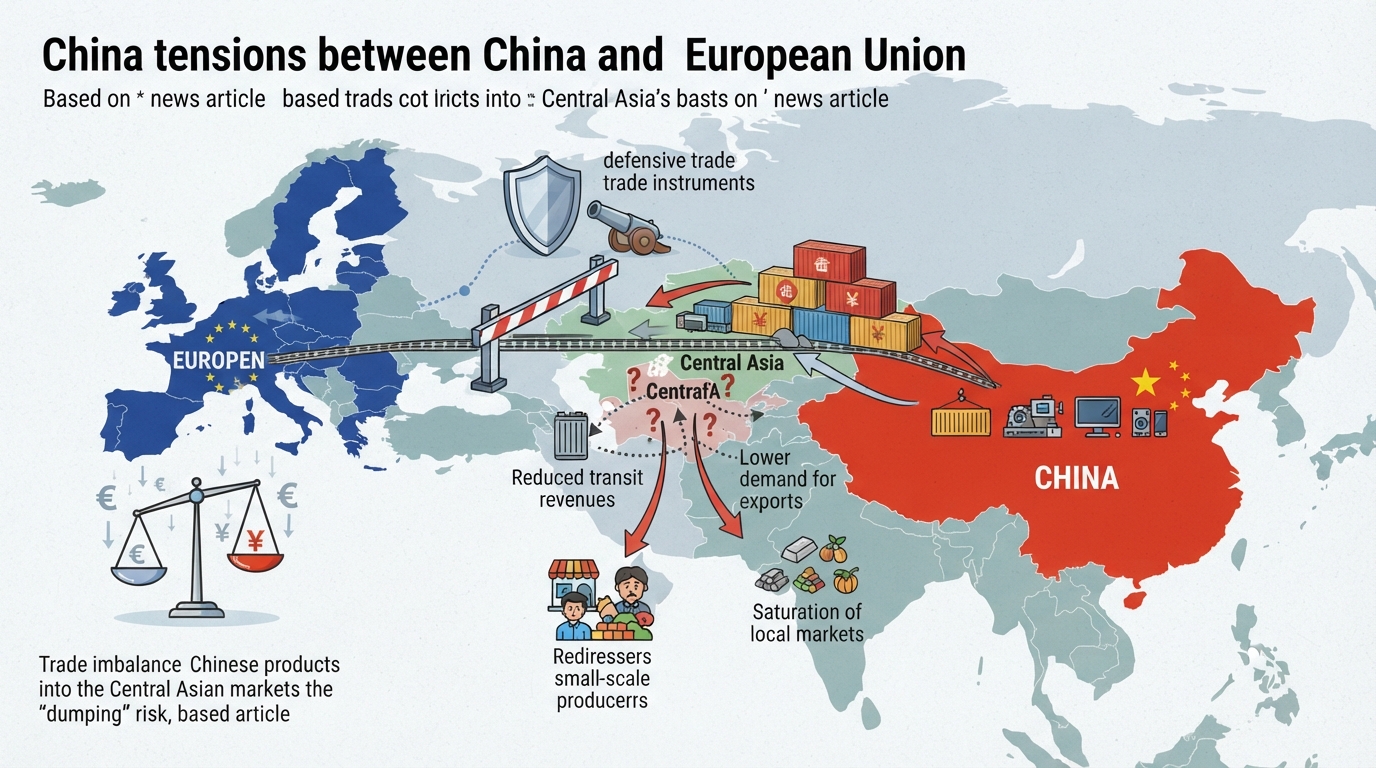
The EU is threatening China with new trade restrictions. In early October, it should become clear whether the European Union will close its market to some Chinese goods or whether the parties will manage to reach an agreement. For the countries of Central Asia, the second option is preferable, whereas the first could result in two consequences: a drop in transit revenues and the saturation of regional markets with cheap Chinese products to the detriment of local producers.
Despite Beijing's statements, the European and American markets remain priorities for the PRC. Therefore, it is not surprising that following Brussels' threats to tighten access for Chinese goods to the EU market, China's Ministry of Commerce spokesperson He Yadong stated that Europe should abandon pressure and engage in an equal dialogue.
She said: "China wants to emphasize that China-EU consultations at all levels must maintain the positioning of China and the EU as stable and balanced key trading partners for each other, while addressing the concerns of both sides on an equal footing."
According to her, neither side should make unilateral demands or dictate terms, let alone use threats of market closure as a tool of pressure and bargaining.
Meanwhile, Eurostat data points to a further increase in the trade imbalance. In the first half of 2026, the EU's deficit in trade in goods with China approached €196 billion. In 2025, it stood at around €360 billion.
The European Commission believes that three key factors contribute to the growth of Chinese exports to the EU: the low exchange rate of the yuan, state subsidies, and overcapacity in the PRC.
The European Union does not have a comparable set of export support tools. Therefore, Brussels fears that a further influx of Chinese goods at prices lower than European ones could lead to the deindustrialization of certain sectors. If Brussels and Beijing do not agree on reducing the trade imbalance, the EU may introduce additional restrictions against Chinese products.
European Commissioner for Trade Maroš Šefčovič stated that the EU-China negotiations must yield concrete results by October. Otherwise, Beijing could face tougher measures. According to him, if the dialogue does not bring results, the EU may resort to defensive trade instruments.
First of all, this could involve anti-dumping, anti-subsidy, and other protective measures. Theoretically, the EU also has at its disposal an instrument against economic coercion, informally referred to as the "trade bazooka."
However, this mechanism is not intended for ordinary trade disputes, but for cases where a third country, through economic pressure, attempts to force the European Union or its member states to change a political decision. A large deficit, state subsidies, or low export prices in themselves are not sufficient grounds for its application.
Furthermore, European Commission President Ursula von der Leyen cannot deploy this tool unilaterally. The decision is made according to an established procedure involving the European Commission and the Council of the EU.
Possible countermeasures include raising tariffs, restricting trade in goods and services, and reducing access for companies from third countries to European public procurement, investments, and intellectual property. In practice, Brussels has not yet used the "trade bazooka." Earlier this year, some MEPs proposed applying it against the US, but the matter did not go beyond discussions.
American business could benefit from the trade confrontation between Europe and China. However, rejecting Chinese goods does not mean at all that the resulting deficit will be instantly filled by Europe's own products or exclusively by supplies from the US. The European Union could increase purchases from producers in Japan, South Korea, Turkey, India, and Southeast Asian countries.
For now, a situation that seems paradoxical at first glance is unfolding. On the one hand, European business is asking Brussels to protect it from Chinese competition. On the other hand, the same companies fear that Beijing will respond by restricting or completely banning them from operating in the Chinese market.
Certain signals are also coming from Beijing. Therefore, the conclusion is obvious: neither China nor the European Union is interested in a complete rupture of relations for two reasons — European industry is closely linked to Chinese suppliers and the PRC market, while Chinese manufacturers still depend heavily on European demand.
But if we still imagine the worst-case scenario, what would await Central Asia in that case?
In June this year, at the "China-Eurasia" expo in Urumqi, Deputy Prime Minister and Minister of National Economy of Kazakhstan Serik Zhumangarin met with Vice Premier of the State Council of China Ding Xuexiang. During the meeting, it was noted that about 85% of land transit from China to Europe passes through Kazakhstan. This refers specifically to overland cargo, not to all Chinese exports to the European market.
A reduction in cargo flow could lead to noticeable losses in transit revenues for Kazakhstan. This is the first economic risk.
The second risk is that trade barriers could trigger a chain reaction, leading to a decline in demand and prices for metals, hydrocarbons, and agricultural products exported by Central Asian countries. However, such a scenario is not inevitable: everything will depend on the scale of the restrictions and the reaction of the Chinese economy.
The third risk of an escalation in the trade conflict between the EU and the PRC is the instability of cargo flows.
The fourth is the potential overloading of alternative transport corridors if China begins to redirect goods to other markets and routes. Conversely, with an overall reduction in exports, the utilization of some routes may decrease.
The fifth economic risk is that China, seeking to compensate for losses in the European direction, may redirect some of its products to the markets of Central Asia. In this case, the interests of local entrepreneurs could indeed suffer: they would have to compete with cheaper Chinese goods.
There is also a political risk. A tightening of the confrontation between Brussels and Beijing could increase pressure on Central Asian states from both the European Union and China.
To reiterate: it may not come to such a scenario. However, it is necessary to take such risks into account and be at least minimally prepared for them. Ultimately, this will help avoid many unpleasant surprises.