

Artificial intelligence, the phone, and the "bank" game: How is a teacher finding the way to children's hearts?
Whenever I look at each of my students, I try to imagine their future. Because today, sitting at the desk in front of me
Artificial Intelligence, Phones, and the "Bank" Game: How a Teacher Finds the Way to Children's Hearts
On an ordinary day, I found myself waiting in a queue. The woman sitting next to me turned out to be a teacher, and we chatted for a bit about this and that. Our conversation naturally turned to raising children.
"From the very first grade, I teach my students not to take what belongs to others, not through empty lectures, but through a real-life test. For example, I place money on the table where everyone can see it. If the children don't touch it, they deserve praise, and I express my gratitude to them. If someone does take it (after all, they are curious children), I never make a public scene out of it, and I don't shame them in front of their classmates. I talk to the child gently, in a way that no one else knows. And before you know it, for the next four years, I can easily leave my bag open in the classroom, and no one touches it..."
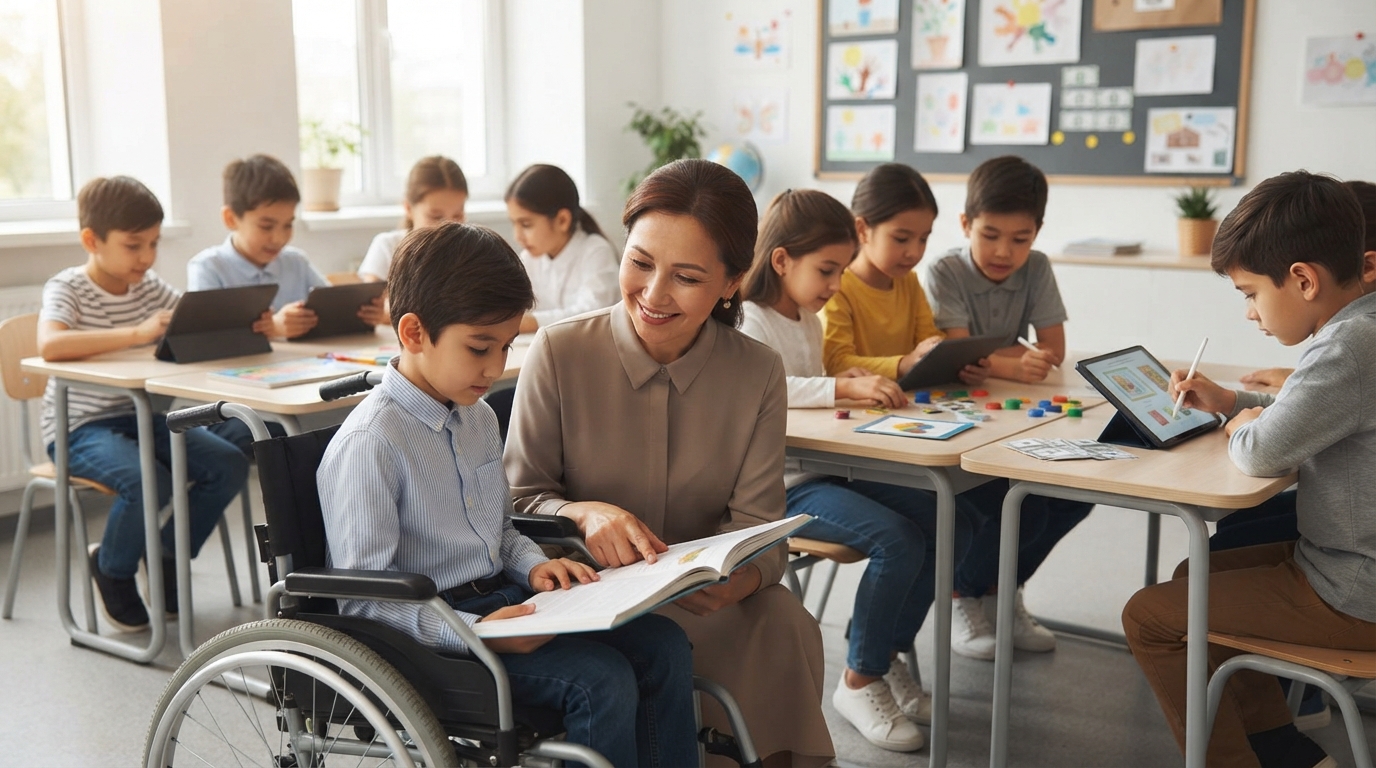
This simple story sparked a desire in me to get to know the teacher better. Sometimes, such unexpected encounters lead to discovering a person's soul, a true hero. My interlocutor, Jumagul Yoqubova, is actually a primary school teacher at General Secondary School No. 5 in the Quva district of the Fergana region. So, is raising forty children who have just entered the 2nd grade, along with three other children with special needs, just an ordinary teaching job, or is it a great responsibility that lays the foundation for the child's entire future education and character? Our conversation was precisely on this topic.
— Tell me, is it difficult to be a primary school teacher?
— Not everyone can be a primary school teacher. Because this profession is not limited to just teaching a child to recognize letters, read, and write. You could say that a primary school teacher is a guiding lighthouse that shows the first path to a child's heart, worldview, and future.
Whenever I look at each of my students, I try to imagine their future. Because the little child sitting at the desk in front of me today will tomorrow be a person who finds their place in various fields of society. Their first knowledge, attitude towards school, and interest in learning are formed precisely in the primary grades.
Therefore, a teacher must deeply feel the responsibility on their shoulders. The stronger the foundation laid in primary school, the more reliable the child's subsequent stages of education will be. For me, along with the student's success in class, their formation as a person is also very important. There is a whole world in the heart of every child. And the teacher's task is to be able to see this world.
— How do you help a child adapt to the environment on their first day at school?
— For me, first and foremost, the child's eyes are important. In the eyes of children stepping into school for the first time, you can see various questions. One child's eyes burn with curiosity and excitement. In another, fear or shyness of an unfamiliar environment is felt, and in yet another, self-doubt.
Therefore, even during my first meeting with my new students, I pay attention to their gaze, their behavior, and their relationship with those around them. Because you cannot find the way to every child's heart with the same key. You need to talk more with some, while others will feel free after a little time. Some children need more encouragement, while others need firmness.
A good teacher must be able to read not only the writing in a child's notebook but also the question in their eyes. Then the child feels close, and the learning process happens naturally.
— Today's children are different from previous generations. Teachers have to compete with phones, cartoons, and the internet. How do you keep a student's attention?
— Today's children have very wide access to the world of information. They see, hear, and absorb things much faster than we did in our childhood. At the same time, their attention is also easily distracted. Sitting in one place for a long time and just listening is difficult for them.
Therefore, the teacher must also change with the times. During the lesson, I use various methods, didactic games, group tasks, and small competitions. Sometimes, to grab a child's attention, I bring their favorite cartoon characters or modern technologies into the lesson.
We should not view the phone only as an "enemy" but teach how to use it correctly. If a child is interested in technology, the teacher can direct this interest towards education.
Of course, you cannot educate through games alone. Sometimes firmness and discipline are also needed. But this firmness should not serve to break the child's spirit, but to teach them order, responsibility, and striving towards a goal.
— Does a grade encourage a child or extinguish their self-confidence? Who is a "good student" for you?
— A grade is a tool that shows a child's effort, but it is not the sole purpose of education. In primary school, it is very important first of all to interest the child in learning, to build the confidence that "I can do it too." For this reason, I try to support students through encouragement and small gifts.
For example, we have organized a small "bank" system with the students in class. If a child answers well, memorizes a poem, or is active in class, they accumulate token "money." After a certain period, they can choose a gift in exchange for their accumulated "funds." This method helps children understand the connection between effort and results.
But for me, a "good student" is not just a child who gets excellent grades in all subjects. A child who asks questions, is curious, thinks independently, is not afraid of making mistakes, and can express their opinion is also a good student. Over time, the striving should serve not for grades, but for acquiring knowledge and demonstrating one's potential.
— Up to what point is parental involvement in their child's education helpful, and where does it start to interfere with the teacher's work?
— Parents should not stay completely away from school. Because few people have more information about a child's mood, interests, and home environment than their parents. The teacher, on the other hand, knows well the child's activities at school and their relationships with peers. Therefore, the stronger the cooperation between parent and teacher, the better it is for the child's development. But this cooperation must have boundaries. Parents should not do assignments instead of the child, nor should they try to hide every mistake or artificially raise their grades. Otherwise, the child stops feeling responsible.
I always tell parents: doing your child's homework is not help. Sometimes, giving them the opportunity to make mistakes, think, and achieve results through their own efforts is the greatest help.
— There are many sources of information for children. But an abundance of information does not yet mean knowledge. What should be taught more to a child in primary school: knowing many things or thinking correctly?
— In this day and age, finding information is not a problem; thousands of answers come up on the internet in a few seconds. Therefore, the task of a modern school is to raise not just a child who "knows many things," but a person who can understand, analyze, and correctly use the information they find.
In primary school, a solid foundation in literacy, mathematics, and natural sciences is provided. But along with knowledge, skills such as independent thinking, asking questions, working in a team, and justifying one's opinion must be formed.
In my lessons, rather than giving children ready-made answers, I ask questions like: "What do you think?", "Why do you think so?", "What other solution could there be?" more often. A child may forget the information received from the teacher, but if the habit of independent thinking is formed in them, they will be able to search for and find the necessary knowledge themselves tomorrow.
— Artificial intelligence has also entered children's lives. Should we fear this, or can we teach them to use it correctly?
— Artificial intelligence can be turned into a useful tool for education, but the greatest responsibility in this lies with the teacher. Rather than banning a child from using it, it is important to teach them how to use it correctly.
It is necessary to explain to students that artificial intelligence is not a tool that "thinks instead of them," but an assistant that helps in research. For example, they can ask it to explain a topic more simply, find examples, or check their work. But copying ready-made answers harms independent thinking. Most importantly, the child must also know how to verify the information provided by artificial intelligence.
— It turns out there are also students with physical disabilities in your class. How do children accept each other in an inclusive educational environment?
— Sometimes, the family environment is felt through a child's behavior and attitude towards peers. But one should not make hasty conclusions; first of all, one must try to understand the child.
As for the students with physical disabilities in my class, I never separate them from others. First and foremost, a child should not be given the feeling that "you are different." We create the necessary conditions for them and adapt tasks to their capabilities.
This is also the essence of inclusive education: every child must feel like a full member of this class. As a result of this, healthy children also receive a very big lesson in humanity: they learn patience, kindness, empathy, and valuing others. In a classroom where kindness and mutual help exist, a child not only receives knowledge but also forms into a true human being...
As I said goodbye to my interlocutor, a thought crossed my mind: sometimes we think of education as consisting of complex programs, modern technologies, and grading systems. Whereas, in reality, everything is very simple: it all begins with the love of an ordinary teacher who can read the question in a child's eyes, and who can show the right path without blaming them for their mistake.