

Archaeologists have found new evidence of Bronze Age human life in Uzbekistan
Archaeologists discover new evidence of Bronze Age human life in Uzbekistan
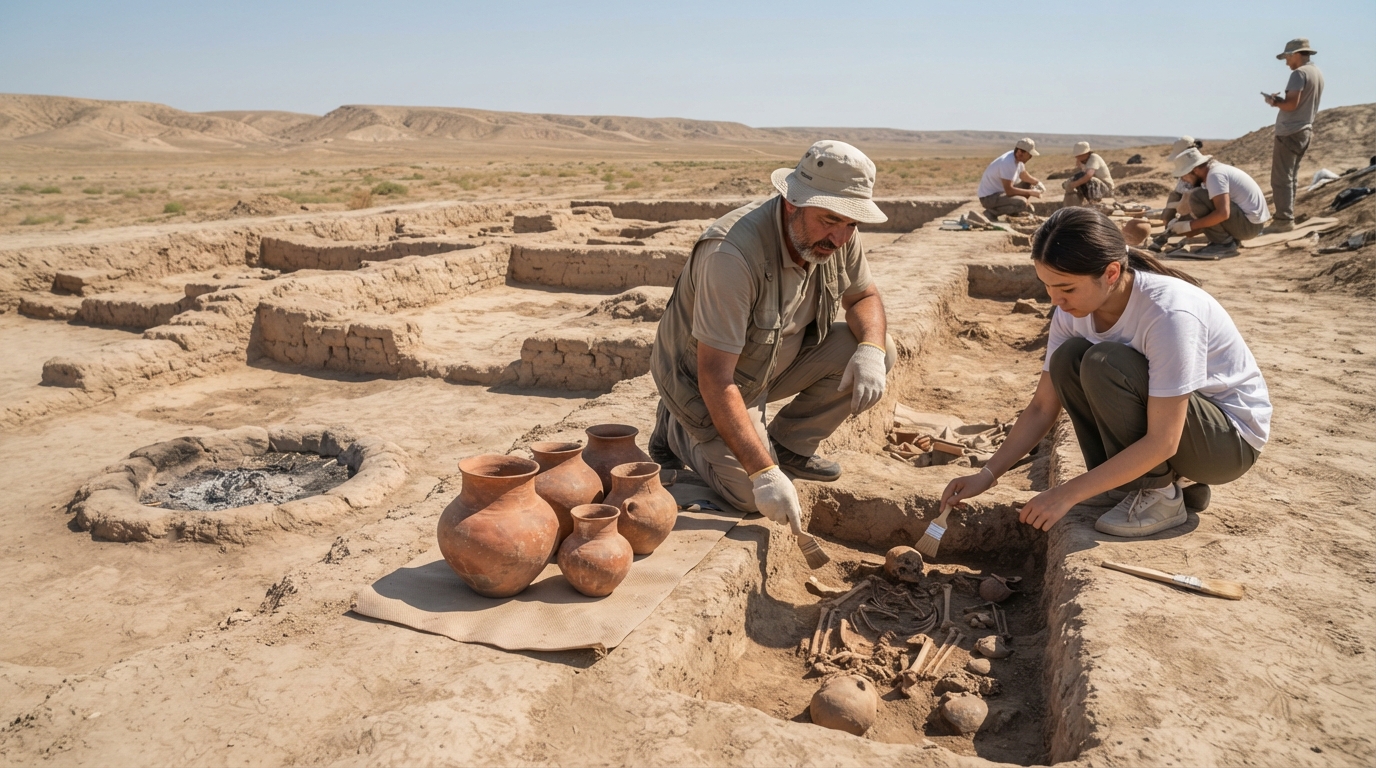
At the Jarkutan site in the Surkhandarya Region, archaeologists have found ancient structures, four intact ceramic vessels, storage pits, and a child burial. These finds will help to better understand how people lived, built homes, and buried the dead several thousand years ago.
In the Sherabad District of the Surkhandarya Region, excavations continue at one of Uzbekistan's most important archaeological sites — Jarkutan. Research began in October 2026 under the leadership of Komil Rakhimov, Candidate of Historical Sciences and Senior Researcher at the Yahya Gulyamov Samarkand Institute of Archaeology.
Students from Termez State University and Francesca Congedo, a PhD student from the Italian University of Salento, are taking part in the expedition.
During the excavations, researchers uncovered the remains of ancient dwellings and utility structures, as well as fragments of ceramic tableware.
Of particular interest are the mud-brick buildings and a hearth with a diameter of about 70 centimeters. These finds will help establish how houses were constructed in the Bronze Age, how the interior space of dwellings was organized, and what individual rooms were intended for.
In the western part of the settlement, archaeologists discovered four intact ceramic vessels. Outside the main area of the site, they found a child burial, a storage pit belonging to the Bronze Age Sapalli culture, and two circular pits filled with ash.
The archaeological finds will allow for a more detailed study of the daily life, economy, and burial traditions of the inhabitants of ancient Jarkutan.
Specialists intend to compare the found objects and structures with other archaeological materials. This will help determine the purpose of different parts of the settlement and trace how they changed over time.
Jarkutan is considered one of the key sites for studying the history of Uzbekistan and the Bronze Age Sapalli culture.
Earlier, the skull of a child aged about 4,000 years with traces of trepanation — a surgical procedure in which a hole was made in the skull — was also discovered here. According to researchers, this find became one of the earliest pieces of evidence of such operations in Central Asia and Asia as a whole.