

Andijan Airport is being "born again." What will the large-scale reconstruction bring?
Andijan Airport's new terminal is scheduled to be completed by the end of the year and open in the spring. It will be eight times larger than the existing one (expandability is included), and its capacity will increase fivefold. Since opening last year, the airport has been showing growth. Gazeta reports.
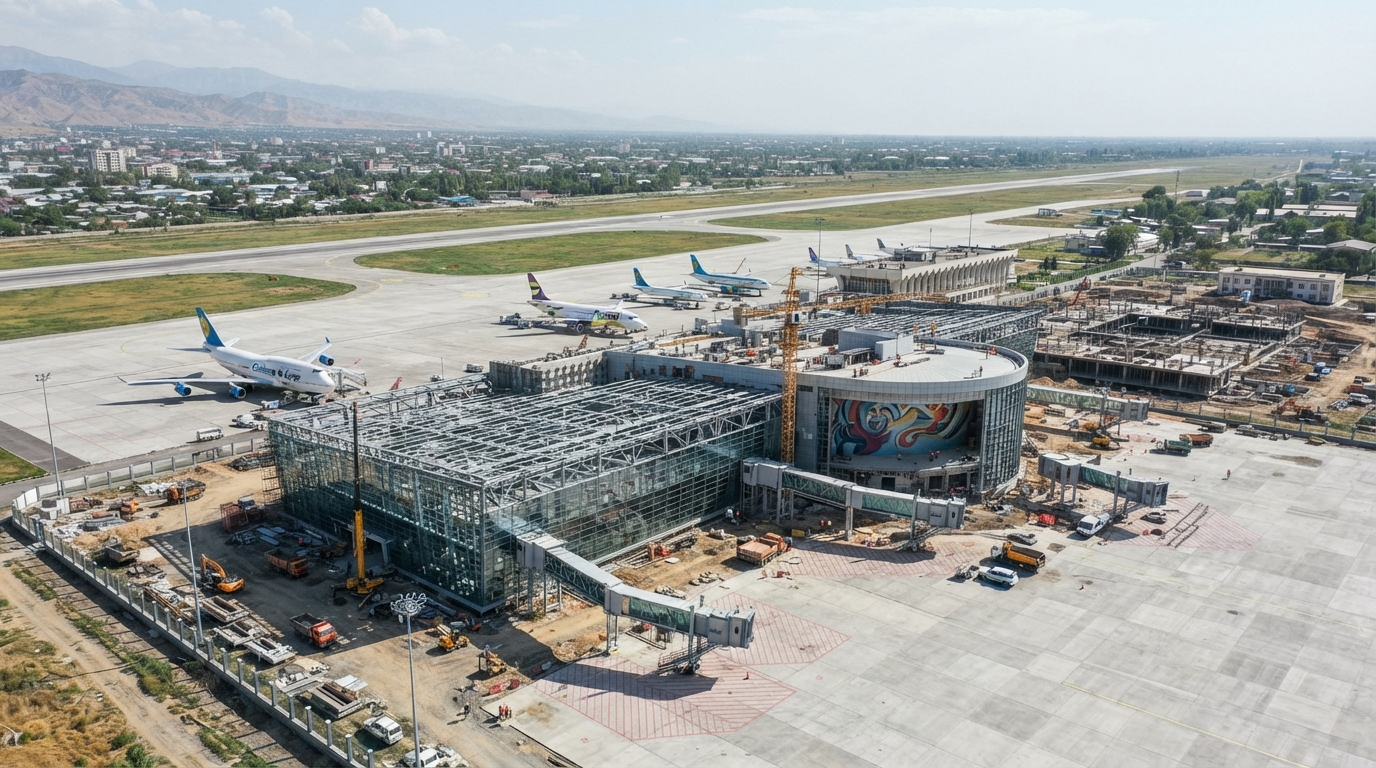
Andijan International Airport is undergoing a large-scale renovation, which, according to Director Sokhibjon Kenjaev, is effectively reviving the airport. The project was presented to journalists on August 17.
Following a two-year renovation of the airport complex, completed last year, construction is currently underway on a new passenger terminal. It is being designed with future expansion in mind. It was previously reported that Andijan Airport is intended to become a key alternate airfield for the Fergana Valley, preventing aircraft from being diverted to Tashkent in the event of inclement weather.
Unlike projects in Samarkand, Urgench, Bukhara, and Namangan, the renovation of Andijan Airport is being carried out independently by Uzbekistan Airports, without the involvement of private investors, through a public-private partnership (PPP) scheme.
A key feature of the project is the preservation of the 50-year-old old terminal building, adorned with a large mural in the waiting room and sunshades in the form of airplanes on the façade. Although it will ultimately be demolished, the mural is planned to be preserved.
Prime Tower Group, which previously worked on the Samarkand airport, is designing the terminal. The general contractor is local construction company Marin Business Trade, known for building a congress hall in Namangan and shopping centers.
The contract for construction and installation work was signed on February 5 following a tender involving approximately six large companies. The preliminary cost of the project is estimated at 335 billion soums, but the final figure may change as design and construction are ongoing.
Sokhibjon Kenjaev explained that abandoning the PPP scheme will allow the company to retain revenues, which will be used to modernize other regional airports. This decision is also intended to demonstrate the company's ability to independently build airports.
The Andijan region, one of the most densely populated regions of Uzbekistan with a population of over 3.5 million, is located in the eastern Fergana Valley and borders Kyrgyzstan, creating favorable conditions for the development of air travel and international transport links.
The capacity of the old airport complex, opened in 1979, limited the growth of traffic volumes. Its area was 2,402 square meters, and its capacity was 200 passengers per hour. In 1995-1996, additional departure and arrival halls were added.
An administrative building is planned to be erected on the site of the old terminal, said Sokhibjon Kenjaev.
The fate of the mural from the old building has not yet been decided. The possibility of creating a museum space for it in the new terminal is being considered. Although the mural does not have cultural heritage status, airport management is working with the Cultural Heritage Agency to have it included in the national register.
The new terminal will cover 19,650 square meters, approximately eight times the area of the existing building. It will be able to handle 1,000 passengers per hour, five times the current capacity.
The first floor of the new terminal will house 14 check-in counters and two self-service check-in and baggage drop-off counters, similar to those at Tashkent Airport. It will also house a domestic departures hall, a CIP lounge, and an international arrivals hall.
Two escalators and two elevators will lead to the second floor, where the international departures hall will be located.
The terminal's layout is designed to ensure passengers can navigate easily and avoid feeling confined.
First Deputy Director of the airport, Kobiljon Abdunazarov, noted that unlike many "closed, labyrinthine" airports, where "you are literally crushed by the walls after each check," all areas of the new terminal will be open, with glass windows allowing passengers to see outside even during security.
The waiting rooms will feature coworking areas with free Wi-Fi, and seats will be equipped with power outlets and USB ports.
The terminal's exterior and interior design will include references to Zakhiriddin Muhammad Babur, a native of Andijan and the founder of the Baburid dynasty.
The project also includes the construction of a new flight control building for the Uzaeronavigatsia Center, and the upgrade of navigation systems. A cargo terminal and a fueling complex are currently in the design stage. According to Abdunazarov, the airport will no longer have any of its old infrastructure after the project's completion.
As of August 14, construction and installation work on the new terminal had reached approximately 40%. The foundation has been fully concreted, groundwater drainage system installed, and metal structures (13,104 square meters) and fire-resistant roofing (10,483 square meters) have been installed.
The first-floor floor, including the reinforcement frame, is 90% concreted. Interfloor beams, bracing metal structures, and façade guides are currently being installed. The next stage of work will be the façade glazing, for which materials have already been ordered from China.
Completion of the terminal is scheduled for the end of 2026, with commissioning scheduled for the first quarter of 2027. This timeframe depends, among other things, on the delivery of equipment purchased abroad.
The modular metal structure allows for future expansion of the terminal.
A new 300-room hotel is being built next to the airport. The terminal is also being considered for the possibility of accommodating a 30-40-bed capsule hotel for passengers with long layovers.
As with all modern airports, the entrance to the terminal will not be fenced and will be accessible by car, taxi, and bus.
It was previously reported that the runway length had increased from 2,985 to 3,300 meters, and its width from 45 to 60 meters. The pavement was completely replaced with concrete with an estimated service life of 30 years. The number of aircraft parking bays on the apron was increased from six to ten.
To increase the airfield's capacity, two new taxiways were built, one of which is a high-speed taxiway. The standard taxiway is already in use, and the high-speed taxiway is scheduled to open soon.
The reconstructed runway first received an aircraft on March 15, 2025—an Uzbekistan Airways maintenance flight from Tashkent. Regular flights soon commenced: initially domestic, and then international flights began in October of last year.
This year, Category II LED lighting was installed at the airfield. It allows aircraft to land with visibility of 300 meters, which is especially important for the Fergana Valley, where visibility can drop to 500-700 meters in winter due to fog. Previously, poor visibility led to flight delays and aircraft being diverted to alternate airfields, including Tashkent. Namangan and Fergana airports currently have Category I equipment.
Perimeter security and power supply systems are also being modernized. As of mid-August, installation of lighting equipment and perimeter fencing was 95% complete, and vertical planning of the area was 90%.
The results of the airfield infrastructure modernization are already visible in passenger traffic. In less than 2025, the airport served more than 94,000 passengers, and in the first seven months of 2026, this figure has already reached approximately 127,000. Based on the results of the first half of the year, Andijan demonstrated the highest passenger traffic growth among regional airports.
By the end of the year, the airport expects to handle over 200,000 passengers, and once the new terminal is fully operational, it will reach 1.1 million passengers per year.
Currently, Andijan serves international flights to Jeddah, Medina, Novosibirsk, Vnukovo, and Istanbul—a total of 8-9 flights per week. Uzbekistan Airways and Silk Avia operate daily morning and evening flights to Tashkent, which are fully booked. Following the launch of the new terminal, the number of flights is planned to increase to 60 per week.
Infrastructure upgrades have enabled the airport to handle larger aircraft, including the Airbus A330 and Boeing 767/787. On July 3, the airport welcomed its first A330 aircraft on a scheduled flight from Medina operated by Flyadeal.
To attract foreign airlines, it is necessary to meet their infrastructure and aircraft maintenance requirements. With this in mind, the new terminal is being built with three jet bridges—a first in the Fergana Valley.
"The faster the airport handles a flight, the cheaper it is for the airline. Aircraft downtime means direct losses," explained Kobiljon Abdunazarov.
A significant portion of demand comes from residents of neighboring Kyrgyzstan. "Just yesterday, we sent a flight to Jeddah, an A330, with 363 passengers—almost 70% of whom were Kyrgyz citizens. The flow from the neighboring country is growing as the border opens and airport services expand," explained Sokhibjon Kenjaev.
The airport is also beginning to develop its cargo service. On August 4, the airport received its first Boeing 747-400 cargo aircraft from Challenge Air Cargo. Previously, these wide-body aircraft only landed in the valley in Namangan for refueling, without cargo.
The Boeing 747 arrived in Andijan carrying a consignment of cattle from Belgium. The initiative was initiated by an entrepreneur who had previously transported animals through the cargo hub in Navoi and then delivered them by road. This scheme increased costs by approximately 2.5 million soums per head of cattle. He now plans to deliver 1,000 head of cattle from Belgium, with six more flights scheduled before the end of the year.
Construction of the cargo terminal is scheduled to begin after the completion of the passenger terminal.