

An MIT study assessed Uzbekistan and Central Asia's readiness for AI development
A study by the MIT Kuo Sharper Center showed the progress of the region's countries in the development of artificial intelligence, but revealed a shortage of computing power and talent.
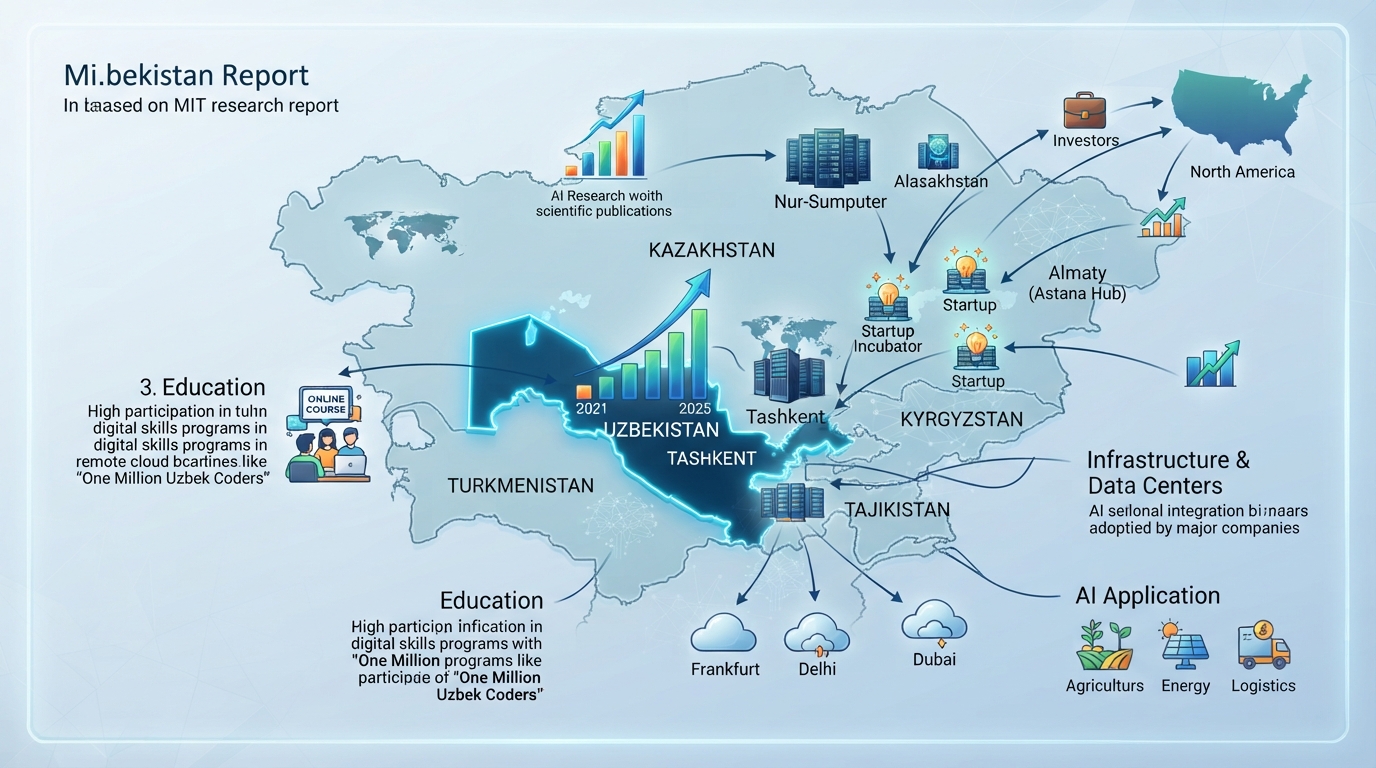
MIT Study Assesses Uzbekistan’s and Central Asia’s Readiness for AI Development
The results of a study examining the readiness of Central Asian and Caucasian countries for artificial intelligence development were presented at Columbia University in New York.
The report covers Uzbekistan, Kazakhstan, Kyrgyzstan, Tajikistan, and Azerbaijan, marking the region's first comprehensive assessment conducted under a unified methodology.
The study, titled *The Next AI Frontier: Central Asia and the Caucasus in the Global Technology Shift*, was prepared by the MIT Kuo Sharper Center. Shamil Ibragimov, Research Director of the center, presented the report during a panel discussion of the same name.
Work on the study began in April 2026. The initial findings were announced on September 22 at ICT Week Uzbekistan 2026 in Tashkent.
The authors emphasize the region's noticeable progress in the AI sector over the past three years. However, technological ambitions currently outpace infrastructure capabilities. The main constraints cited include a shortage of computing power and the need for reliable energy supplies.
According to the study, all five countries have established artificial intelligence regulations at the legislative level, and responsibility for this sector rests at least at the ministerial level in every state. In Uzbekistan, AI-related norms are embedded into existing legislation.
At the same time, the region still relies on foreign cloud platforms with data centers located in Frankfurt, Delhi, and Dubai. While three years ago the region lacked GPU-based computing power, it now houses three supercomputers included in the global TOP500 ranking.
According to Ibragimov's assessment, decisions regarding access to advanced chips and the provision of energy infrastructure to be made over the next one to two years could determine the region's technological development for the next decade.
Between 2021 and 2025, countries in the region published 4,278 scientific papers on artificial intelligence. The annual publication volume grew more than fivefold over this period.
The quality of scientific research is also rising: 42% of articles are published in first-quartile journals, and the region's field-weighted citation impact stands at 1.5, compared to the global average of 1.0.
However, mass education remains largely limited to short distance-learning courses. According to the study's authors, the next step must be in-depth training for specialists capable not only of using existing AI tools, but also of creating new models.
The study covered 650 startups and 103 companies with more than 100 employees.
About 80% of surveyed startups classify themselves as AI companies. Among enterprises founded in 2023 or later, this figure reaches 81%.
At the same time, 84% of startups experience a shortage of GPUs, and 71% use foreign cloud platforms.
Among large companies, 68% are still exploring AI application possibilities or running pilot projects. Only 3% have made artificial intelligence the core of their operations, while nearly half lack a clear implementation strategy.
Ibragimov called the gap between startup activity and demand from large enterprises one of the main opportunities for the region's development.
He also urged stronger regional integration. According to his estimate, individual national markets are relatively small, whereas a unified regional space can attract more investment. Listed among the advantages of Central Asia and the Caucasus were renewable energy potential, a geographic location at the heart of Eurasia, and relative stability.
A separate section of the study is dedicated to Uzbekistan's indicators. The number of the country's scientific publications on artificial intelligence grew from 26 in 2021 to 861 in 2025 — a more than 27-fold increase. In this metric, Uzbekistan surpassed Kazakhstan, which published 579 papers in 2025. The two countries account for 82% of the region's peer-reviewed scientific articles indexed in Scopus.
In July 2026, the Digital Government National Supercomputer, managed by the Ministry of Digital Technologies, launched operations in Tashkent. It entered the TOP500 ranking. During its first month, system utilization reached approximately 90%, and its computing capacity is planned to triple by 2027.
Uzbekistan also holds a significant share of regional online education. Of the 4.7 million Coursera learners in the five countries, 3.4 million are from Uzbekistan. Among key initiatives for digital skills development, the study's authors highlighted the One Million Uzbek Coders program.
In the private sector, 79% of surveyed Uzbek startups classify themselves as AI companies.
In the country's energy sector, electricity transmission and distribution losses stand at 5% — the lowest figure among the states analyzed. Furthermore, DataVolt and LinkWise data center projects have been announced in Uzbekistan.
The study names IT Park Uzbekistan as one of the key instruments for attracting technology companies to the region, alongside Kazakhstan's Astana Hub and Kyrgyzstan's High Technology Park.
Residents of such hubs receive tax incentives. Uzbekistan is also developing a special legal zone, Enterprise Uzbekistan, geared toward foreign investors and tech companies.
According to IT Park data, 607 new export-oriented residents joined its ecosystem in the first half of 2026 — 177% more than in the same period a year earlier. The number of new residents with foreign capital reached 297, an increase of 154%. In total, the ecosystem counts over 1,200 companies with foreign capital.
Ecosystem companies are represented in 75 countries. The largest number of new foreign residents came from the United States.
In total, 1,200 IT Park residents export services and digital products to 102 countries. For comparison, there were eight such companies in 2017. Of the current number of exporters, 315 operate in the regions of Uzbekistan.
North America remains the largest export market, accounting for 54% of exports.
The presentation of the study in New York was part of IT Park Uzbekistan's efforts to promote the country's technological potential among American investors and partners.
According to the organization, over this time it has supported more than 600 innovators, including over 400 fellows from 67 countries. Companies founded by its fellows serve more than 17 million customers.