

An international event dedicated to the European Day of Languages was held at UzSWLU
On September 30, 2026, an international event dedicated to the European Day of Languages took place at the Uzbekistan State University of World Languages, with the participation of the Delegation of the European Union to Uzbekistan and the British Council. The meeting brought together representatives of diplomatic missions of European countries, international organizations, and cultural centers, as well as university lecturers and students. Speaking at the opening ceremony was the Rector of the Uzbekistan State University of World Languages […]
An international event dedicated to the European Day of Languages was held at UzSWLU
On September 30, 2026, an international event dedicated to the European Day of Languages took place at the Uzbekistan State University of World Languages, with the participation of the Delegation of the European Union to Uzbekistan and the British Council.
The meeting brought together representatives of diplomatic missions of European countries, international organizations, and cultural centers, as well as university professors and students.
The opening ceremony featured speeches by Ilkhomjon Tukhtasinov, Rector of the Uzbekistan State University of World Languages, and Toivo Klaar, Head of the Delegation of the European Union to Uzbekistan, Ambassador. Participants were shown a video presentation about the university, its educational programs, and international relations. Following the opening, a group photo of the guests and participants was taken.
The program then continued with thematic presentations dedicated to the languages and culture of the European Union countries. Representatives of diplomatic missions, international organizations, and cultural centers spoke about the characteristics of the languages, everyday expressions, national traditions, and educational opportunities.
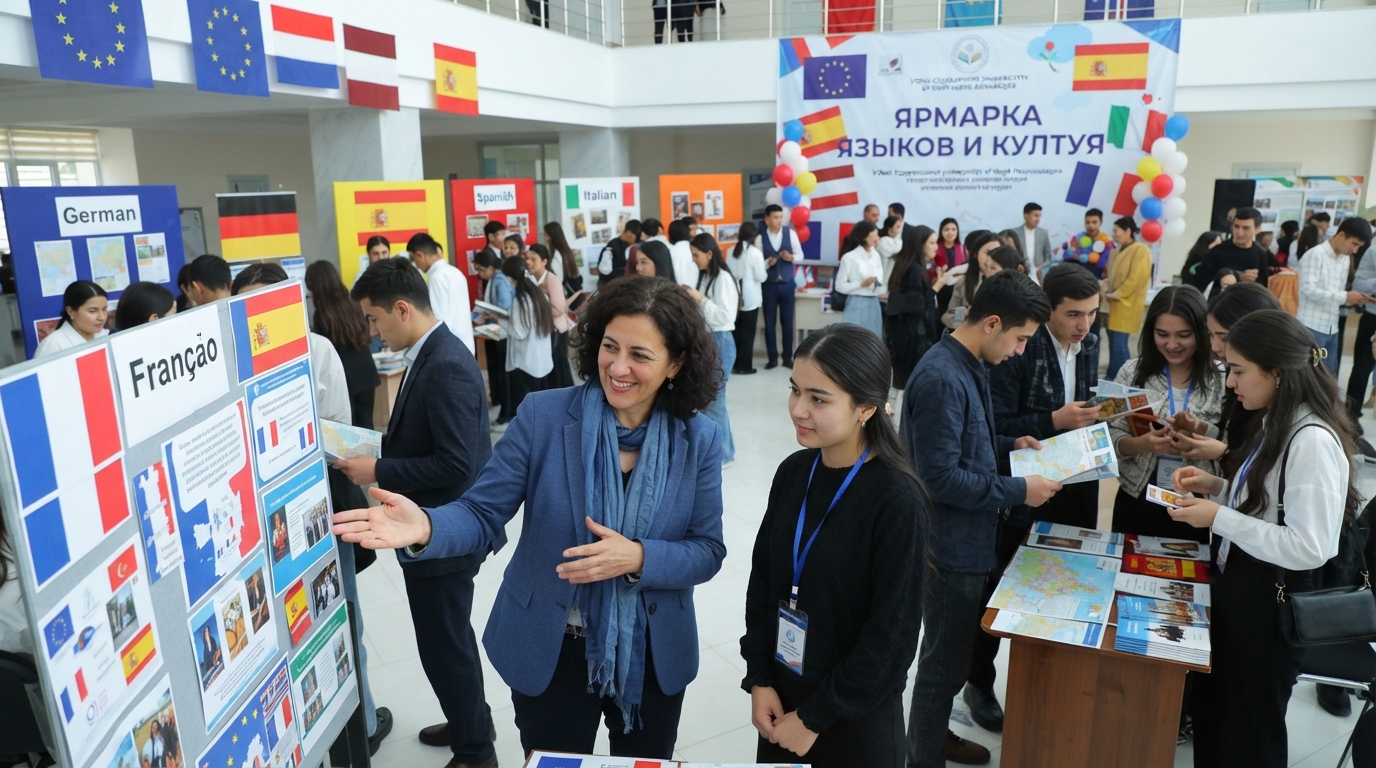
A "Languages and Cultures Fair" exhibition was held in the university lobby. The stands featured informational and exhibition materials about European countries, including information on culture and educational institutions.
Marisa, a teacher at the Alliance Française who has been teaching French for four years, shared her impressions.
According to Marisa, interest in the French language in Uzbekistan remains high. It is studied by both students and adults, many of whom successfully pass international exams.
"I am very happy to work at the Alliance Française because the demand is indeed high. There are many students in Uzbekistan studying French, as well as people who have successfully passed their exams. We are proud of this," the teacher said.
Marisa herself is fluent in several languages — French, English, Russian, and Uzbek. She emphasized that language proficiency significantly helps in daily life and communication.
For her, participating in the event was her first visit to the university and an opportunity to meet students and colleagues.
Speaking about effective foreign language learning, Marisa named three main conditions: a clear goal, realistic deadlines, and regularity.
"First of all, you need to have a goal — for study, emigration, work, or career growth. Then, it is important to set realistic deadlines. And, of course, regularity is necessary. I would call these the three main steps on the path to learning the French language," the teacher explained.
Hamrakulova Zarnigor, a first-year student at the Uzbekistan State University of World Languages, also shared her impressions.
She noted that participating in the event helped her gain a deeper understanding of the importance of language as a part of culture and a means of bringing people together.
"Today, representatives of many countries have gathered here. I was inspired by the idea that language is not just a way of communication, but also a means that unites people, connects them with the past, and reflects culture. I was very glad to see our guests and take part in this event," the student said.
The event contributed to the development of the university's international relations, the support of multilingualism, and intercultural dialogue. Students had the opportunity to interact with representatives of European countries, learn more about their languages and cultures, and get acquainted with educational opportunities and international initiatives.