

An equal among equals
Uzbekistan has every right to develop relations with the US, as well as with other countries, guided by its own understanding of national benefit
**Equal Among Equals**
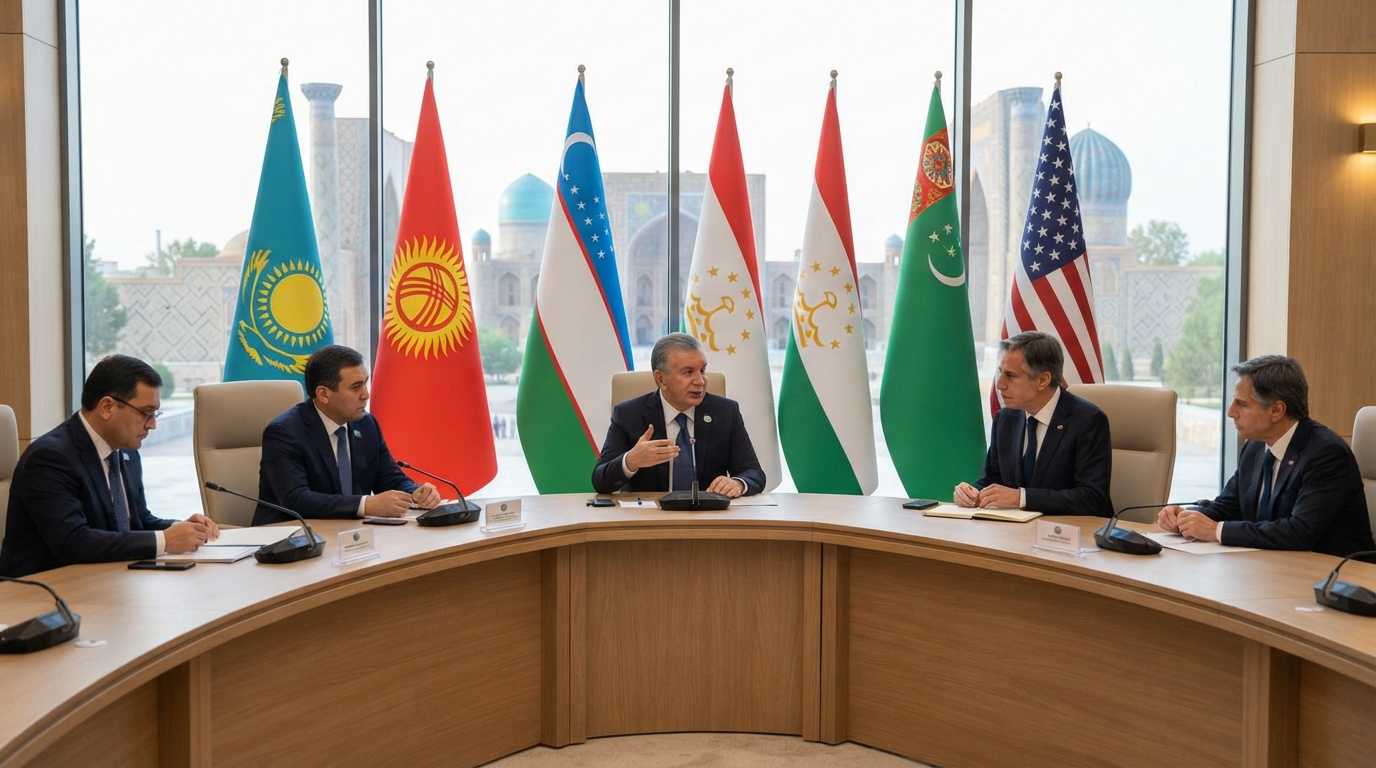
The meeting of representatives of five Central Asian states and the United States, which took place on October 19 in Samarkand in the C5+1 format, deserves attention not only as another diplomatic event, but also as a sign of a gradual change in the role of our region in the international economy and politics.
What matters more here is not so much the number of signed documents and made statements, but rather the direction they indicate. Central Asia, which until recently was perceived by many outside the region primarily through the prism of relations with Russia and China, is ever more confidently asserting itself as an independent participant in international processes capable of building ties with various centers of power based on its own interests.
For Uzbekistan, which hosted the meeting participants in Samarkand, this is particularly important. The country is not merely providing a platform for negotiations, but is consistently expanding the space of its foreign policy and economic opportunities, demonstrating its readiness to engage in dialogue with the world's major powers without needing to explain to anyone why it requires new partners. This, perhaps, is the main political meaning of what is happening: Tashkent seeks not to choose between existing areas of cooperation, but to create additional ones, strengthening its own positions while simultaneously expanding the opportunities of neighboring states.
Once, Islam Karimov formulated an idea that has not lost its relevance today: one must unite with the strong in order to become stronger oneself. This phrase contains the quite pragmatic logic of state policy. A strong partner is needed not to use their authority or demonstrate proximity to them at international events, but to gain access to technology, capital, knowledge, markets, and management experience that allow for the development of one's own economy. At the same time, proximity to a strong state has never guaranteed prosperity in itself. The outcome depends on how skillfully a country converts external opportunities into internal achievements.
The Samarkand meeting offers Uzbekistan and other Central Asian states precisely such a chance. However, it should be viewed without excessive euphoria, since diplomatic agreements turn into economic results only when they are transformed into concrete projects, investments, production capacities, jobs, and competitive products. A political declaration opens the door, but the participants in the cooperation must walk through it themselves.
The joint statement adopted on October 19 by the foreign ministers of the five Central Asian states and US Secretary of State Marco Rubio covers a wide range of areas: transport and trade, investments, energy, the extraction and processing of minerals, digital technologies, regional security, cybersecurity, education, and the preservation of cultural heritage. This is not a single major project capable of altering the region's economy in a few years, but a system of potential links, the development of which through consistent work can yield long-term results.
It is revealing that the economic agenda is not reduced to traditional trade in raw materials. The parties speak of forming high-value-added production chains, expanding regional industrial cooperation, improving customs procedures, and developing e-commerce. In other words, this concerns the opportunity to gradually transition from a model in which a country sells predominantly natural resources or low-processed products to a model that allows earning from technology, manufacturing, and more complex services.
For Uzbekistan, this is a matter of practical necessity. A growing population, the need for new jobs, the modernization of industry, the development of agriculture and infrastructure require a constant increase in labor productivity. It is impossible to indefinitely compensate for insufficient economic efficiency by constructing new facilities, expanding state spending, or securing further loans. Sustainable growth implies that enterprises produce more output at lower costs, workers acquire modern professional skills, and business has access to markets, financing, and technology.
Let us be honest, American involvement could prove useful in each of these directions. The United States possesses significant capabilities in the digital economy, industrial automation, financial services, engineering, agricultural technology, energy, and the development of complex equipment. For Uzbekistan, it is of fundamental importance not just to import ready-made solutions, but also to create conditions for the localization of production, training of specialists, transfer of competencies, and the emergence of its own technological companies. Ideally, foreign investment should leave behind in the country not only equipment, but also knowledge, professional personnel, production links, and the capacity to independently develop mastered technologies.
Analysts note that the area related to digital technologies deserves special attention. The development of e-commerce, reliable digital systems, cybersecurity, and innovative entrepreneurship is capable of changing the position not only of large enterprises, but also of small businesses. For an entrepreneur from a regional center or a small town, access to digital infrastructure and international markets may prove no less important than the construction of a large industrial facility. But this requires trained personnel, quality education, reliable communications, clear rules of operation, and real protection of property rights. Technological progress becomes possible where knowledge and investment unite with a favorable business environment.
No less promising is cooperation in education and healthcare. Joint programs for training engineers, specialists in information technology, energy, and industrial automation, faculty exchanges, the development of vocational education and scientific research can yield results that will turn out to be more significant than many one-off financial injections. A modern enterprise can be built in a few years, but training qualified specialists requires time and systematic work. If cooperation with American universities, companies, and research centers helps build such a system in Uzbekistan, its effects will be felt for decades.
A separate and perhaps sensitive topic for some is critical minerals and natural resources. Central Asia possesses reserves of raw materials essential for energy, electronics, engineering, and other high-tech industries. Amid shifting global production chains, interest in such resources is natural. However, it would be a mistake to view it solely as an opportunity to increase extraction and exports. According to experts, the main task is to develop, as far as possible, geological exploration, processing, the production of materials and components, build competencies, and secure a higher share of value added that remains within the region.
This is precisely where the boundary lies between short-term gain and strategic calculation. Raw material exports can quickly generate foreign exchange earnings, but by themselves do not create an advanced industry. If, however, cooperation provides for the construction of processing plants, the introduction of modern geological survey methods, the training of engineers, and the formation of supply chains, then natural wealth becomes the foundation for more complex economic development. Of course, this requires taking into account environmental consequences, contract transparency, the economic feasibility of projects, and the interests of future generations. The latter is particularly important.
For Uzbekistan, the energy sector is also of great significance. A growing economy requires a reliable power supply, network modernization, increased production efficiency, and the use of various energy sources. The joint agenda outlines the development of an energy partnership and interest in civil nuclear technologies. In bilateral talks in Samarkand, opportunities for cooperation in the space industry and expanded engagement on critical minerals were also discussed. The American side reaffirmed its interest in developing contacts with Uzbek partners in these areas.
A symbolic yet substantive step was Uzbekistan's accession to the Artemis Accords, which govern the principles of international cooperation in the peaceful exploration of space. On October 19, Foreign Minister Bakhtiyor Saidov signed the relevant document, making Uzbekistan the 77th country to join this initiative. Of course, the signing itself does not mean the immediate launch of a national space program or access to all advanced US technologies. However, it creates an additional institutional framework for participation in international projects and demonstrates the country's desire to expand its presence in new technological domains.
For a state interested in modernizing its economy, this is an important signal. The reason is simple: today, a nation's international standing is determined not only by territory, population size, natural resources, and military potential, but also by its ability to participate in creating technology, establishing standards, and building scientific connections. Even if the practical results of space cooperation emerge gradually, the direction itself merits attention as part of a long-term strategy.
There is another advantage to the Samarkand meeting that is not always noticeable behind the list of sectoral agreements. The C5+1 format involves the United States interacting with all five Central Asian states at once, while the joint statement links external partnership with the development of intraregional trade, improved transport connectivity, the alignment of customs procedures, and industrial cooperation. You must agree that such an approach serves the interests of all five countries. For Uzbekistan, situated at the center of regional transport and trade links, this opens additional prospects. The development of the Trans-Caspian Route, connecting Central Asia with the Caucasus and further with European markets, can broaden the choice of cargo delivery routes and reduce reliance on a limited number of transport corridors.
Accomplishing these tasks requires infrastructure investments, harmonized tariffs, predictable transit times, efficient operation of ports and border services, as well as the elimination of administrative barriers. In short, there is a great deal of work to be done.
Naturally, the interests of the five states do not coincide in everything, and their capabilities and priorities differ. Multi-party cooperation will therefore require aligning positions, a willingness to seek compromises, and the ability not to turn every disagreement into a political conflict. Yet the very opportunity to discuss shared tasks on an equal footing is important in its own right. Let us not treat as a revelation the obvious fact that Central Asia is gradually shaping a more independent agenda, in which relations with external partners are viewed not as an alternative to internal regional cooperation, but as a way to strengthen it.
Security remains an important component of the joint statement. The parties outlined cooperation in countering terrorism and transnational organized crime, strengthening borders, combating illicit drug and arms trafficking, human trafficking, and cybercrime. Issues of nuclear security, non-proliferation, and the peaceful use of atomic energy were also mentioned. At the same time, security partnerships must develop with due regard for national interests and the autonomy of the participants.
The Samarkand meeting is also interesting from the perspective of diplomatic balance. Uzbekistan maintains relations with Russia, China, European Union states, Türkiye, the Islamic world, and other partners. One would like to believe that deepening ties with the US does not automatically require weakening cooperation with anyone else. A foreign policy built on national interests assumes the capability to engage with different states in areas where it is beneficial, without turning a partnership with one into an obligation to follow its stance on all international matters.
Politics is not merely an exchange of visits and mutual assurances of respect. It represents practical work to align interests, distribute risks, and create conditions that will yield benefits today and in the distant future. A friendly atmosphere facilitates negotiations, but does not substitute for the economic component. States come to international platforms with their own goals, and the United States is no exception. Washington is interested in expanding its commercial presence, accessing resources, strengthening transport and technological ties, and developing relations with a region of strategic importance.
I am convinced that recognizing this does not mean suspecting the American side of any special ulterior motives. It means understanding the standard logic of international relations. The US has its own economic and geopolitical interests, Uzbekistan has its own, and a stable partnership arises only when the parties find mutual benefit. The more clearly national priorities are formulated, the higher the likelihood of obtaining concrete results from negotiations. And the more potential partners a country has, the broader its capabilities to secure acceptable terms.
In my view, the most significant outcome of Samarkand lies not in Uzbekistan drawing closer to America, but in its expanding the range of available opportunities. This is a serious claim for multi-vector and multilateral cooperation without pre-established political preferences. Such a policy demands consistency: one cannot change priorities at every new stage under the influence of external expectations, nor can one abandon promising directions simply because their development might cause dissatisfaction in another state.
And again, let us be honest: Uzbekistan has every right to develop relations with the US, as with other countries, guided by its own understanding of national benefit. Respect for sovereignty implies that partners recognize Uzbekistan's right to independently choose the directions of its economic and political engagement.
…Islam Karimov was right about the main point: uniting with the strong makes sense when it allows one to become stronger oneself. Today, this thought should be understood more broadly than simply seeking an influential patron or a major investor. What has been said holds true with one, but very important, reservation: a strong partner can help, but cannot replace one's own efforts.
The right to be equal among equals is not a reward for diplomatic courtesy, nor does it depend on how favorably external observers react to new steps. It is established by a state's ability to consistently protect its own interests, fulfill obligations, and offer partners that which represents real value to them.
This is what we should proceed from.