

An attack on Yandex data centers could slow down the development of AI in Russia by several years — media
Ukraine's attack on Yandex data centers could slow down the development of AI in Russia by several years. Following the attack, all three of the company's supercomputers ceased operation. Restoring them will take years due to a global shortage of advanced NVIDIA chips.
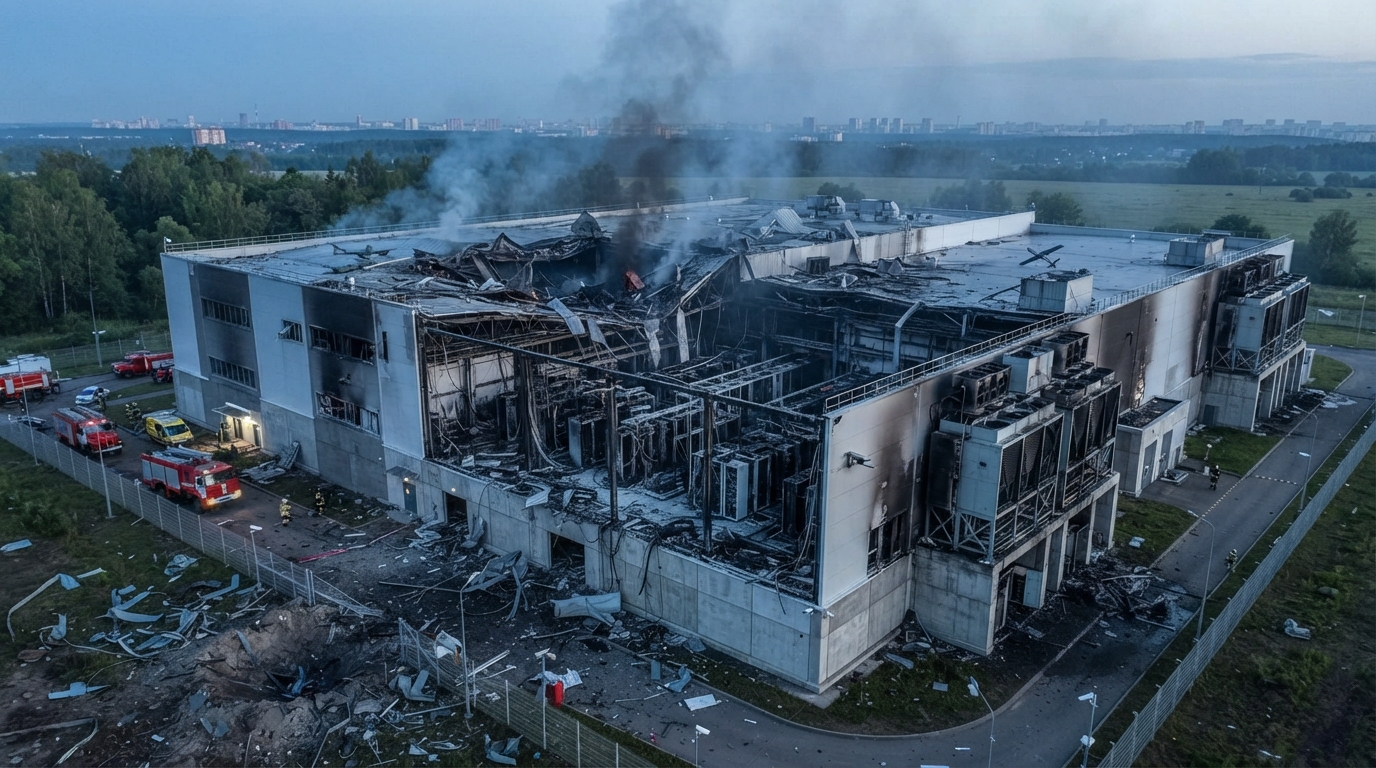
Attack on Yandex data centers could set AI development in Russia back by several years — media
On October 8−14, several large data centers in Russia belonging to Yandex and Sber were struck by drones. As a result, disruptions were observed in Yandex's cloud services. Prior to these attacks, the Russian armed forces had been targeting data processing centers in Ukraine, and the attack on Yandex data centers was a retaliatory strike by the Ukrainian armed forces, according to a number of publications.
According to experts' estimates, the country's data centers were built for peacetime conditions and a normal lifestyle, and such attacks were not taken into account when designing their protection systems. At the same time, building robust defense systems would have required massive capital expenditures. Specialists now predict that the capital expenditures not made in a timely manner will cost the company dearly.
In particular, the attacks on Yandex data centers affected the main areas in which Russia's number one IT company is developing — search services and artificial intelligence, the publication writes. According to computing systems experts interviewed by the publication, the AFU attacks could lead to large-scale consequences for Yandex, both from a business perspective and as a leader in Russian IT.
Following the drone attacks, all three supercomputers at Yandex's disposal were rendered inoperable for an indefinite period. The first attack occurred on the night of October 8 in the city of Sasovo, Ryazan region. Located there is "Chervonenkis", considered the most productive machine among Russia's publicly presented supercomputing systems, as well as "Lyapunov", which ranks third in performance.
The following night, the AFU attacked one of the largest data centers in Russia — Yandex's largest data center located in Kaluga. On the night of October 11, the data center in Vladimir housing the "Galushkin" supercomputer was struck. And on the night of October 14, a large data center belonging to Sber in Balakovo, Saratov region, was attacked.
Four experts interviewed by the T-invariant publication expressed confidence that the company's computing capacities suffered serious damage. In their view, the main reason for the vulnerability of the equipment as a result of the drone attack and subsequent fire is the direct free-cooling system, that is, cooling with outdoor air (flow fans force air through filters, which then passes through server racks). Even if the fire did not directly reach the supercomputer racks, soot, ash-filled air, and small burn residue could have penetrated the internal parts and damaged them.
In the summer of 2026, Yandex announced that it was starting to implement liquid cooling systems. According to experts interviewed by T-invariant, any element of liquid cooling is considered more effective in the event of a fire, but it is unlikely that the company managed to complete such re-equipment works across all its data centers.
One of the experts working for a global AI technology giant, as written by the publication, is skeptical of the technologies used by Yandex to cool supercomputers. "Respectable companies stopped using free cooling a long time ago," noted the T-invariant interviewee.
According to specialists, cleaning supercomputer components from smoke, soot, and burn residue could take up to half a year. If it becomes necessary to replace components, including expensive and, most importantly, scarce NVIDIA chips or their alternatives, restoring full operation of the computing devices could drag on for one to two years.
According to experts interviewed by T-invariant, the main problem that arose for Yandex after the AFU attack on data centers is the partial or complete loss of computing power. There are at least two reasons for this. It is true that the out-of-service data centers negatively affect Yandex's capitalization, but even more importantly, these problems could slow down the development of AI, to which the company's core business is directly tied, by months and years.
After the initial drone strikes on Yandex data centers on October 8 and 9, most investors maintained a moderately positive attitude toward the company: cloud technologies account for a small portion of revenue, and the load can be redistributed among other data centers. Stock values immediately dropped by several percent. The third attack and the likelihood of subsequent AFU drone attacks further reinforced negative financial forecasts.
Yandex does not separately disclose its AI-related figures in its financial reports, so conclusions about this can be drawn based on the "Search and AI" segment. This direction, according to T-invariant's observations, has the highest adjusted EBITDA margin among all disclosed Yandex segments. In the second quarter of 2026, this figure stood at 46.3 percent, and in the first half of the year, it was 44.8 percent. Additionally, the "Search and AI" segment generated the highest adjusted EBITDA in absolute terms.
At the same time, AI is already making a significant contribution to advertising revenue growth: according to the company's statement, almost half of this growth in the second quarter of 2026 was provided by the ARGUS recommendation technology. Although Yandex does not separately disclose the profitability of AI products, the report contains data showing how important AI is to the company's financial condition.
The main risk is undoubtedly associated with AI, the publication's interviewees believe. It is precisely the three supercomputers in two data centers that serve to develop the company's neural networks and other elements of the AI ecosystem. If computing power operations have to be temporarily suspended to clean equipment from fire and smoke consequences, the infrastructure generating nearly half of the advertising revenue growth will remain idle for months. And if the supercomputers are even partially damaged, development will be pushed back by years.
Experts explain this for two reasons. The first reason is sanction restrictions placed on the delivery of NVIDIA A100 accelerators to Russia. As a special operation to create a top-secret "MSU-270" supercomputer at Moscow State University showed, this is an extremely expensive and complex process. The second reason is the global shortage of advanced NVIDIA chips, with supply contracts already signed two to three years in advance. This is reported to have been confirmed by two independent sources of the T-invariant publication.
Thus, at a time when demand is growing rapidly, the development of YandexGPT and Alice AI has stopped indefinitely.
"Yandex built its centers and supercomputers in peacetime and for peacetime. The entire development was focused on normal human life; no one ever imagined that drones would come flying over the roof. Earthquakes and other natural disasters are not expected in Ryazan, Kaluga, and Vladimir regions, so no one even thought about investing in the physical protection of the buildings," explains one of the supercomputer industry experts to T-invariant.
The design logic of Yandex's infrastructure is as follows: energy efficiency, backup power supply, simplicity and low cost of the cooling system, and the ability to redistribute the load between sites.
According to a BBC Russian Service source, Yandex regularly practiced shutting down one data center and shifting the load to others. However, the sequential failure of several large sites was probably not considered in the exercises. The publication's source also notes that two separate buildings in Vladimir may have been viewed by services as mutual backups: it was considered impossible for both of them to fail at the same time.
"In Russia, simple 'boxes' are usually built for data processing centers and data centers: there are no strong walls, barriers, or similar protective equipment. Despite the presence of advanced, even local technologies, liquid cooling systems are practically never found, nor are complex fire extinguishing systems installed. For Russian business, all of this represents excessively large capital expenditures. No one could afford it. On top of that, there is an extremely high level of centralization. Approximately 70−80 percent of all centers are located around Moscow and Saint Petersburg," explains the supercomputer technology expert.
The first public calls to increase the security of data processing centers and data centers in Russia rang out just a few days before the initial attacks, T-invariant writes. In particular, Russian Deputy Minister of Digital Development Yevgeny Filatov raised the issue on October 6 at the "Digital Solutions" forum regarding "relocating computing capacities, all useful IT load further away from Moscow, Saint Petersburg, and the Moscow region… to places where strikes do not reach yet," and on the evening of October 7 (a few hours before the first attack), RBC published a report stating that representatives of IT business and the Ministry of Digital Development were discussing the possibility of placing data centers intended for AI in "friendly countries."
By that time, as the BBC Russian Service recalls, Russian troops were already striking data centers in Ukraine. Between September 23 and September 28, they damaged at least six such facilities. As a result of the attacks, people were left without internet, and TV broadcasts were interrupted. At that time, the Russian Ministry of Defense even posted a photo on its social networks with the caption "Digital detox… compulsory procedure," writes T-invariant. On October 4, two days before Filatov's speech, Volodymyr Zelenskyy warned of retaliatory strikes: "Did they really think we wouldn't respond?"
"When I was in Germany, I studied the Leibniz Supercomputing Centre near Munich. This building is shaped like a cube, has no windows, and is surrounded by moats so that it cannot be rammed by a car. The entrance consists of a small drawbridge. The cube itself is actually a building within a building — a Faraday cage. That is, truly serious physical and other types of protective measures have been taken here," relates one of the experts interviewed by T-invariant.
At the same time, this supercomputer, as the expert notes, lags behind Yandex's "Chervonenkis" in the Top500 ranking. However, the Germans invested heavily in its security.
"While such a system cannot save from ballistic missiles, it can easily protect against drones. In addition, incredible underground data processing centers in Norway and Finland are also vivid examples. Another aspect is Alibaba's supercenter in China. Almost all leaders in the supercomputer market included in the Top500 do not spare money on capital expenditures and install complex liquid or immersion cooling systems. Meanwhile, our local IT leaders try to save on all of this," explains the expert.
"When Yandex and Sber were building these facilities before the war, naturally, they did not include the need to protect against warhead drones carrying dozens of kilograms of explosives in the structural features of the buildings," the publication writes. Citing data from "HAKA Moscow", the company that constructed one of the Yandex data centers in Vladimir in 2016−2017, the publication writes that the following main tasks were envisioned during the center's construction:
All such buildings constructed from metal structures based on modern technologies are vulnerable to strikes by drones with relatively small warheads.
In addition to the vulnerability of Yandex and Sber data center buildings, a mistake was also made in choosing locations for construction, writes the publication. Entering the fifth year of the war, enterprises located in Moscow and its surroundings gained a major competitive advantage. The military and government clearly preferred to protect the capital when allocating air defense resources (the Ukrainian leadership acted similarly regarding Kyiv).
The basis of drone defense still consists of traditional short-range air defense systems, which are insufficient to protect the entire territory of the country. However, the concentration of such systems around Moscow made striking targets in the capital a difficult task. Nevertheless, by mobilizing many drones in a single wave, the AFU sometimes manages to breach the defenses around the city and reach individual critical enterprises, such as the Moscow Oil Refinery.
"It will be completely impossible to restore the operation of supercomputers of this level now and in the near future. It is not even a matter of having funds or not. The main problem is not even sanctions, but a shortage of chips and other components: a huge queue has formed for them worldwide. However, the costs of gray and black imports are also very high. In short, things are bad right now," considers the supercomputer specialist interviewed by T-invariant.
In November, the next update of the world's Top500 supercomputers ranking will be published. Currently, "Chervonenkis" occupies the 101st spot in the ranking, while Kazakhstan's Alem system holds the 104th place (Kazakhstan's second machine is in 122nd place — higher than all remaining supercomputers of the RF).
T-invariant experts have no doubt that the "compulsory digital detox" arranged by the AFU in response will lead to Russia ceding its position to Kazakhstan in terms of leading supercomputer indicators in the Top500 ranking as early as this autumn. Competing with the US, China, and Japan is completely out of the question — the RF is already far behind them, the publication notes.