

Ambassador: Türkiye is one of Uzbekistan's key partners
Uzbek Ambassador Ilkhom Khaidarov spoke about the development of relations with Turkey, a $3 billion trade turnover, and the participation of 2,276 companies.
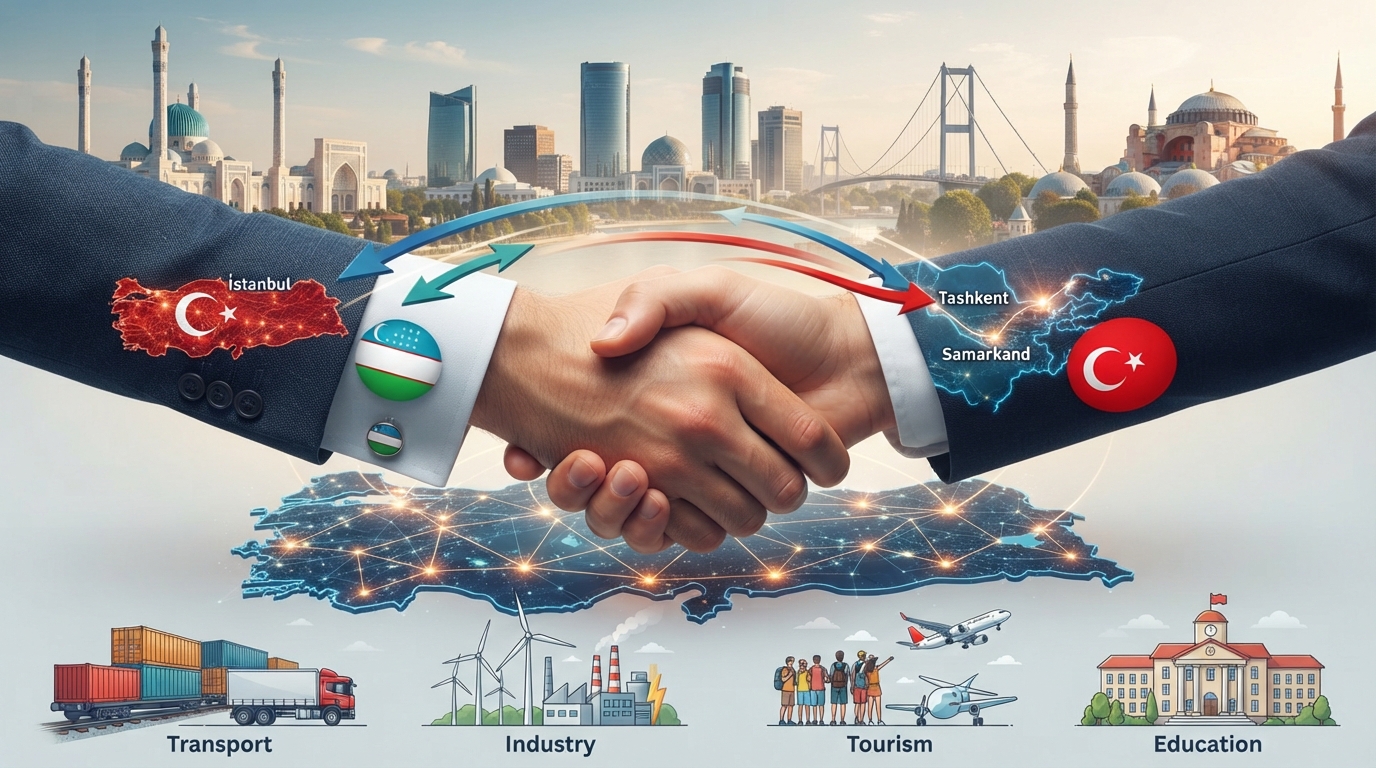
Turkey is one of Uzbekistan's most important economic partners, with approximately 2,276 Turkish companies implementing major investment and industrial projects. This was stated by Uzbekistan's Ambassador to Ankara, Ilkhom Khaidarov, in an interview with Anadolu Agency on the occasion of the country's 35th anniversary of independence.
According to the ambassador, bilateral relations have reached a qualitatively new level in recent years. The countries have established mechanisms for regular high-level consultations and new formats for strategic cooperation. In particular, the "4+4" mechanism, covering foreign policy, defense, security, and internal affairs, is in effect.
Joint working groups have been established between virtually all ministries and agencies of the two countries. Their activities cover the economy, investment, industry, energy, transport, education, tourism, culture, and other areas.
Khaidarov noted that economic cooperation is one of the key elements of the strategic partnership. By the end of 2025, trade turnover between Uzbekistan and Turkey reached $3 billion. Currently, the two sides are close to reaching $5 billion.
The countries intend not only to increase trade volumes but also to deepen industrial cooperation, increase the production of high-value-added goods, develop transport and logistics infrastructure, and expand the portfolio of joint export-oriented projects.
"We strive to attract Turkish companies not only to the existing market, but also—on a much larger scale—to participate in projects aimed at transforming Uzbekistan into a regional manufacturing and export hub," the ambassador stated.
He emphasized that opportunities for cooperation stem from the combination of Turkish technology, management experience, and market access with Uzbekistan's manufacturing and human resources potential.
According to Khaidarov, the two countries' geographical location also creates additional opportunities for economic cooperation. Uzbekistan is located in the center of Central Asia, and Turkey is an important transport and logistics hub linking Europe and Asia. Therefore, developing transport links is important not only for bilateral trade but also for economic ties between the regions.
Tourism and air travel are also developing. In the first half of this year, over 100,000 Turkish citizens visited Uzbekistan. By the end of the year, over 200,000 Turkish tourists are expected.
There are currently over 130 flights per week between the two countries. The ambassador noted that the development of air travel, tourism, student exchanges, cultural programs, and business forums contributes to further rapprochement between the peoples of the two countries.
Speaking about Uzbekistan's development, Khaidarov noted that in recent years, the country's GDP has grown 2.5-fold, reaching $145 billion last year, with exports exceeding $33 billion and direct investment exceeding $43 billion.
According to him, the initial goal was to reach $160 billion in GDP by 2030, but this figure is expected to be exceeded this year. A total GDP of $300 billion has been identified as a new strategic goal for 2030.
The ambassador also emphasized Uzbekistan's growing international role and noted the changes in Central Asia associated with the formation of a "New Uzbekistan." He noted that countries in the region have made significant progress in resolving border issues, water resources, trade, transport, and security based on trust and dialogue.
Khaidarov specifically noted the historical foundation of relations with Turkey. Turkey was the first state to recognize Uzbekistan's independence. According to the ambassador, historical, linguistic, and cultural affinities, as well as mutual respect, have formed a solid foundation for a modern strategic partnership.
He emphasized that the current level of relations is not viewed as an end goal. The parties intend to build on the results achieved to further expand cooperation in the economy, investment, industry, transport, tourism, and other areas.