

Amazing underwater shots. Finalists of the Ocean Photographer of the Year 2026 competition announced
Amazing underwater shots: Finalists of the Ocean Photographer of the Year 2026 competition announced
The jury has announced the finalists of the Ocean Photographer of the Year 2026 photo contest, dedicated to the ocean and its rich life. The competition focuses on the beauty and majesty of the ocean, the fragility of marine ecosystems and the need to protect them.
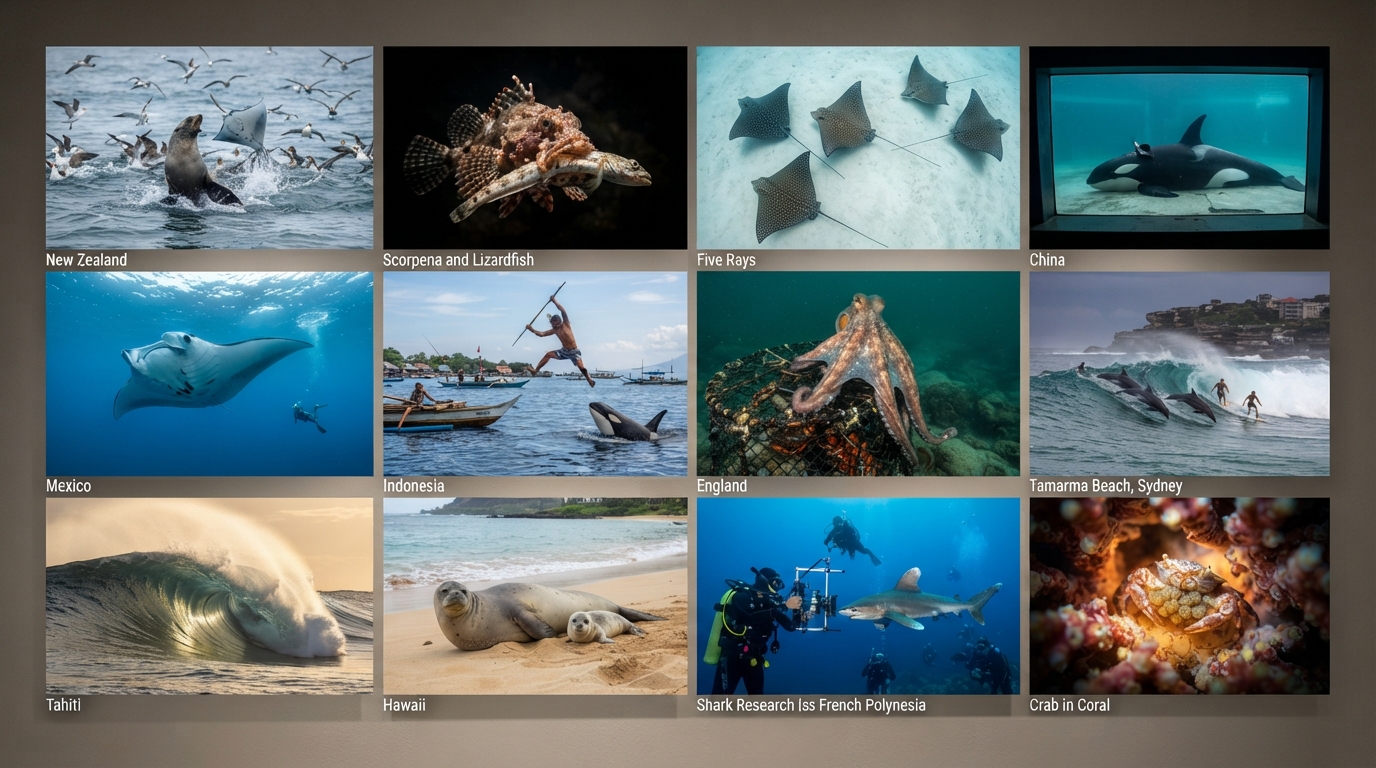
**New Zealand**
**Photo:** Finalist in the Wildlife category / Allan Cronin. A fur seal eats a skate in New Zealand waters, while seabirds gather around it, waiting for the remaining pieces of its prey. Since the seal cannot swallow the skate whole, it repeatedly tosses it into the air, breaking it into small pieces. The photo was taken from a small boat.
**Mexico**
**Photo:** Finalist in the "Human-Nature Connection: People and Planet" category / Anita Verde. A giant sunfish swims in the clear waters off the coast of Baja California, Mexico.
**Tahiti**
**Photo:** Finalist in the "Fine Arts" category / Ben Zouard. A giant wave crashes onto the shore off the coast of Tahiti. Its crest is shaped by the wind blowing from the land, while sunlight turns the splashing water into a bright curtain. The photo was taken from a hydrocycle and with a long-focus lens. The noisy moment in the ocean is a composition reminiscent of the famous Japanese artist Katsushika Hokusai's engraving "The Great Wave off Kanagawa."
**Scorpion and Lizard**
**Photo:** Finalist in the "Wildlife" category / Andrea Michelutti. A scorpionfish devours a lizard. The compact composition in the photo makes the same process between the two fish even more vivid. The photographer attached a special device to the flash, directing the light directly onto the fish, while the background was left blurred.
**Indonesia**
**Photo:** Finalist in the "Human-Nature Connection: People and Planet" nomination / Sirachai Arunrugstichai. A whaler from the village of Lamalera, Indonesia, jumps out of a boat with a harpoon in hand to attack a killer whale. Besides sperm whales, killer whales are one of the largest prey items hunted by the people of Lamalera. Such hunting is considered extremely dangerous. The killer whale in the photo eventually died, but managed to overturn the boat. After that, the fishermen had to be rescued by other vessels. Local people have been hunting whales and other cetaceans for a living for more than 600 years, and the meat is distributed to all residents of the village. Today, the use of motorized boats has made this traditional activity increasingly controversial, making it the subject of heated debates about culture, livelihoods, and marine conservation.
**Hawaii**
**Photo:** "Conservation: Hope" / Leighton Lum. A Hawaiian seal rests with her one-week-old pup on Kaimana Beach in Waikiki. Female seals nurse their pups for about six weeks, during which time they barely feed themselves. During this time, they can lose up to a third of their body weight. During this time, the pups grow rapidly and prepare for an independent life.
**Five Stingrays**
**Photo:** Finalist in the "Fine Art" category / John Kovitz. Five scaly eagle rays glide over the sandy seabed, their dark bodies with white spots standing out sharply against the pale background. These stingrays often travel in groups in search of food. They use their electroreceptors to detect mollusks and crustaceans hidden under the sand.
**England**
**Photo:** Conservation: Impact finalist / Eduardo Santana de Vega. An octopus pokes its head out of a lobster trap off the southwest coast of England. At first, it looks like it has fallen into the trap. In fact, octopuses enter such traps to eat the crabs and lobsters, and then crawl out on their own.
**Shark tracking**
**Photo:** Conservation: Hope / Thomas Pavy. This image shows the process by which an unnamed shark becomes a distinct species that scientists can identify. Using photo-identification and laser-calibrated video surveillance, scientists can track sharks over long periods of time, determine their size and sex, and record changes in their population. The studies are conducted without the use of bait or other means to attract the animals. They will help to learn more about the tamataroa, a species of protected and culturally significant species in French Polynesia.
**China**
**Photo:** Finalist in the "Conservation: Impact" category / Jingyi Zhang. A male killer whale lies motionless on the concrete floor of a pool at the Chimelong Ocean Kingdom aquarium in China. Its heavily drooping dorsal fin is one of the obvious effects of long captivity. The animals were captured as young animals in the Sea of Okhotsk, off the coast of Russia. They were separated from their family groups and deprived of the natural social environment that is an integral part of the life of killer whales in the ocean.
**Australia**
**Photo:** Finalist in the "Adventure" category / Gergo Rugli. Dolphins swim in the waves next to surfers at Tamarama Beach in Sydney. The waves were strong that day and the wind was blowing from the land. The pod of dolphins stayed close to the surfers for more than an hour, moving naturally through the waves as if people were a normal part of the seascape.
**Shrimp among the coral**
**Photo:** Finalist in the "Invisible Ocean: Hidden Worlds" category / Andrea Michelutti. The crab with its eggs is hidden among the coral branches. The photographer placed a flash with a special device behind the coral to create a fiery glow around the eggs. The additional light from the front helped to show the animal without damaging the delicate environment.
The winners of the separate nominations of the "Ocean Photographer of the Year 2026" competition, as well as the grand prize winner, will be announced in September.