

Alphabet reform, Turdimov's statements and Rubio's visit - weekly digest
The alphabet has been reformed, but the main question remains open: when will we fully transition to the Latin script? The status of teachers, exclusive powers, and prohibitions on governors: the new minister of education has begun his duties. Declaration of income and expenses: it will be started not by officials, but by the residents of two cities.
**Alphabet reform, Turdimov's statements, and Rubio's visit — weekly digest**
**An end put to the issue of amending the alphabet**
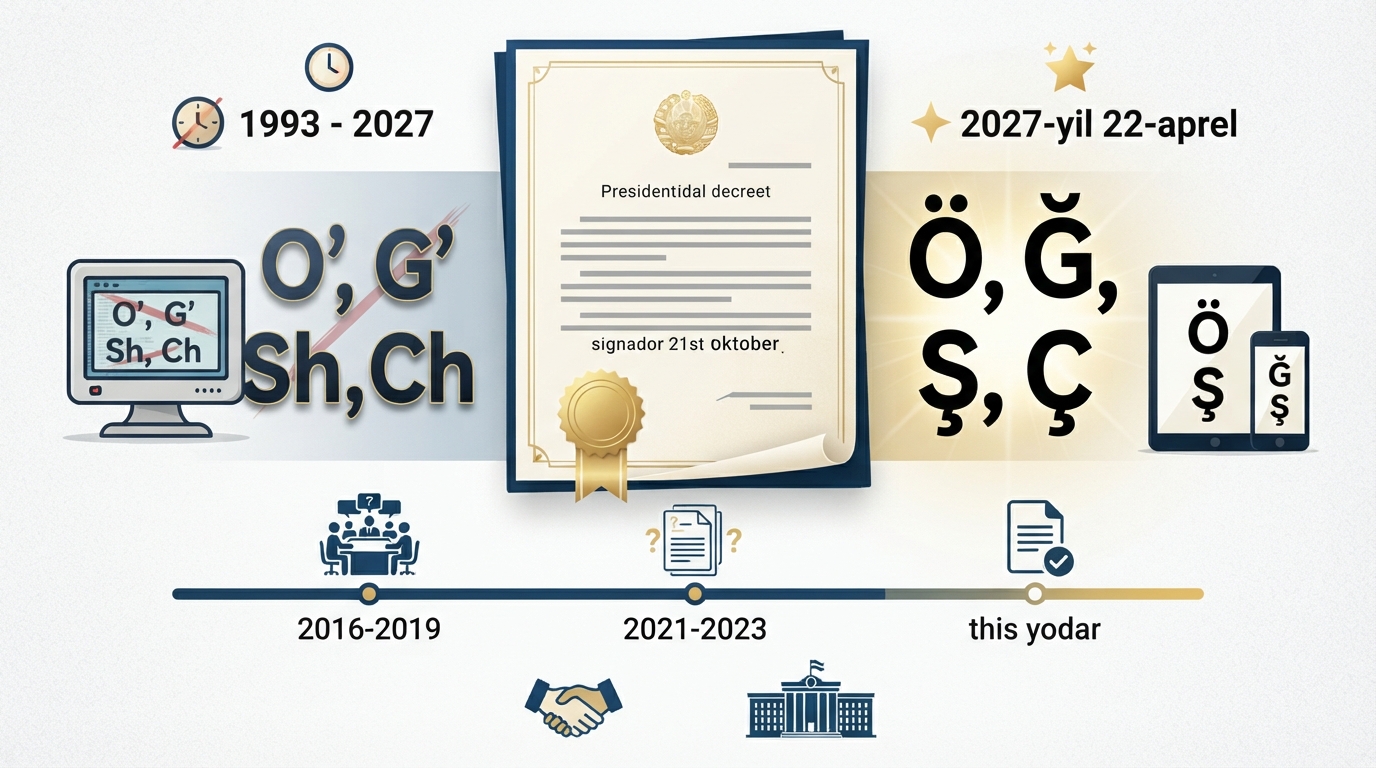
An end has been put once and for all at the legislative level to the issue of four letters in the Latin-based Uzbek alphabet. The letters O‘, G‘, Sh, Ch, which were considered technically flawed, were replaced with integral letters (Ö, Ğ, Ş, Ç) based on the "one sound – one letter" principle. The law on this was signed by the president on October 21 — Uzbek Language Day.
It will come into force after 6 months — from April 22, 2027. The Cabinet of Ministers must approve a program of measures to ensure the execution of the law within 2 months. Symbolic marks of state bodies, images of the coat of arms, signboards, indicators, and other items will be converted to the improved alphabet as they become unusable or within the timeframes set in the government program.
The diacritic form of these four letters was present in the Uzbek-Latin alphabet adopted in 1993, but in 1995 they were changed into forms with apostrophes and letter combinations. Later, with the spread of computers and phones, these letters began to cause various problems in practice. After the change of power in 2016, a working group was formed in subsequent years to reform the alphabet. Based on heated debates, the working group developed various options and put forward differing conclusions in 2018, 2019, 2021, 2023, and 2026; finally, this year's proposal took the form of a law.
In July 2023, the head of state called for the completion of the work on improving the alphabet.