

Approved alphabet change and the task of ending poverty - weekly digest
The Senate has approved the changes to four letters in the alphabet; the government promises a complete transition to the Latin script. Mobilization in the fight against poverty: khokims are taking on the obligation to provide everyone with employment. Home prices in Tashkent have been mass-appraised: officials commented on the issue of the tax burden. A European president praised energy projects in Uzbekistan; it was stated that China would build the second nuclear power plant.
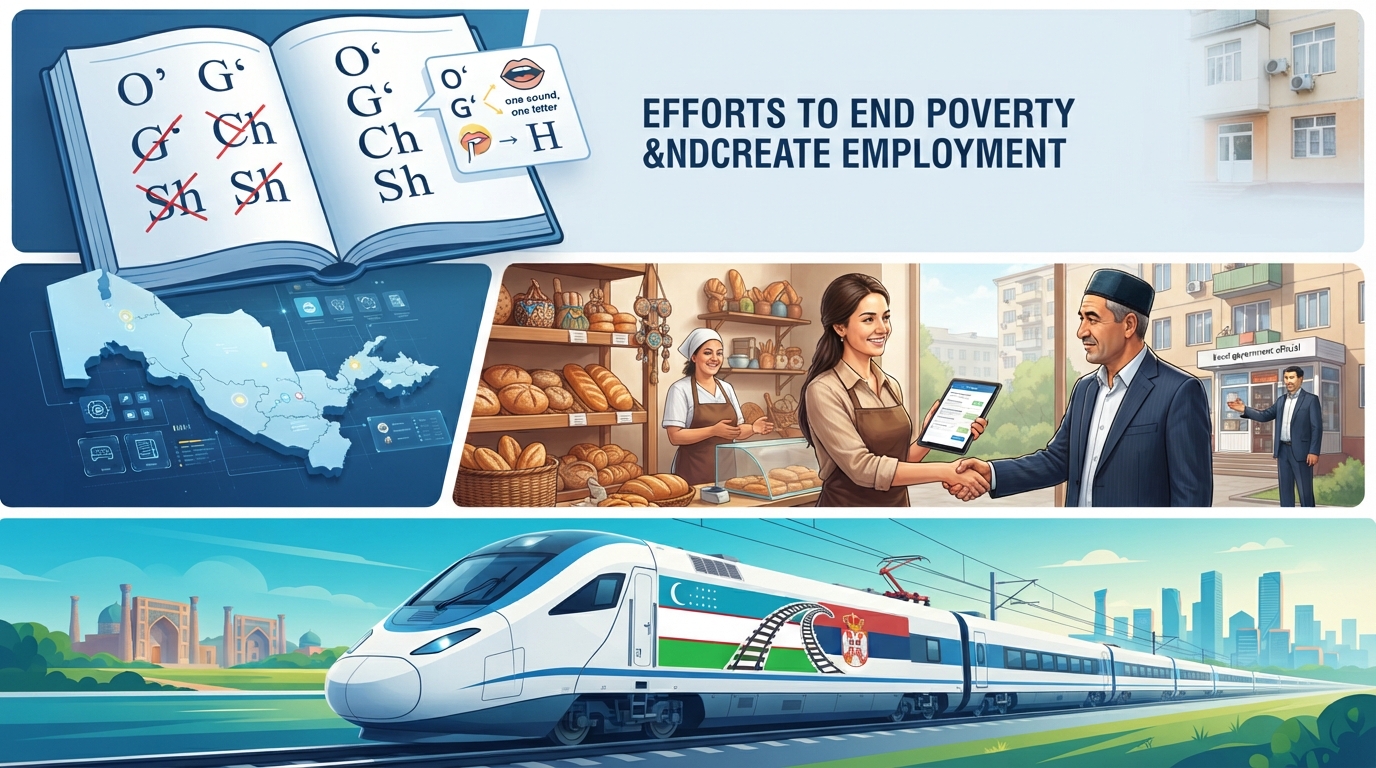
Approved alphabet changes and the task of eradicating poverty - weekly digest
The law on changing four letters in the Uzbek alphabet based on the Latin script has been approved by the Senate. The document provides for the transition of the letters G‘, O‘, Sh, Ch to the "one sound – one letter" principle (Ğ, Ö, Ş, Ç).
The decision to accept or reject this change, which has been approved by both chambers of parliament, is now at the discretion of the head of state. If accepted, the law could be signed by October 21 – Uzbek Language Day.
Odiljon Mamatkarimov, Chairman of the Senate Committee on Science, Education and Health, said that the introduction of unified letters instead of the four combinations in the alphabet would be a solution to serious problems in the digitalization of the Uzbek language.
"In short, the adoption of this law shows how politically and culturally determined Uzbekistan is in pursuit of its national interests. This reform is not only for today, but a solid foundation for our future generations to grow up literate, digitalized and proud of their language," the senator said.
Once the law is signed, a program of measures for its implementation will be adopted. Symbolic signs, coat of arms images, indicators, signboards and other items of state organizations containing the old letters will be used either until they become unusable or until the period specified in the program.
The issue of textbooks was the first to be raised in the Senate. Azizbek Turdiyev, Deputy Minister of Preschool and School Education, answered the question:
"Our textbooks are updated annually by grade. For example, textbooks for 1st grade are updated every year anyway. The frequency of updating textbooks for grades 2-4 is three years, which means that every three years textbooks for grades 2-4 are updated. For grades 5-11, our textbooks are updated once every 5 years. Therefore, after the law comes into force, starting from 2027, we will print 1st grade textbooks in the new alphabet anyway, and by 2031 all our textbooks will be fully updated. From this point of view, no additional funds are required."
During the meeting, it was also mentioned that the transition to the Latin alphabet has not yet been fully completed, and as a result, with the change of four letters, three different alphabetic forms of Uzbek writing will appear in practice. Senator Husan Ermatov, who raised this issue, admitted the truth: "We chose the Latin alphabet, but we lacked the determination to transition to it":
"We have not yet fully transitioned to the Latin alphabet. We can say that this was also due to the fact that we chose the Latin alphabet, but lacked the determination to transition to it. But today, with the adoption of this law, if there is also a lack of determination here, in reality, three alphabets may end up working. From the point of view of making this determination a bit more serious, if we explain to our population: will a specific deadline be set? For example, when will the mass media and books transition to this?"
In response, Nodirjon Kholboyev, Director of the Department for State Language Development under the Cabinet of Ministers, said that the government is on the verge of ending the practice of dual alphabets:
"Indeed, we have spent a lot of time in limbo between two alphabets. On the initiative and will of our esteemed President, we are on the verge of ending this dual alphabet system. Naturally, the question arises: won't the issue of three alphabets arise? Therefore, after this law comes into force, we want to put this issue strictly on the agenda. In particular, after the law comes into force, we plan to make it mandatory for all media to operate in the approved, improved alphabet, which has become a single standard.
Of course, citizens can use the alphabets they are used to in their free correspondence, but we will put the full transition in official administration and official media on the agenda."
The law was unanimously approved in the Senate – there were no votes against or abstentions. Now, if the president also signs the document, it will come into force 6 months after its official publication.
Cases of forced removal of citizens from the social registry are being observed again. In addition, it is said that in some regions, employees are being forced to work overtime and even perform various tasks on weekends.
The Labor Inspectorate reminded that forced labor is prohibited; it also stated that the unjustified removal of a citizen from the social registry deprives them of guaranteed social protection.
"No instruction can serve as a basis for restricting the labor rights of an employee or the social protection rights of a citizen. If the appeals are studied and the cases are confirmed, measures prescribed by law will be taken against the guilty officials," the Ministry of Employment said in a statement.
On the day this statement was made, it became known that Qahramon Quronboyev, Chairman of the Association of Neighborhoods (Mahallas), was dismissed from his post. Following this, the post of Deputy Prime Minister of the Republic of Uzbekistan – Chairman of the Association of Neighborhoods was established, and Gofurjon Mirzayev was appointed to it. The post of Presidential Advisor on Personnel, which Mirzayev had held until now, was abolished. Mirzayev's deputy in the Administration, former Minister of Internal Affairs Pulat Bobojonov, will now continue his activities as his deputy in the Association of Neighborhoods.
These personnel changes are taking place against the background of new, strengthened measures to reduce poverty. According to the new system announced last week, responsible leaders, khokims (governors) and banks for the "neighborhood seven" have switched to an enhanced work regime. Their work will be coordinated by Gofurjon Mirzayev. Also, local headquarters for poverty and employment issues have been established, and the authority to manage preferential credit resources for family entrepreneurship and youth entrepreneurship has been transferred to the khokims, who are the heads of the headquarters. Shuhrat Abdurahmonov, the khokim of Andijan region, was one of the first to demonstrate the practical application of this system:
"Our esteemed President said: 'For those who want to do business, provide [the credit] in cash if they want, put it on their card if they want, or transfer it if they want.' From now on, he assigned the task that khokims will be responsible for providing credit to those who want to become entrepreneurs, for the running of their business, and for the result of their project. Today, here in Andijan, we are providing a 50 million soum credit in cash to our first swallow, Zulkhumor."
On Wednesday, additional measures to reduce poverty were announced at a meeting chaired by the President. In particular, it will not be necessary to convert an apartment into a non-residential category to organize trade and service activities such as a barbershop, beauty salon, small shop, or atelier on the 1st floor of multi-story buildings. Defining these and other tasks, Shavkat Mirziyoyev said that the performance of those responsible for increasing public income would be assessed at the end of the year.
"I want to warn you once again: if a leader does not go down to the neighborhood, does not see the real situation with his own eyes, does not lead the 'seven' himself and show who should do what, the work will not progress. Leaders who do not understand the current policy will definitely be dismissed," the head of state said.
At the meeting, members of the government and khokims reported on what they have been doing under the new system that started last week. For example, Shuhrat Abdurahmonov, the khokim of Andijan region, said that 14,382 problems were identified in 18,269 families within 6 days:
"On the very night you gave the instruction, we sat down and established the headquarters. I set up 8 working groups in each city and district, esteemed President. [...] I promised you that in 20 days I will have a 100 percent picture in my hands: who is unemployed in Andijan, what they want, whom I need to train, to whom I need to give credit, to whom I need to give land. [...] Of course, as you said, we will sleep less and walk more. God willing, we will make you proud, I assure you, esteemed President."
The khokims of Namangan, Qashqadaryo and Bukhara regions once again promised to make their regions free of poverty and unemployment by the end of the year.
"We have the opportunity to turn it into an area free of poverty and unemployment – we will ensure this is done. You yourself appointed all my district khokims from among the youth, I will make them all work, esteemed President. There will be no issue, everyone will work," said Shavkat Abdurazzoqov, the khokim of Namangan region.
"We are auditing every neighborhood. According to the instruction, we worked with each of them and organized targeted work. [...] Our resources in Qashqadaryo region are very large, if we establish our work systematically, esteemed President, as we promised before, we have both the capability and the conditions to make Qashqadaryo a region free of poverty and unemployment, esteemed President," said Murodjon Azimov, the khokim of Qashqadaryo region.
"In Bukhara region, we have undertaken the obligation to completely eradicate poverty and unemployment among the population that is outside of state care. By the end of this year, the set tasks will be fully completed," said Botir Zaripov, the khokim of Bukhara region.
The preliminary results of the mass valuation of real estate, conducted as an experiment in the city of Tashkent, have been presented for public discussion. Owners can view the valuation results through the relevant service on the MyGov portal and express their agreement or disagreement.
According to the valuation methodology, the values presented to the owners are said to be up to 30 percent lower than the market price. If the owner approves the state-valued value of their home, they press the "I agree" button. If they consider the valued value to be incorrect or see technical errors in the valuation report, they can object.
According to officials, the owner's expression of agreement or disagreement with the valuation result has no legal consequences for now. Even after the indicated value enters into legal force, the owner will retain the right to object to it.
It is known that property tax is calculated based on the cadastral value of the property. The values calculated in the mass valuation are several times higher than the cadastral values. For this reason, concerns have arisen among people about the possibility of a sharp increase in property tax. Officials are denying this for now.
According to Dilshod Sultonov, Deputy Director of the Institute of Fiscal Studies, the increase in the value of real estate as a result of mass valuation does not automatically mean that the tax burden will increase by the same amount. According to him, an instruction was given not to increase the tax burden. Therefore, the main task now is to form a database of new values, test the methodology, and later consider the issue of setting tax rates.
If the results of this mass valuation conducted as an experiment in the capital and the methodology used in it are found to be correct, this system will later be introduced in regional centers as well.
Uzbekistan has elevated its relations with another European country to the level of strategic partnership. During President Shavkat Mirziyoyev's state visit to Serbia, the two heads of state signed a joint declaration on establishing strategic partnership relations. President Aleksandar Vučić presented his Uzbek counterpart with the highest state award – the Order of the Republic of Serbia on a Large Chain; naming one of the streets in Belgrade after Tashkent was another expression of mutual friendship. It is planned to open a diplomatic mission of Uzbekistan in Belgrade, and for the Serbian Embassy to start operating in Tashkent, as well as to connect the capitals of the two countries with a direct flight.
20 documents were signed in the presence of the presidents: including agreements to start negotiations on a free trade agreement, establish cooperation on labor migration, simplify cargo transportation and support the Middle Corridor. Shavkat Mirziyoyev invited Serbian companies to implement joint industrial and agricultural projects in Uzbekistan. In turn, negotiations are underway for "O'zbekiston Temir Yo'llari" JSC to build a 200 km railway line as part of the modernization of Serbian railways.
Aleksandar Vučić said that another area of cooperation could be the defense sector. According to him, Serbia will start producing long-range ballistic missiles in about a year. "We are ready to cooperate with our Uzbek friends in this direction as well," the Serbian President said. It should be noted that Serbia's exports of weapons and military equipment reached $1.6 billion in 2023, up from $384 million in 2020.
In his speech at the Uzbekistan-Serbia business forum, Vučić revealed another detail from his one-on-one conversation with Shavkat Mirziyoyev: as it turned out, the second NPP in Uzbekistan is planned to be built in cooperation with China.
"This morning in our one-on-one conversation, I asked President Mirziyoyev and he told me: 'We are building one nuclear power plant with the Russians, the second plant with the Chinese, but this is not enough for me. Before I finish this, I will start building more, I will continue to work,'" the Serbian President quoted his Uzbek counterpart.
According to Aleksandar Vučić, Uzbekistan is increasing its energy capacity, anticipating that the demand for electricity will increase in the future. Shavkat Mirziyoyev is taking into account that in the future, much more electricity will be needed for data centers, artificial intelligence, innovations and electric vehicles, Vučić said.
It is worth recalling that the "major preparation" for building the second NPP in Uzbekistan was announced last month, but local officials had not yet disclosed the name of the partner country.
The new high-speed train has significantly reduced the travel time from Tashkent to Andijan. Starting from September 10, the CRRC-Dalian electric train imported from China began operating on the Tashkent–Andijan–Toshkent route: with this, the distance between them was reduced from 6-7 hours to 4 hours and 15 minutes. The second train of the same model began operating on the Khiva–Bukhara–Khiva route from September 9. In addition, from September 7, a new electric train purchased from Russia was launched on the Parkent–Tashkent–Parkent route.
A new privatization program has been approved. According to the presidential decree, by the end of the year, assets with a total value of nearly 100 trillion soums are to be put up for sale, from which at least 14 trillion soums in revenue must be ensured. The program covers 84 enterprises, more than 1,200 real estate properties and 8,000 hectares of land plots. The initial payment amount was reduced from 30 percent to 15 percent; new opportunities for purchasing large assets at a discounted price and in installments were established. Notably, Humo Air, which was previously sold, is also on the sales list – as it turned out, the 2022 agreement on the privatization of this airline has been canceled.
The road patrol and post-patrol services are sharing powers with each other. By presidential decision, the principle of "different tasks – single authority" is being established in the structures of internal affairs bodies. In this regard, for example, PPS (post-patrol service) officers can also take measures to eliminate traffic congestion on the road or for certain types of traffic violations. YPX (road patrol service) officers, on the contrary, will participate in ensuring peace in the neighborhood; they will be able to apply administrative penalties to persons who litter in undesignated places or consume alcohol in public places. It is also planned to temporarily restrict the entry of persons who have violated public order at public events to future public events.