

Almost half of households do not see benefits of economic growth, report says
Analysis has found a "stark" gap in the spending power of households in the north and south of England on average.
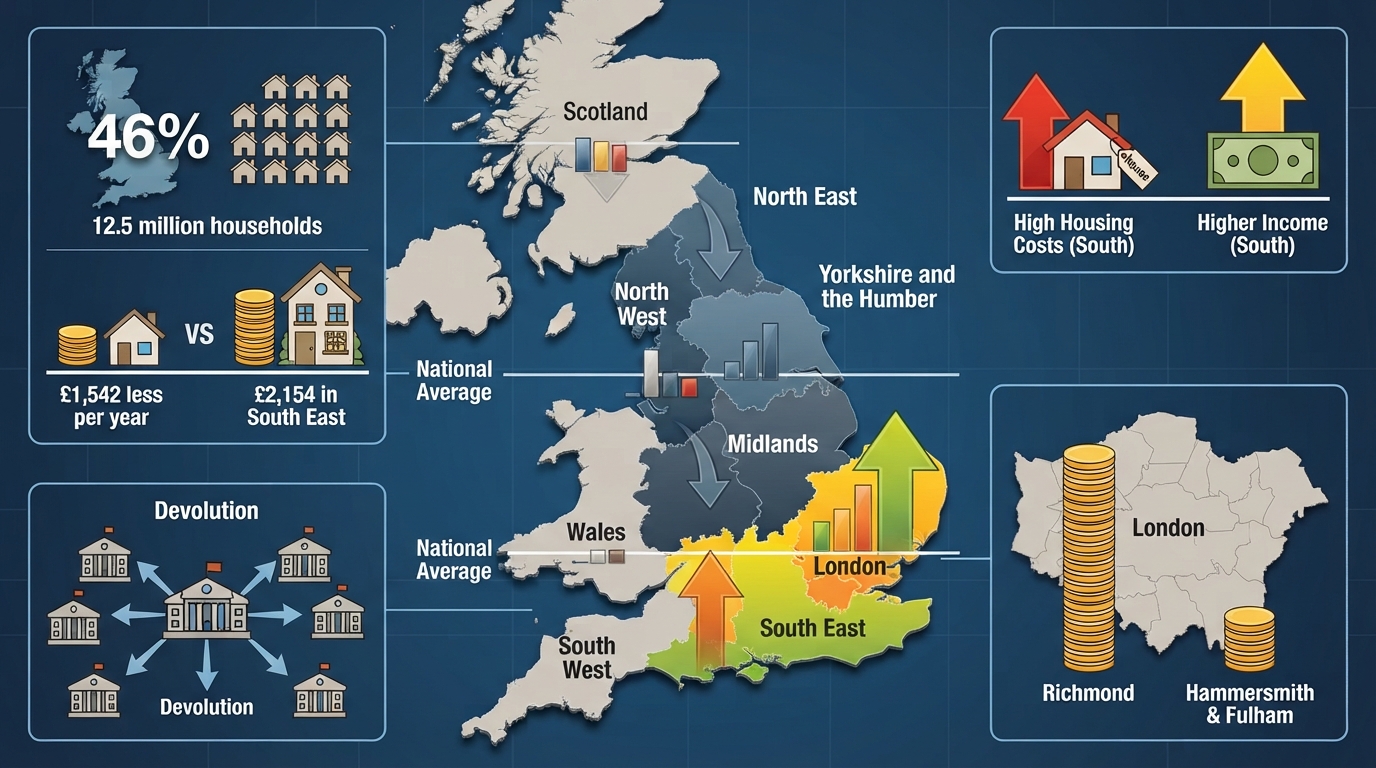
A new report indicates that nearly half of British households reside in areas where economic growth does not translate into an improved quality of life, highlighting a significant North-South disparity in household spending power.
Researchers at the consultancy firm PwC found that every region in the north of England, the Midlands, and Wales had a lower spending power than the national average, while London and the South East were comfortably above it.
These findings emerge as Prime Minister Andy Burnham has committed to addressing the cost of living and regional inequalities to enhance living standards. However, questions persist regarding the new Prime Minister's economic strategies, with rising UK government borrowing costs expected to influence public spending decisions.
The report, released on Thursday, stated that the equivalent of 12.5 million households—46% of the total—live in parts of the country where economic growth, often evidenced by increased business investment and job opportunities, is not leading to better living standards.
Households in the North East of England, the report noted, had a spending power 6.6% below the national average, equating to £1,542 less per year. The North West was £1,493 less, while Yorkshire and the Humber experienced the largest deficit, with spending power down £1,917 comparatively.
Conversely, households in the South East were found to have spending power 9% above the national average, representing an additional £2,154 per year, followed by London.
Household spending power is considered a reliable indicator of whether economic growth is improving living standards. PwC measures this by analyzing income after taxes and housing costs, also factoring in household size and composition to provide a more accurate picture of disposable income for other expenses.
The UK has experienced years of sluggish growth, although official figures show the economy expanded by 1.2% in the first six months of this year.
Economic growth is generally desired by most countries as it typically leads to increased consumer spending, job creation, higher tax revenues for the government, and improved wage increases for workers. Theoretically, this collective effect leaves people better off, but the benefits take time to materialize and do not necessarily reach everyone. According to PwC, "only a fraction" of a rise in GDP—a measure of economic growth—translates into increased spending power.
Researchers observed a clear North-South divide in household spending power, but also noted similar disparities within seemingly more affluent areas, such as London and the South East. For instance, Richmond's average annual disposable income was the highest in London at £35,448, almost double the £18,384 recorded in neighboring Hammersmith and Fulham.
Rachel Taylor, government and health industries leader at PwC, commented, "The research shows just how differently prosperity is experienced across the UK, with stark variations not only between regions but on each other's doorstep."
While higher housing costs in the south of England impact spending power compared to the north, researchers found that higher incomes on average mitigate this effect for households, maintaining the divide.
Scotland and the South West of England were identified as exceptions to this trend, with lower housing costs and smaller households resulting in spending power slightly above the national average.
The report advocated that the next phase of transferring power from central government to local authorities, known as devolution, "must allow local areas to retain more of the revenues generated by local growth alongside more freedom on how best to use resources." It further argued that success "should be judged not simply by whether local economies grow, but by whether that growth leads to greater prosperity, wider opportunity and better lives for the people and communities within them."
Devolution has been a central tenet of Burnham's leadership vision, with pledges to create "the conditions for good growth in every postcode."
A government spokesperson stated that the establishment of No10 North is part of its growth mission to reshape "how the country is run." They added, "We have already announced unprecedented financial powers to English mayors so they can receive a share of income tax revenues to boost local economies and improve public services."
However, Conservative leader Kemi Badenoch has criticized Burnham's "diagnosis" and "theory of growth," calling them "completely wrong." She stated, "He thinks that if government spends more money, we will all get richer - that is not how this works," and dismissed the creation of No10 North as a "gimmick."
Burnham has promised further devolution and public control of essential services.