

Airports of Uzbekistan handled over 12 million passengers in nine months
Uzbekistan airports carried over 12 million passengers in nine months
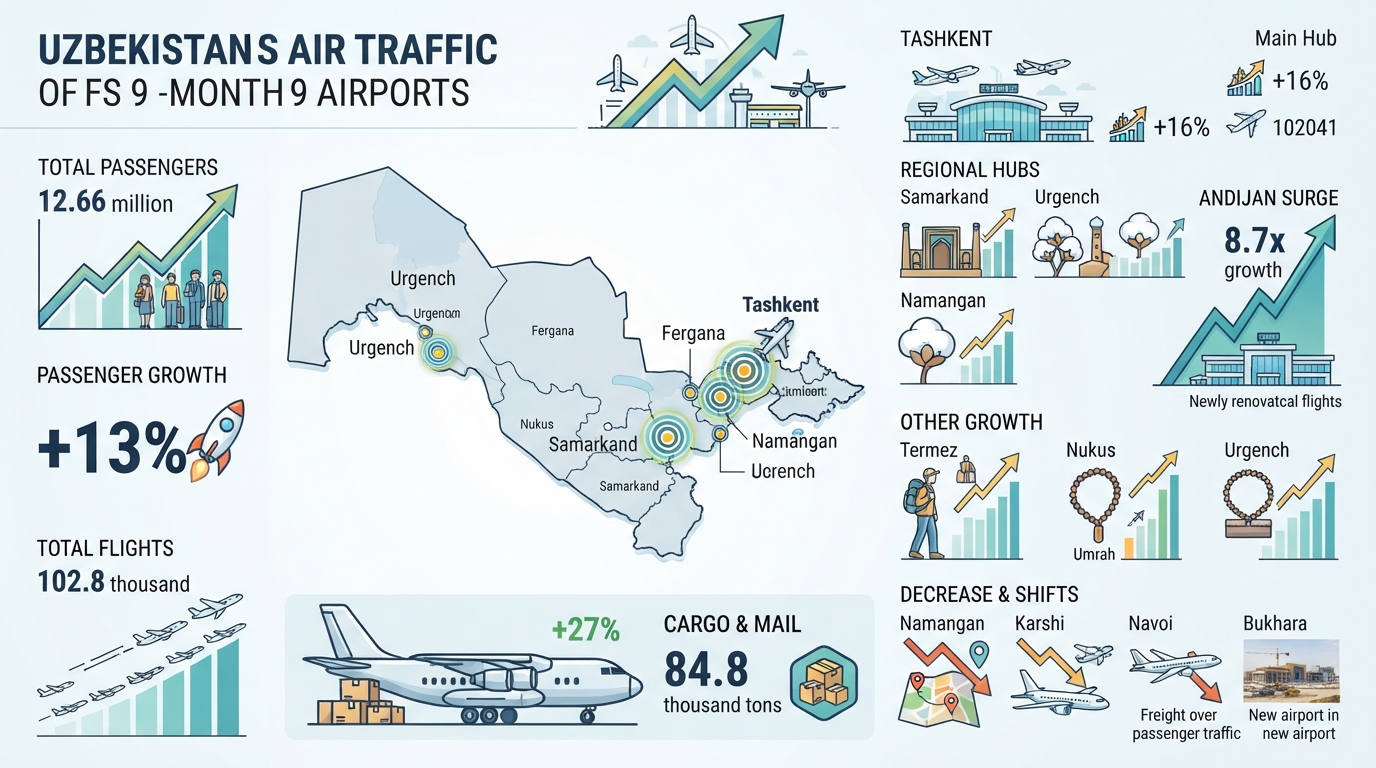
During the nine months of 2026, Uzbekistan's airports served more than 12.6 million passengers — 13% more than a year earlier. The number of flights also increased, and the volume of processed cargo and mail grew by more than a quarter. At the same time, dynamics varied across the regions.
From January to September, the country's airports served 102.8 thousand flights — 10% more than last year. Of these, 71.6 thousand were on international routes, and another 31.2 thousand were domestic.
Total passenger traffic amounted to 12.66 million people. International flights were used by 10.36 million passengers, and domestic flights by 2.3 million. Growth was 13% and 15%, respectively.
Tashkent remains the country's main aviation hub. The capital's airport received 8.49 million passengers and served 62.5 thousand flights. Compared to last year, passenger traffic grew by 16%, and the number of flights by 7%.
Among regional airports, Samarkand leads in passenger numbers with 1.11 million people, Urgench with 724.4 thousand, Fergana with 511 thousand, and Namangan with 497.6 thousand passengers.
The most notable growth was recorded in Andijan: passenger traffic increased 8.7 times, to 161.4 thousand people. However, such a surge is largely explained by last year's low base. The airport resumed operations after a large-scale reconstruction on March 20, 2025, so it was not yet operating at full capacity in the same period last year.
Significant growth in passenger numbers was also noted in other cities. In Termez, the indicator increased by 48%, in Urgench by 18%, and in Nukus by 17%. In Termez, this was facilitated by the development of transport for pilgrims departing for Umrah and the launch of flights by Flyadeal airline. More affordable pilgrimage tours also attracted residents of neighboring countries. In Urgench and Nukus, the opening of new international flights served as an additional factor.
However, not all airports managed to increase passenger traffic. In Namangan, it decreased by 16%, and in Karshi by 22%. According to Uzbekistan Airports, the indicators are influenced by changes in the route network, demand on individual routes, and airline schedules taking into account the geopolitical situation.
In Fergana, on the contrary, passenger numbers grew by 5%, although the number of flights decreased by 11%. In Samarkand, passenger traffic remained at last year's level, while the number of flights decreased by 2%.
In Navoi, the very structure of the airport's operations is changing. Despite the reduction in passenger flights and a 22% drop in passenger traffic, the total number of served flights increased by 14%, and the cargo segment strengthened its position.
In Bukhara, 407.4 thousand passengers were served in nine months — 1% less than a year earlier. At the same time, a project for a new international airport is being implemented in the region, which is expected to expand capabilities for air transport and tourism development.
Separate growth was recorded in the cargo segment. In January–September, Uzbekistan's airports processed 84.8 thousand tons of cargo and mail — 27% more than in the same period of 2025. The bulk of the volume fell on the Tashkent airport, which processed 78.9 thousand tons.
, in Fergana, there are plans to create an international airline jointly with the Afghan carrier Kam Air.