

AI machine 'helps save 25 million Lego bricks'
The automated technology can sort up to 100,000 pieces a day at a Lancashire mill.
**AI machine 'helps save 25 million Lego bricks'**
The Rawtenstall company accepts both complete Lego sets and boxes of mixed pieces
An artificial intelligence-driven sorting machine has helped keep 25 million Lego bricks out of landfill, according to a company.
WeBuyBricks, which is based at Hall Carr Mill in Rawtenstall, Lancashire, buys unwanted Lego, then cleans and sorts the pieces so they can be sold again.
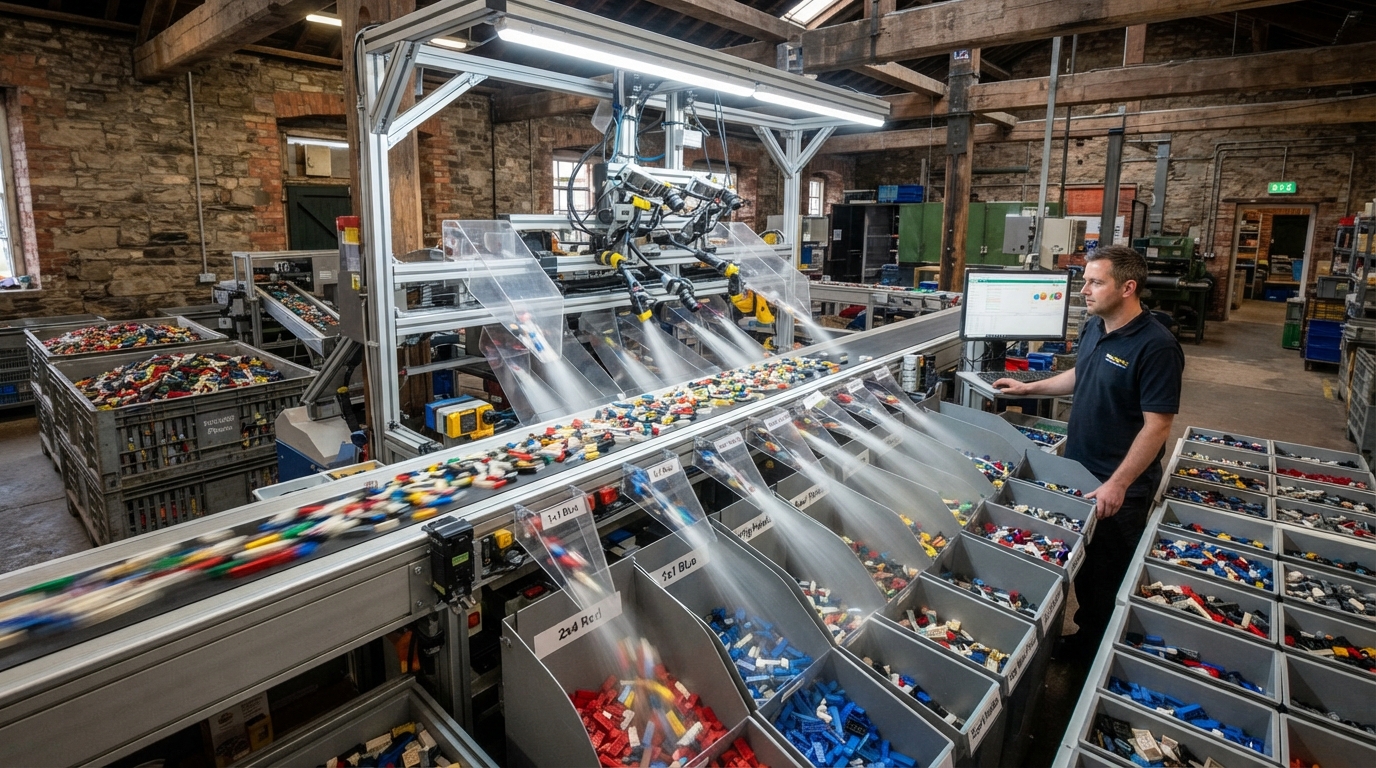
Its Brick-O-Matic uses cameras, artificial intelligence and jets of air to identify individual pieces and can sort up to 100,000 of them a day, the firm said.
Head of projects Brad Hacking said automating the work was vital because sorting large amounts of mixed Lego by hand was "really difficult".
WeBuyBricks says the machine has capacity to sort up to 100,000 Lego pieces a day
Boxes of mixed Lego are fed into the machine, where the pieces move beneath camera systems using AI and machine-learning software to identify them.
Hacking said the system could recognise more than 60,000 different Lego pieces.
After identification, jets of air send the pieces into separate chutes so they can be used to build sets again.
He said the machine could handle two pieces a second and claimed it was more than 100 times more efficient than sorting Lego manually.
He added that there were currently more than 10 tonnes of Lego at the Rawtenstall site waiting to be processed.
The company says it believes the Brick-O-Matic is the first machine of its kind in the UK.
Hacking said the network of conveyor belts and air jets had grown from an initial idea into something that "does feel very Willy Wonka or Wallace and Gromit".
Loose Lego travels through a network of conveyor belts inside the Brick-O-Matic
The system can also tell staff how complete a Lego set is.
Hacking said that if a set was missing five or 10 pieces, the machine could be adjusted to look specifically for them as more Lego passed through, or staff could buy the missing pieces elsewhere.
Star Wars and Harry Potter are among the most popular themes handled by the business, along with Marvel and DC sets.
Hacking said it also received rare, vintage and retired Lego.
He said all the Lego is cleaned, checked for authenticity and stripped of foreign objects before being resold.
The machine can separate Lego pieces so they can be used to rebuild sets and create bundles
One of the company's aims was to make Lego more affordable, he said, with sets on its website priced at between 40% and 60% less than their new price.
Hacking said the business wanted consumers to become as comfortable buying pre-owned Lego as they had become with buying used clothes.
Alongside complete sets, the company sells bundles of loose bricks, such as pieces of a particular colour for projects or people building their own designs.
The technology is operating inside a building with its own industrial history.
Hacking said Hall Carr Mill, in its current form, dated from 1872 and had not been fully used since around the mid-to-late 1990s.
He said the company had considered moving into newer industrial premises elsewhere in Lancashire but wanted to stay local so it could keep staff, some of whom had worked for the business for many years.
WeBuyBricks grew out of used-book business WeBuyBooks, which Hacking described as its parent company.
He said there was something fitting about installing modern AI technology in an old mill because the looms operating there in the late 1800s would themselves have been at the forefront of technology.
"We're feeling like we're just reinvigorating it for the modern age," he said.