

Achieving understanding
The International Media School for Young Journalists and Bloggers of the CIS Countries gathered representatives of six Commonwealth nations in Almaty
Achieving Understanding
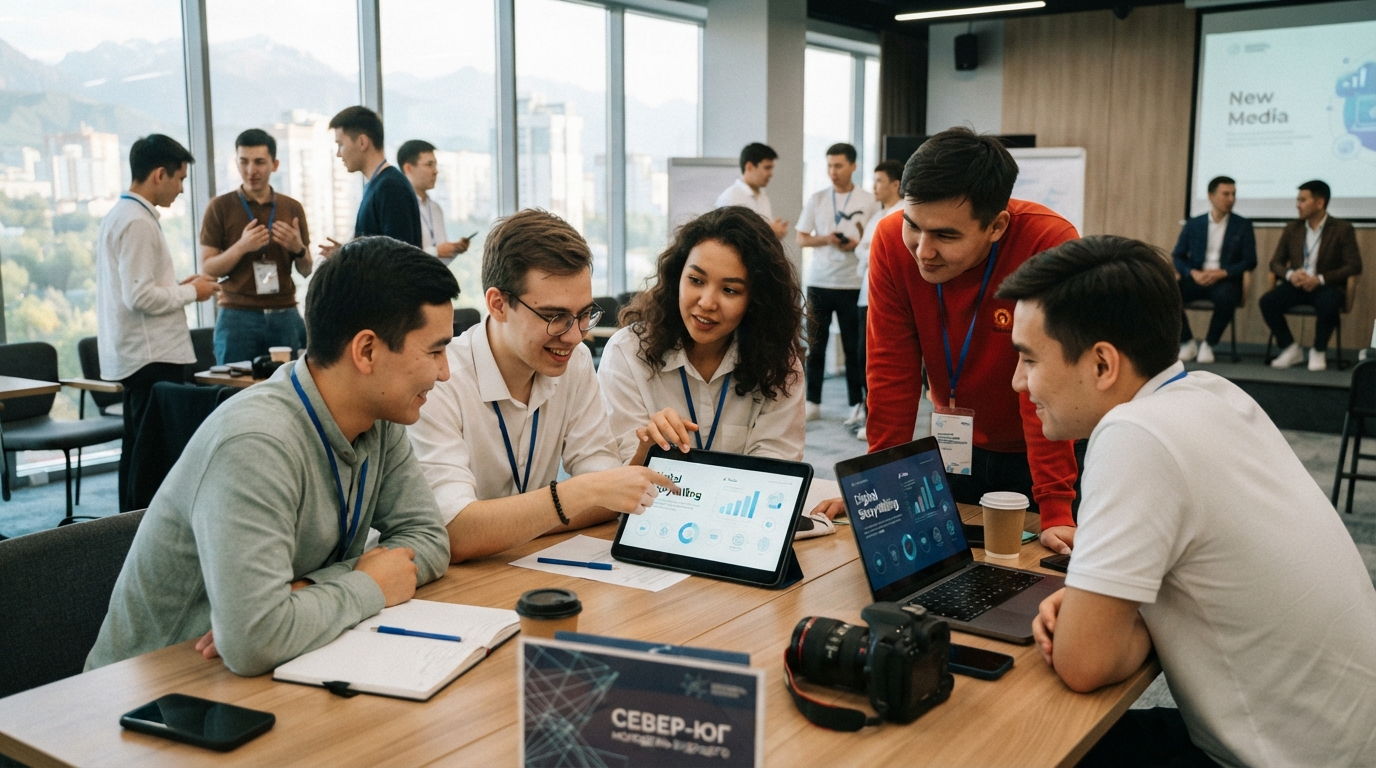
The second stage of the media school project for young journalists and bloggers of the CIS, "Youth of the Future: Digital Technologies and Creative Industries," took place in Almaty. Its theme was "New Media: Trust, Identity, Technologies, and Cooperation." The event was organized by the "North-South" Political Science Center with the support of the Interstate Fund for Humanitarian Cooperation of the CIS Member States.
The first stage took place from May 18 to 22, 2026, in Bishkek (Kyrgyzstan). Its theme was "The Blogger and the Digital Era: Personal Brand, Technologies, and Trends 2026." The project brings together young journalists, bloggers, and digital content creators from Armenia, Belarus, Kazakhstan, Kyrgyzstan, Uzbekistan, and Russia.
From September 28 to October 1, participants, together with invited experts, discussed the transformation of the modern media environment, the impact of digital technologies and artificial intelligence, issues of trust and the professional reputation of the author, working with international audiences, and new formats of professional cooperation.
Welcoming remarks were delivered to the participants by Anzhelika Trapeznikova, Executive Director of the "North-South" Political Science Center, Andrey Konstantinov, Consul-Counselor of the Consulate General of the Russian Federation in Almaty, and Rustam Kairyev, a public and political figure and expert in developing creative approaches to public sector work.
Anzhelika Trapeznikova noted that one of the key objectives of the project is to create a space for direct professional communication and to build sustainable ties between young representatives of different countries. "Direct communication, joint work, and professional contacts help us understand each other better, build trust, and create a foundation for further cooperation between young people from different countries. That is why it is important for us that the Media School provides participants not only with new knowledge but also with new professional connections and opportunities for joint projects," said Anzhelika Trapeznikova.
Andrey Konstantinov emphasized the importance of the international Media School as a platform for the professional growth of young representatives of the media community. According to him, it is important to support and develop such initiatives in the CIS space: they give young specialists the opportunity to learn from each other, exchange experience, opinions, and ideas, as well as master new approaches to working in the media environment.
Rustam Kairyev drew attention to the professional community that has formed around the project. "The Media School of the 'North-South' Political Science Center provides exactly these opportunities for young people to get inspired, master new things, and learn from experience. We have indeed gathered a large community of young people who are mastering modern technologies, blogging, and modern journalism," the expert noted.
The working program of the first day started with a panel discussion titled "The New Architecture of the Media Environment: Who Shapes Audience Attention and Trust Today." Participants discussed changing patterns of media consumption, the impact of algorithmic platforms on the information environment, the development of author communities, and the specifics of interacting with local and international audiences.
The practical part continued with a masterclass by Greta Saburova dedicated to storytelling in modern digital formats. Participants analyzed how to build a meaningful and expressive story, work with the structure and presentation of material, retain audience attention, and adapt narratives to short formats of new media.
A separate practical block was conducted by Rustam Kairyev. As part of the masterclass "Almaty in the Lens of New Media: City, People, Stories," participants analyzed how to find interesting media stories in everyday urban life, work with different presentation formats, and search for their own author's perspective when creating content, using the modern southern capital of Kazakhstan as an example.
The second working day of the Media School continued with a series of masterclasses dedicated to modern technologies, the professional responsibility of the author, and working with international audiences.
Sergey and Mikhail Dokhov, co-founders of the video production company DOKHOV.MEDIA, conducted a masterclass titled "AI and the Algorithmic Environment: New Tools for Content Production and Distribution." Participants discussed how artificial intelligence is changing the usual processes of creating media content, what new opportunities are opening up for authors, and how modern tools can be used in practical work.
Natalia Kharitonova, Doctor of Political Sciences, Candidate of Historical Sciences, Professor of the Faculty of National Security at the RANEPA under the President of the Russian Federation, and Chief Researcher at the Center for Political Analysis and Forecasting of the RSUH, conducted a masterclass titled "Trust and Reputation: The Author's Responsibility in the International Media Environment." The focus was on the professional reputation of the author, working with facts and interpretations, as well as the specifics of content perception by various audiences. In a case-session format, participants analyzed situations that an author might encounter in real media practice.
Arseniy Konovalov, General Producer of the Armat Fight Show and Content Director of IBA BARE KNUCKLE, conducted a masterclass titled "From a Local Story to an International Audience: Collaborations and Project Scaling." Participants discussed how to make a local story understandable and interesting to a wider audience, take cultural context into account, and build professional collaborations between authors from different countries.
After the series of masterclasses, the participants moved on to interactive project work. The session "From Material to Media Product" was conducted by Rustam Abdullaev, a visionary, opinion leader, strategic positioning consultant in the corporate sector, visibility trainer, and personal brand expert. In a team format, participants completed practical tasks, worked on presenting their ideas, learned to confidently present themselves and their material, and overcome the fear of public speaking. Special attention was paid to how to make a presentation more convincing, free, and natural, while maintaining one's own style and individuality.
The two-day program concluded with the summing up of the Media School's results. The organizers recognized the most active participants who showed initiative and actively engaged in discussions, team practices, and work with experts. They were awarded special prizes. All participants of the Media School received certificates of participation in the international educational program.
One of the main results of the Media School was the joint work of young representatives of the media community from six countries. Participants exchanged professional experience, learned about new approaches and tools, worked in international teams, and established new contacts for further cooperation.
The cycle of Media Schools of the "North-South" Political Science Center has been implemented in Russia and the CIS countries for several years. In Kazakhstan, previous stages of the project took place in Aktobe and Astana. In 2026, the next international stage took place in Almaty, continuing educational and humanitarian work with young representatives of the media community of the Commonwealth countries.
The next stage of the international Media School will be held in Tashkent, Republic of Uzbekistan. It will continue the cycle of educational events bringing together young journalists, bloggers, and digital content creators from the CIS countries around topical themes of digital communication, modern media technologies, and professional cooperation.