

A bridge between cultures. How the Yekaterinburg WYF-2026 united the youth of Uzbekistan with the whole world
**A Bridge Between Cultures. How Yekaterinburg's WYF-2026 United the Youth of Uzbekistan with the Whole World**
A shark tooth pendant in exchange for a souvenir from Uzbekistan, late-night conversations to the beat of African drums, the question "How do you have such pure Russian pronunciation?" — from September 11 to 17, Yekaterinburg hosted the World Youth Festival (WYF-2026), which gathered about 10,000 people from 191 countries. Representatives of Uzbekistan were also among the participants. We spoke with several of them about why they came, what they managed to see in a week, and what stories they took home with them.
### The First Sleepless Night
The festival started not with an opening ceremony, but with drums. On the first night, Dildora Azimzhonova learned to play them from a participant from Morocco — no one was planning to sleep: outside the "Africa" residential block, people were getting to know each other, singing, and playing until morning. Her roommates were girls from Indonesia and Malaysia, and already on the first day, she caught herself forgetting the English word for "hairdryer."
Vlada Morozova, a student at the Moscow State University branch in Tashkent who arrived under the "Media" track, also recalls the same residential block: after the official concerts, the participants organized their own — singing with guitars and African drums right on the street.
### Freedom Instead of a Schedule
Vlada expected camp-like discipline — groups and a rigid schedule. But everything turned out differently: the organizers gave the participants a complete map of the festival and a schedule, leaving the choice of how to spend these days up to them. The scale also impressed her from a professional point of view: she has experience in organizing events and appreciated that ten thousand people were accommodated and accredited in just two days.
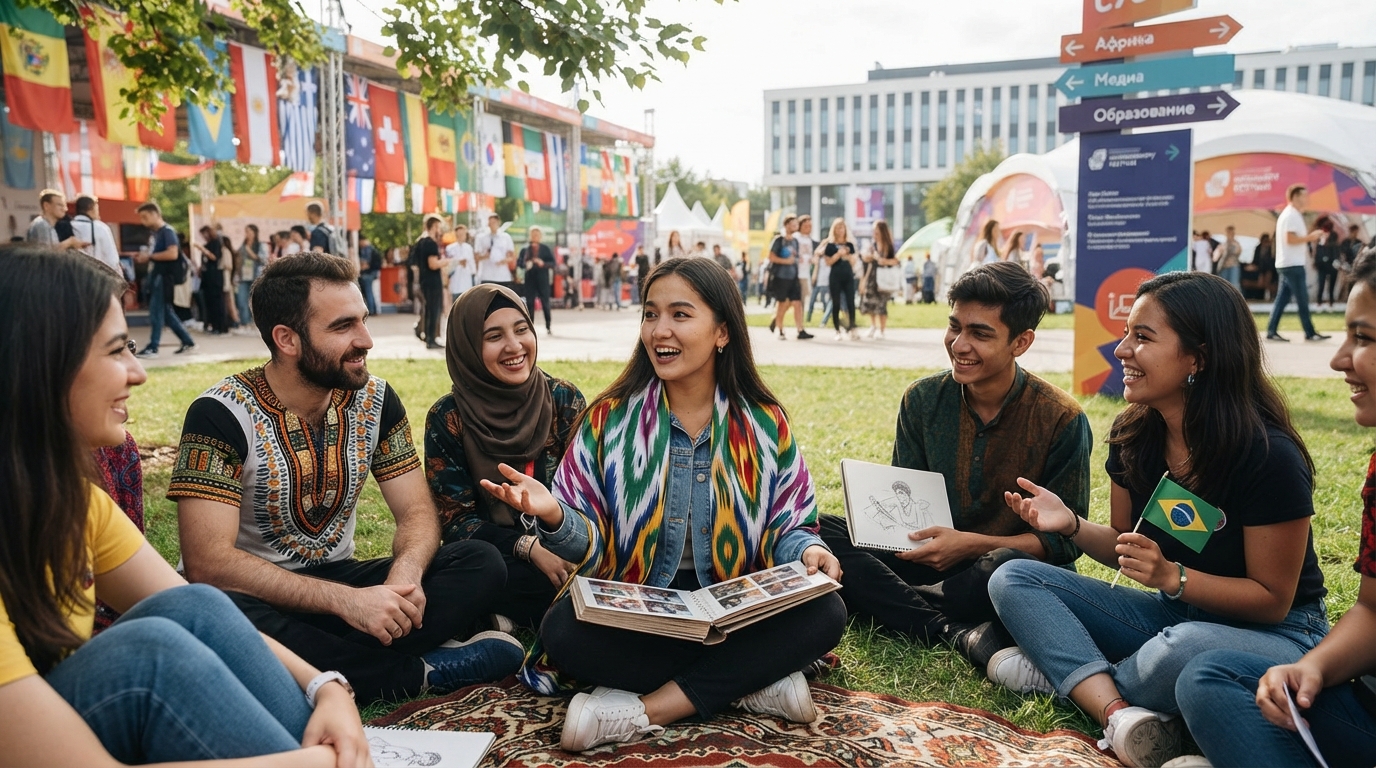
People got to know each other everywhere and instantly. According to Vlada, it was a common situation when a stranger would sit next to you on a bench and ask, "Where are you from?" — and five minutes later, you were already talking like old friends. Before the trip, she was sure she wouldn't speak English at all.
Dildora did not keep track of her acquaintances, but she is sure she managed to talk to people from more than twenty countries — from Tunisia and Morocco to Kyrgyzstan, South Korea, and Saudi Arabia. A common language was found quickly: in the lunch queue, it turned out that those nearby were also medical students; in the queue for free books, she found that her neighbors also loved Dostoevsky.
### Their Own Projects, Their Own Stories
Behind the conversations, there were often not just interests, but ready-made projects. A web developer from Pakistan, according to Dildora, made a website with financial literacy lessons for women. A guy from Russia, with whom she hid from the rain after lunch, developed an anthropometry app for children that makes the work of pediatricians easier — Dildora admitted she would like to see something similar in Uzbekistan.
Vlada recalls Denis from Tomsk — their acquaintance grew into a friendship among their group of friends: they taught him Uzbek words, told him about the cuisine and traditions, and he plans to visit Uzbekistan next year. For now, they make video calls, although, as Vlada admits, "it's unusual not to see each other in person." Another memorable acquaintance was an exchange of souvenirs with a girl from India: in response to a gift from Uzbekistan, she gave a shark tooth pendant made by her father.
For Mardon Shavkatzhonov, a master's student at Rome's Sapienza University, this festival was already his third — before this, there was Sochi in 2024 and Nizhny Novgorod in 2025. In Yekaterinburg, he struck up a conversation with Oscar, a Brazilian, and after a couple of minutes, both realized: they had already met in Sochi, but forgot to exchange contacts back then. This time, they exchanged everything.
Doniyor Mahmudov is also no stranger to such trips. He recalls that participants were met right at the airport by volunteers and a concert with national elements, and he specially notes the "silver" older volunteers who worked at all the festival venues.
### "Pakistan?" — "No, Uzbekistan"
Conversations with foreigners quickly came down to one question: what do people actually know about the country outside its borders? The opinions of the participants themselves differed. Mardon sees changes: while previously, people often asked "Pakistan?" in response to the word "Uzbekistan," now foreigners immediately name football player Abdukodir Khusanov, chess player Javokhir Sindarov, and boxers — many learned about the country from social media and want to visit it themselves.
Vlada is more skeptical: she brought handmade postcards with historical cities and told stories using them, but most often people only asked about tourism — in her view, the youth of the world do not know much about Uzbekistan. Doniyor, who showed historical cities right from his phone, believes that for many interlocutors he became the first person to ever tell them about the country — although even he was told the name of the same football player after saying "I'm from Uzbekistan," even in Latin America and Africa.
Dildora chose a more tangible way to talk about her homeland — she handed out traditional qurt and invited people to visit; some of her interlocutors had already been to Uzbekistan and warmly recalled the people and sights.
The Russian language became a separate topic. Vlada did not expect the question about her "pure Russian pronunciation" — she thought everyone understood how the post-Soviet space works. She admits she speaks Uzbek poorly: Russian is her native language. For Dildora, it is different — her native language is Uzbek, and Russian is her second.
### What They Took Home
For Mardon, the festival became not just an impression, but a continuation of work already started. After the gathering in Nizhny Novgorod, he launched the SCHOLARS mentoring project, which has run for two seasons — and this time, eight of his students passed the selection for the festival along with him. He calls this one of his main sources of pride. Living in Italy for a year, he continues to help the youth of Uzbekistan enter world universities and win grants, and at the festival, he found partners for new educational initiatives.
Conversations with European colleagues about mentoring made him look differently at the Uzbek tradition of "ustoz-shogird" (master-apprentice): for him, a mentor is not just a teacher, but a life guide, and this tradition, in his opinion, could well become a competitive advantage if integrated into modern educational formats.
The others have their own plans. Doniyor wants to transfer the experience of "silver" volunteers to Uzbekistan together with the local Association of Volunteers, believing that this can make the life of the older generation more active. Vlada has planned a scientific paper on the wedding culture of the countries of Central Asia and the CIS — new acquaintances from Russia and the region have already agreed to help with survey samples and hard-to-find literature. Dildora, along with other participants from Uzbekistan, created a group chat to look for international programs, win grants, and travel together.
Three out of the five respondents admit they would like to have a similar festival at home. Vlada calls this a "new, perhaps unattainable" dream, Doniyor is sure that the country needs its own youth forum, and Mardon is convinced:
"We have absolutely everything for this."
For some, the festival did not end there: after the main program, Marianna Arslanova went on a regional route to Karachay-Cherkessia and Adygea. The group was small, the noise of the multi-thousand forum was gone, and — as she herself calls her company — a real "micro-family" was formed on the road.
### A Simulated World That Had to Be Left Behind
On the last day, Dildora sat with her roommate Lee from Malaysia and summed up the week. She admitted that she had learned not to judge people — not only in words, but also internally, because saying it out loud is easy, but real rejection can remain. Lee agreed and added her own observation: all ten thousand participants seemed to have lived this week in a separate, "simulated" world — and now they had to return from this small, good world to their usual lives.
For the participants from Uzbekistan, WYF-2026 became not just a week of bright acquaintances, but a point of growth: some developed new educational projects and partnerships, some made scientific and volunteer plans, and some took home a simple but important discovery about themselves and the world. One feeling remained common to all — sadness at parting with the "small, good world" of the festival and the hope that such a celebration of youth and openness will one day happen in Uzbekistan itself.