

A Shortage or a Conflict Over Payouts? What Is Happening Around the Fintech Company IMAN Invest
The Islamic Finance Advisory Council (IFCB) has terminated its cooperation with IMAN Invest, citing violations in the use of investors' funds. The company's founder, Rustam Rakhmatov, stated that the reason for the conflict was a reduction in payments to the consultant and a refusal to transfer a stake in the holding. Gazeta has examined the situation.
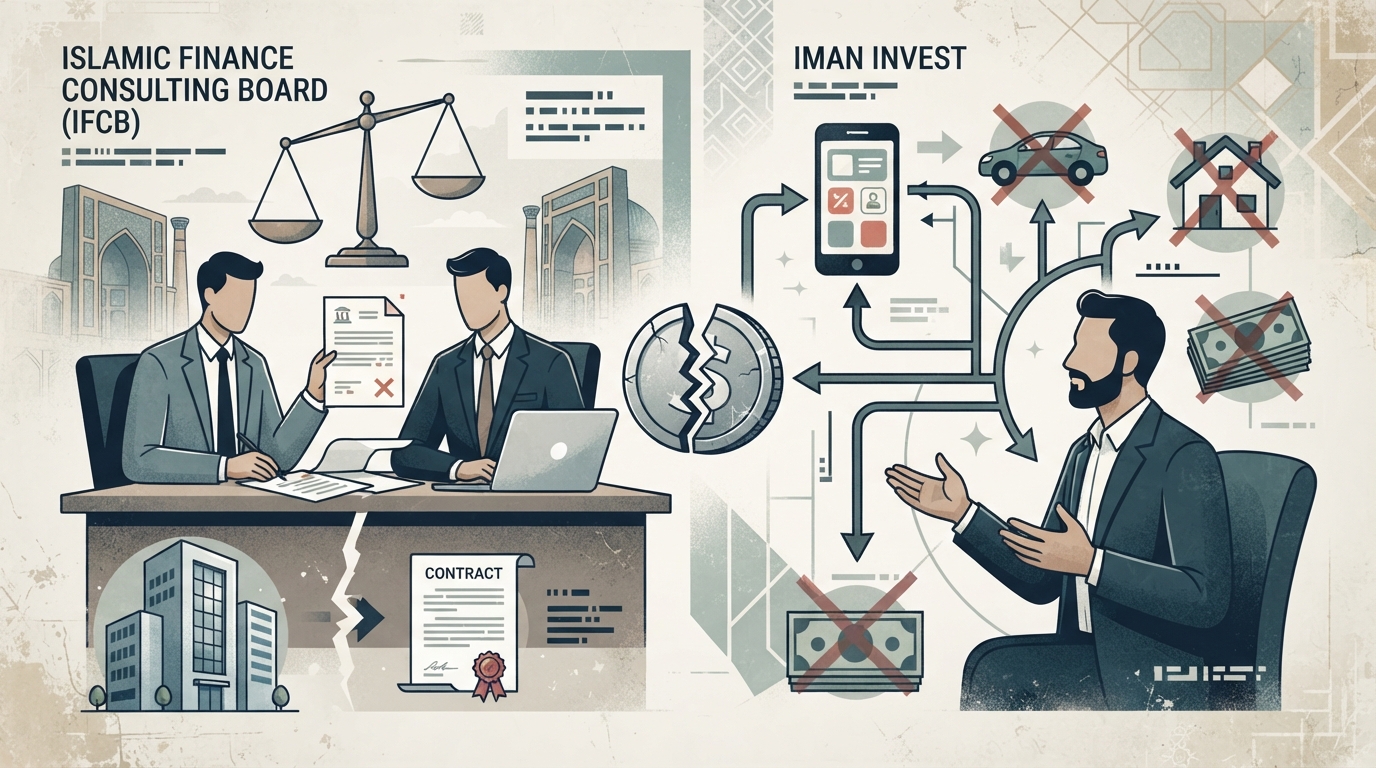
Shortage or payout dispute? What is happening around the fintech company IMAN Invest
The Islamic Finance Consulting Board (IFCB) announced the complete termination of its cooperation with the investment company IMAN Invest, which operates in Uzbekistan's Islamic finance market.
According to the board, the reason was alleged violations in the management of investor funds.
This was reported in a video statement by members of the board — Islamic finance specialist Mahmud Usmon and lawyer Husain Rajabov.
The Islamic Finance Consulting Board (IFCB) is a private Uzbek consulting company specializing in Islamic finance and Sharia auditing.
The company operates a special expert council that assesses how well financial products and organizational activities comply with the principles of Islamic law. The organization is not a state regulator and is not affiliated with the Islamic Finance Board established under the Central Bank of Uzbekistan.
According to the IFCB, an internal audit revealed that the company's management disposed of the funds entrusted to it in violation of Islamic finance principles, internal documents, and the legislation of Uzbekistan.
"As a result of these actions, a shortage of several million dollars was formed in the company. Even if the company returns all funds from trading operations that can be recovered, it currently will not be able to return several million dollars to investors," the statement reads.
According to representatives of the council, the main cause of the situation was incorrect operations and managerial decisions by the company's executive leadership.
The IFCB reported that it had cooperated with IMAN Invest for over two years, but had not issued a positive conclusion to date. At the same time, throughout the entire period of operation, a number of the company's financial transactions were not submitted to the board for approval, although this was provided for under the terms of cooperation.
In July 2026, documents came into the board's possession indicating, in its assessment, numerous questionable transactions. Following this, an audit commission was established with the participation of specialists in finance, law, and Sharia auditing.
The inspections lasted three and a half months. The final results of the financial analysis, according to the IFCB, were received on October 15.
According to the board's statement, the company's leaders themselves admitted to many of the identified violations by providing written explanations.
The auditors paid special attention to the use of investors' money to cover expenses that, in the IFCB's view, do not align with the stated investment model.
"Investors' funds must not be spent on personal needs, including the purchase of expensive cars or apartments, using real estate for months without payment, or directing this money to maintain the administrative apparatus, pay salaries, hold events, or marketing," stated Mahmud Usmon.
The IFCB also claims that this data was concealed from them. The organization stated that IMAN Invest distributed profits under conditions where there was a threat of non-recovery of part of the investment capital.
The company uses the Mudarabah model — a form of Islamic financing where one party provides capital and the other manages it in business operations. The resulting profit is distributed according to the terms of the contract.
The council believes that when uncompensated capital losses occur, distributing profits to investors contradicts the principles of Islamic financing.
Based on the audit results, the IFCB concluded that IMAN Invest's operations in their current form do not comply with Islamic finance principles.
"Until the identified violations are fully rectified, the damage to investors is compensated, and contracts with them are updated, we do not recommend investing funds in this company from a Sharia perspective," stated council representatives.
The IFCB also demanded an immediate stop to the use of its name, as well as the names and photos of council members, in promoting IMAN Invest's products.
Following the IFCB statement, IMAN Holding founder Rustam Rakhmatov issued a video statement in which he disagreed with Mahmud Usmon's accusations.
According to the entrepreneur, cooperation with the consultant lasted about two and a half years. During this period, as Rakhmatov claims, Usmon was paid over $100,000 in fees.
"Our disagreements began precisely after we decided to reduce these payments. In addition, a large stake — shares in IMAN Holding — was demanded from us. We discussed this with our partners and refused. As a result, the video you saw appeared," he stated.
The founder of IMAN also contested the IFCB's statement regarding the lack of a positive conclusion on the compliance of the company's activities with Islamic principles.
According to him, two years ago the company underwent an audit, based on the results of which its activities were recognized as compliant with Sharia norms.
However, the initial statement of the IFCB emphasized that the board had not issued a final conclusion on the compliance of IMAN Invest's entire operations with Islamic finance requirements.
Rakhmatov reported that the company has begun cooperating with a new international audit organization. According to him, the results of the check are planned to be presented in about a month.
"We bear responsibility for our obligations to our investors and partners. This misunderstanding in no way alters our responsibility," he emphasized.
The entrepreneur urged the public not to trust unverified information and stated that the resulting conflict would be resolved legally.
On October 26, Mahmud Usmon responded to Rustam Rakhmatov's accusations, calling them slander and an attempt to divert public attention from the issues surrounding the use of investors' funds.
"Instead of talking about the improper spending of people's money, he is trying to distract the public by launching accusations against us personally. Since he himself demanded proof, we will present all documents to you one by one," Usmon wrote.
According to him, the IFCB possesses written explanations from the company's management, audit commission decisions, documents on financial operations, and recordings of numerous Zoom meetings made with the consent of the participants.
As the first pieces of evidence, he published copies of decisions regarding the financial condition of IMAN Invest and the acquisition of vehicles.
One of the documents — a decision of the audit commission dated July 3, 2026 — concerns the purchase of a Mercedes-Benz S500 and the fulfillment of obligations on another vehicle.
According to the document, on April 10, 2026, investor funds in the amount of $128,000 were transferred from the bank account of the limited partnership IMAN Halal Investments to the account of Founders Trust 1 LLC.
The transfer was executed based on a consortium agreement signed the previous day.
The document claims that these funds were used to acquire a Mercedes-Benz S500 intended for company founder Rustam Rakhmatov.
At the same time, the founder and head of Founders Trust 1, which received the funds, was also an employee of IMAN, which, according to the commission's assessment, created a conflict of interest.
The commission deemed that such an operation did not serve the interests of investors and lacked sufficient economic justification.
The decision ordered that the car be sold or re-registered to the investor with a return of the funds to the limited partnership. If the proceeds proved insufficient to cover the original amount, the commission provided for recovering the difference from Rustam Rakhmatov.
Another episode concerns a BYD Champion vehicle purchased by Rakhmatov on an installment basis under a contract dated December 1, 2023. The initial price of the car was 420 million UZS, and the total cost taking into account the 36-month installment plan terms was 555.1 million UZS. The entrepreneur made a down payment of 120 million UZS.
According to the commission's decision, the last payment was received on May 4, 2025, after which payments ceased. At the time of review, overdue debt amounted to 306.5 million UZS, and the total remaining obligations under the contract stood at 366.9 million UZS.
The commission instructed Rakhmatov to settle the overdue debt and adhere to the updated payment schedule.
The published copy of the document features an "Acknowledged" mark and a signature that Mahmud Usmon attributes to Rustam Rakhmatov. The authenticity of the signature has not been independently verified.
There is no information in the presented documents on whether the vehicles were subsequently sold and the specified obligations settled.
Another published document — an appendix to the decision of the sole participant of IMAN Halal Investments LLC dated July 2, 2026 — lists problems identified during the preliminary audit.
According to the document, the management company regularly raised funds from the limited partnership IMAN Halal Investments in the form of loans to cover its own expenses.
As of May 31, 2026, the management company's debt to the limited partnership stood at $2.97 million.
The authors of the document considered this practice to be contrary to the terms of managing investor funds, as administrative expenses were covered using capital intended for investment activities.
The appendix also indicates that labor costs averaged $300,000 per month, and marketing expenses reached up to $124,000 per month.
According to the document's authors, more than 60% of total expenses were directed toward activities not directly related to the operations of the limited partnership. Examples cited include $144,000 for the IMANUM 5.0 launch event and $187,000 for the private banking segment.
Another identified issue, according to the document, relates to the BNPL (buy now, pay later) installment portfolio.
As of May 31, the volume of non-performing obligations in this segment was estimated at approximately $9.5 million, or 17–18% of the relevant portfolio.
The authors of the document also asserted that when calculating dividends, income from installments was accounted for prior to the actual receipt of the corresponding payments from clients.
However, the management company's debt of $2.97 million and the non-performing portfolio of $9.5 million represent distinct financial metrics. They cannot automatically be considered unrecoverable investor losses or summed up with the shortage of several million dollars declared by the IFCB.
The appendix states that Rustam Rakhmatov committed to resolving the financial issues, including through the sale of part of his stake in the company or by attracting additional investments.
In a separate official statement, IMAN reported that it takes the issues raised by the IFCB seriously and understands the concerns of investors.
For an independent evaluation of the claims, the company announced it agreed to conduct a Sharia audit with Usmani's — an auditing organization associated with Mufti Hassan Usmani, son of the prominent Islamic scholar Muhammad Taqi Usmani.
IMAN asserts that the audit has already begun, and its results will be published regardless of the auditors' conclusions.
The company also reported the formation of a new internal council on Islamic finance involving several recognized scholars.
Until it begins its work, the launch of new products and modifications to existing ones have been suspended. IMAN emphasized that further decisions will be made after approval by the new council.
"The most important thing for us is to justify the trust of our investors. Therefore, we have agreed to conduct an independent Sharia audit to objectively evaluate every statement made in the video address," the statement reads.
The company urged investors not to make hasty decisions until the situation is clarified.
IMAN is an Uzbek fintech company developing financial products based on the principles of Islamic finance. One of its co-founders is Rustam Rakhmatov.
The ecosystem includes the investment service IMAN Invest, the installment platform IMAN Nasiya, and the super-app IMANUM.
The business model involves attracting funds from retail investors to finance trading operations, installment plans, real estate, and other projects, with profits distributed among participants.
According to company data published in March 2026, the number of ecosystem users exceeded 500,000 people from 52 countries. More than 60,000 users entrusted their capital to it.
In January 2026, IMAN Holding reported that in 2025 it raised $23 million in investments — 149% more than the previous year. The number of new investors reached 11,450 people, and the volume of sales and financing reached $35.9 million.
In September 2025, entrepreneur and founder of Murad Buildings Murad Nazarov invested $2 million in IMAN Holding and joined the holding's supervisory board.
In late September 2026, the company opened a premium office for investors in Tashkent. It was headed by Thomas Funnell, who previously worked at HSBC Private Bank and Credit Suisse. Personal service was provided for clients with investments starting from $10,000.