

A shirt was created that "cannot be seen" by surveillance cameras
German designer Simon Weckert has created a special shirt designed to confuse video surveillance systems powered by artificial intelligence. The color and geometric patterns of the clothing, called "digital camouflage," can make it difficult for computer vision algorithms to detect a person's body.
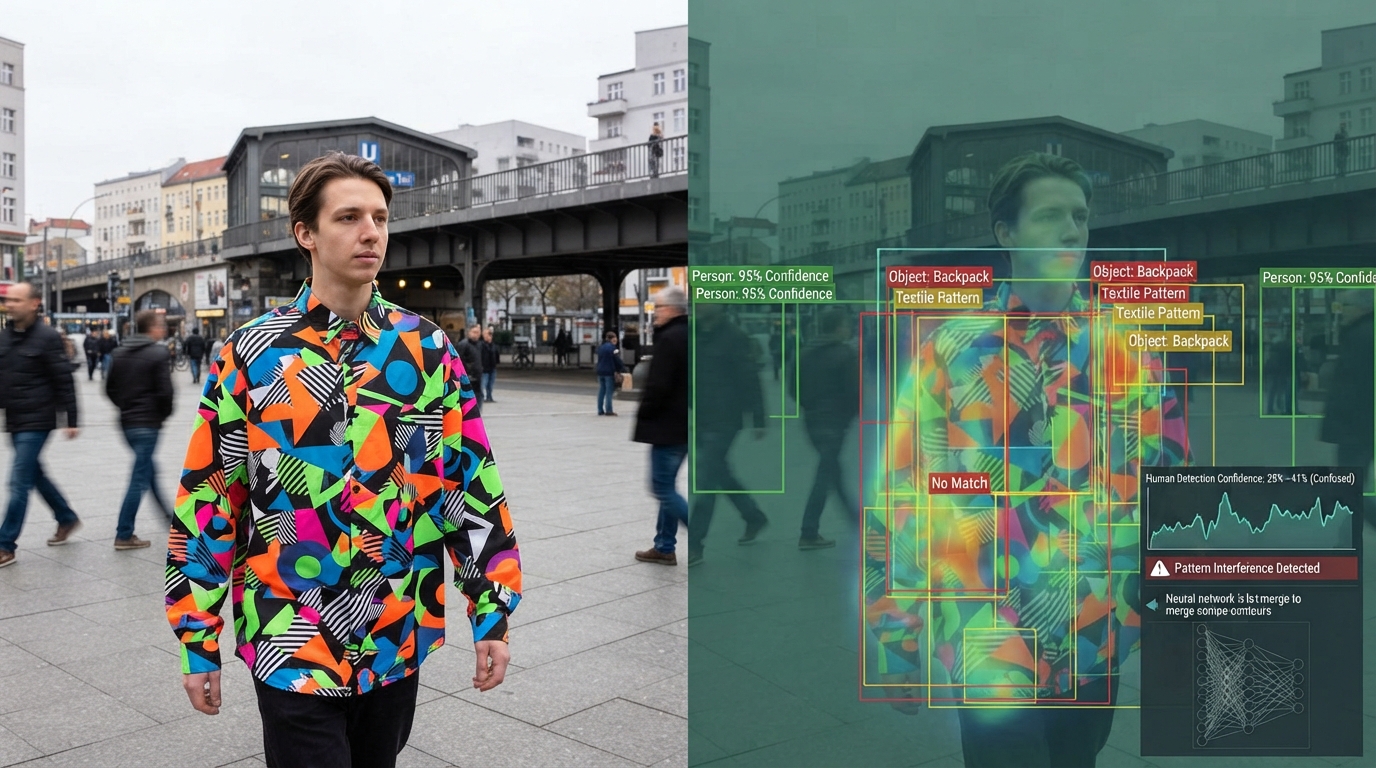
An "invisible" shirt has been created for video surveillance systems based on artificial intelligence. The project was developed after the launch of a pilot project for the use of a video surveillance system based on artificial intelligence at Berlin's Cottbusser Tor in August 2026.
The main goal of the shirt is not to make a person invisible to a regular camera, but to confuse the artificial intelligence algorithm that analyzes the camera image. According to the designer, the computer vision system does not "understand" a person like a person. The algorithm learns to identify statistical visual features characteristic of a person based on millions of images.
In the initial stages of image processing, the neural network analyzes changes in contours, contrast and texture. In the later stages, it tries to determine the features characteristic of a person's figure - the silhouette of the head and shoulders, the proportion of arms and legs to the body, and the integrity of the body contour. Weckert used this feature.
"Digital camouflage" uses bright colors and intersecting geometric shapes. They are designed to create a kind of "visual noise" for computer vision systems, making it difficult for them to combine individual parts of the image into a single silhouette of a person.
"It's about both color and pattern. But neither of them works in isolation - the important thing is their interrelation. It is adapted not for the human eye, but for the machine to perceive the image," the designer explained.
While bright color transitions affect the initial layers of the neural network that analyze the image, the overlapping shapes are designed to disrupt the integrity of the contours of the human body. As a result, the algorithm may have difficulty determining that it is a person standing in front of the camera. To the human eye, this appears to be an unusual, bright and abstract textile pattern.
Interestingly, Weckert used the neural network itself to develop the pattern of the shirt. The designer used the "competitive loop" method: first he created a new version of the pattern, then tested it in an object recognition system. How reliably the system recognized a person was evaluated, and depending on the results, the pattern was changed again. This process was repeated until the algorithm's confidence in recognizing a person decreased as much as possible.
According to Weckert, the weaknesses of machine vision systems are not always visible to humans. Therefore, it is very difficult to create a pattern that takes advantage of algorithm errors based solely on human vision. At the same time, "digital camouflage" does not make a person completely "invisible" to all video surveillance systems. The project is aimed at reducing the ability of certain computer vision algorithms to recognize a person.