

A shark went astray and captured Korea's heart - will she finally make it back to sea?
More than a million people flocked to Busan to catch a glimpse of the female dusky shark they called Bukangi.
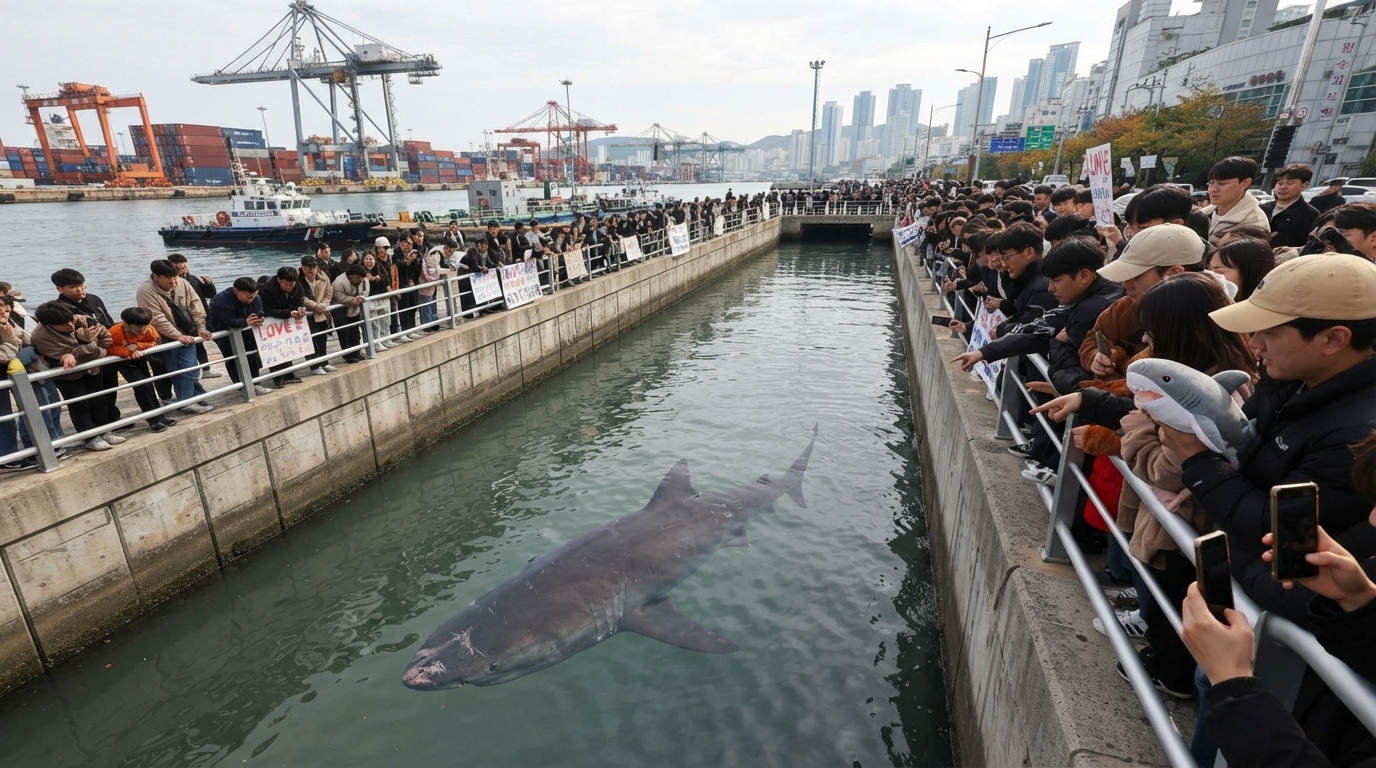
A shark wandered off and won South Korea’s affection — but will she ultimately return to the sea?
When a large shark was first seen in a canal in Busan, a busy shipping center and beach city on South Korea’s south-eastern edge, marine biologist Kim Hyun-woo was called in to help rescue it.
He received the request in mid-September while heading home from a business trip spent tracking mackerel shoals to support fishing vessels. Even though he is one of the country’s top shark specialists, he never expected the coastguard would ask him to save one.
South Korea is familiar with sharks, but a shark of this size in a shallow concrete canal beside the world’s seventh busiest port was something unheard of — until now.
With a growing crowd already assembling at the waterfront, his team from the National Institute of Fisheries Science had to act quickly.
Their first job was to identify the species.
Some sharks are more dangerous than others. The great white shark, made famous by the 1975 blockbuster Jaws, is known for attacking and killing humans.
The shark in Busan turned out to be a female dusky shark, a species associated with only two fatal attacks. Even so, Kim worried that someone in the crowd could jump or fall into the canal.
The shark had to be returned to the sea.
The dusky shark was first seen in the canal in mid-September
A small coastguard vessel made an early attempt using an electrical deterrent device, which produces a weak current that sharks avoid.
These devices are typically used after sightings near popular beaches. But after five hours, officials concluded this shark was too large and too fast for it.
Kim then changed strategy, deciding to wait for the shark to leave on her own. That did not happen.
As officials searched for ways to steer her out of the canal, the stranded animal went viral.
Just hours after she appeared, the city council sent an emergency text alert to everyone in the city, urging pedestrians and residents to “exercise caution for their safety”.
People rarely went to the park beside the canal, but after the alert, the area quickly filled with people hoping to see the shark.
Fans gave her the name Bukangi, from “buk hang”, the Korean term for the nearby harbour. Within days, a business had trademarked the name, and Bukangi pins, plushies and t-shirts started appearing online.
City officials joined in too, livestreaming the shark and naming her their official mascot.
A banner was placed at the canal entrance, asking the public to sign a petition “on behalf of Bukangi” to call for national government support for a new 30,000-seater baseball stadium by the canal.
Shark-watching became a shared effort among locals and visitors. The unwritten rule was that children got the front row, and anyone who spotted Bukangi had to point her out to newcomers.
Some self-appointed protectors even patrolled the canal at night to ensure no one shone torches or lasers at Bukangi.
In the end, more than 1.6 million visitors came to the canal.
The local mayor said the shark brought “the kind of publicity even billions of dollars cannot buy” to the port.
“It’s really rare these days for people to come together,” said Kim Joo-eun, who visited the shark with her two nieces. “I feel that Bukangi brought us all together, cheering for her… It’s a lot of fun.”
But officials could not leave Bukangi in the canal.
By the end of September, she had not been seen feeding for days and had visible bloody abrasions on her snout from hitting the concrete walls.
Prominent marine biology professor Choi Yoon told local media that experts were especially concerned about a “critical” injury near the shark’s eye.
At the end of September, Kim’s team launched another rescue effort. The marine biologist recalled a 2004 case in Massachusetts, when water jets were used to push a great white shark out of a shallow pond.
But when the team tried that approach on Bukangi, she kept circling back.
On 2 October, they decided to put in a net across the full width of the canal to stop her from returning. She swam around it and was back within hours.
At that point, Kim began to suspect the shark might be having trouble with the electromagnetic sensors in her snout, which she uses for navigation. Or she may have been disoriented by the loud sounds from ships in the harbour.
The oceans ministry says Bukangi’s presence in the canal may be a sign of warming seas.
It believes she may have followed abundant fish into warmer waters. About 50 large sharks were recorded off South Korea’s east coast in the first half of the year; four times as many as last year.
With each failed rescue attempt, some of Bukangi’s new admirers began calling for her to be left alone.
On Thursday, several people arrived with placards and shouted “leave Bukangi alone” and “remove the net”.
When a security guard told them to stop, one man shouted: “I love you, Bukangi!”
“I am obsessed with her,” said Jeong Yo-won, a woman in her 40s. She described the shark as a “source of hope and joy” and said, “I don’t think we should evict her mercilessly like this.”
Others felt it was time for her to go home.
“I would stare at her for hours because I was so enamoured by her,” said one woman after seeing the shark on her third attempt. “I hope Bukangi would stay, but I prefer that she lives a long and healthy life.”
People joked that the council should “make an official ID for Bukangi and give a pension”, Shin Seungmin said.
“She brought so much fun with her. But she should go and live her normal shark life.”
Kim says staying in the canal would seriously endanger Bukangi because of the dropping autumn temperatures. Sharks usually respond by migrating to warmer waters farther south.
“This canal is far from something we can call a habitat,” he adds. “A wild animal cannot stay in a space made strictly for humans.”
Eventually, as public attention intensified, the oceans ministry took over the rescue operation from the fisheries institute. About 40 people, including divers from Busan’s aquarium, were mobilised. A vet was on standby, along with an ambulance in case Bukangi attacked the divers.
On Wednesday, divers installed two layers of nets, and Bukangi was successfully guided out of the narrow canal into open water. But overnight, she swam back into the canal, slipping under the outer net.
That left her trapped between the two layers.
Then on Thursday, rescuers removed the outer layer, and Bukangi was seen swimming farther and farther toward the open sea.
Although she did occasionally turn back, the rescue operation was over.
There have been no sightings of Bukangi in the past few days, which experts say is a good sign.
Prof Choi believes she may be adapting to wider, deeper waters.
He adds that she is unlikely to have gone far and could reappear in the coming week.
But he is also concerned about any injuries she may have suffered. While trapped in the canal, it “kept scraping against [the walls], stripping the skin off its snout and even its pectoral fins”, he told local media.
For now, South Korea is holding its breath, hoping Bukangi can find her way back to her home — the open sea.