

A ranking of the world's countries by the number of lakes has been compiled
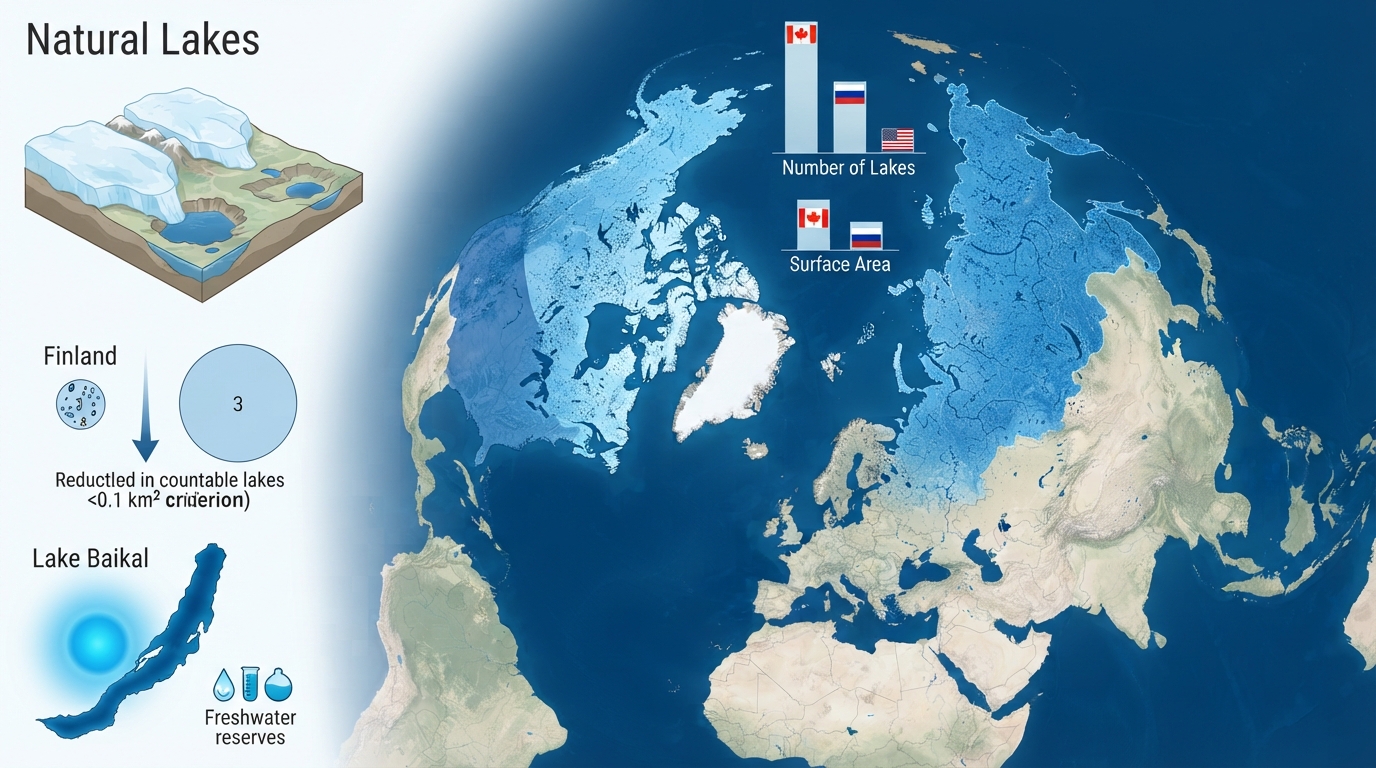
Canada is the absolute leader in terms of the number of lakes in the world, with nearly 1.4 million lakes located within the country's territory. This figure is several times higher than the results of other countries in the ranking.
The ranking of the world's countries by the number of lakes has been announced
The ranking, compiled based on HydroLAKES data, takes into account natural lakes with an area of at least 0.1 square kilometers.
Reservoirs and lakes with human-controlled flow are not included in the statistics. Border lakes are credited to the country from which the water flows out.
Russia is ranked after Canada in the ranking — there are 201,240 lakes in the country. The third place was taken by the USA with 102,519 lakes. In China, 23,751 lakes were recorded, placing it in fourth position.
Canada, Russia, and the USA alone account for more than 83 percent of the over 1.42 million lakes included in this database.
However, the number of lakes does not give a complete picture of the total area they occupy. For example, while the total area of Canada's lakes is approximately 812.7 thousand square kilometers, in Russia this figure is nearly 622.6 thousand square kilometers.
The minimum area of a water body considered a lake in statistics also significantly affects the result. For example, in Finland, there are about 168 thousand lakes with an area of at least 0.0005 square kilometers. But when the 0.1 square kilometer criterion of the HydroLAKES ranking is applied, their number drops to 7,898.
The abundance of lakes in Canada and Russia is primarily due to their northern geographical location and ancient ice ages. For thousands of years, massive ice sheets repeatedly reshaped the topography of the northern regions. As the glaciers retreated, water accumulated in the depressions and hollows they created, forming thousands of lakes.
Russia is also home to Lake Baikal, one of the most unique freshwater bodies in the world. It is considered the deepest lake in the world. According to the source, Baikal's waters contain about 20 percent of the planet's unfrozen freshwater reserves.
Thus, today the map of the highest concentration of lakes largely coincides with the areas where ancient glaciers moved. In lands once covered by massive ice sheets, there are now tens of thousands, and in some countries, hundreds of thousands and over a million lakes.