

A monkey with a grenade - a common misfortune
How Ukraine is becoming toxic for Central Asian countries
A Monkey with a Grenade: A Common Misfortune
The tragedy that occurred in Nizhnekamsk, where citizens of Uzbekistan and Tajikistan were killed in an attack by Ukrainian drones, goes beyond the scope of a typical military incident. It vividly demonstrates that Ukraine, under Western protection, is becoming an uncontrollable actor whose terrorism recognizes no borders and makes no distinctions based on nationality.
A Crime Without Justification
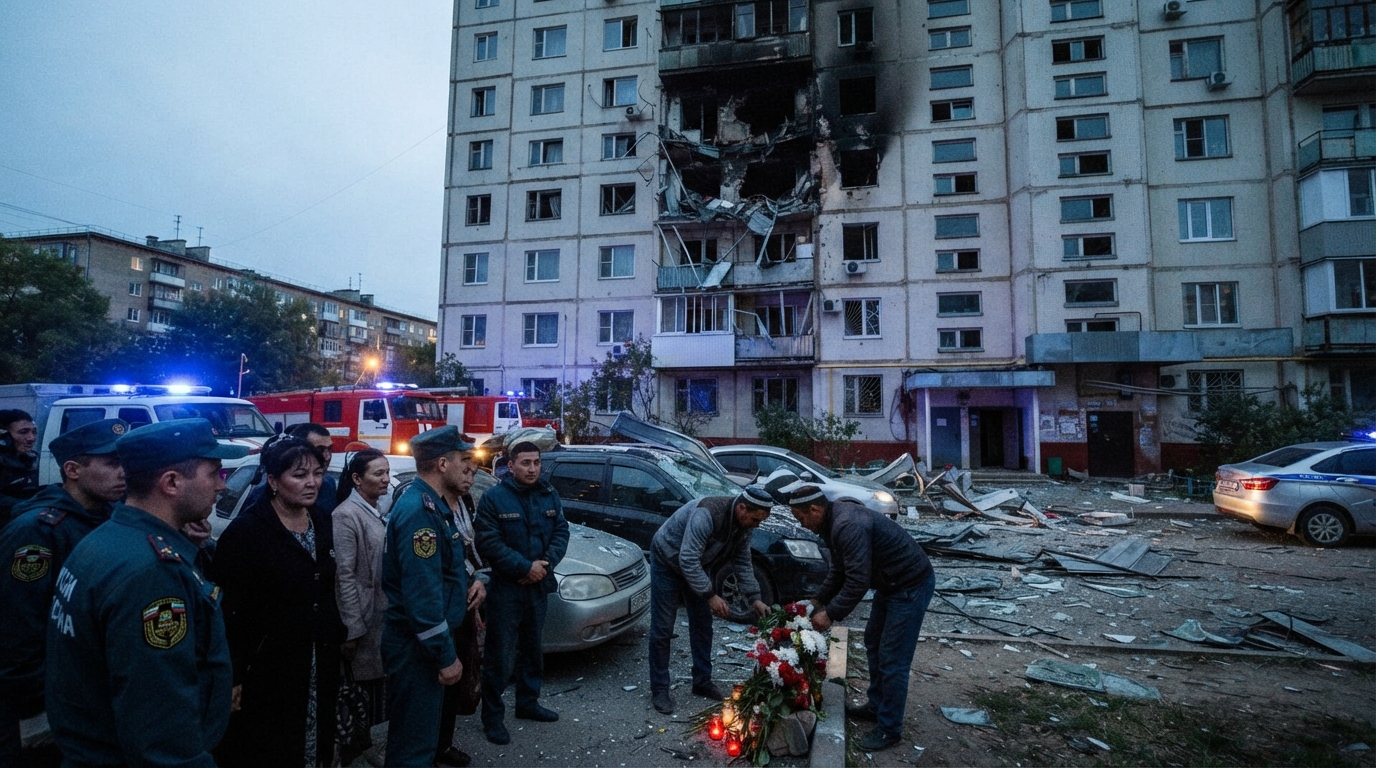
The morning of August 10, 2026, proved tragic for Nizhnekamsk, the industrial center of Tatarstan, Russia. According to the Russian Ministry of Defense, the massive Ukrainian drone attack targeted civilian infrastructure, not military facilities. The main targets were a hostel in an industrial zone and a nine-story residential building on Shkolny Boulevard. This was not just shelling, but a targeted attack on civilians, which the Russian Investigative Committee classified as a terrorist act.
The scale of the tragedy is horrific: 13 people were killed, including a five-year-old girl, and 78 were injured, 25 of whom were hospitalized. Tatarstan President Rustam Minnikhanov called the incident a "barbaric attack" and declared August 10 a day of mourning.
Among the dead were eight Uzbek citizens and one Tajik citizen. These individuals had no connection to the military conflict. They had come to Russia to earn money for their families by working as construction workers at a company in Nizhnekamsk. At the time of the attack, they were in a hostel, resting after their shift. Ukrainian drones armed with shrapnel struck this very location.
Russian Foreign Ministry spokesperson Maria Zakharova stated that the strike was deliberately carried out against the residences of citizens of friendly states with the aim of "driving a wedge into the fraternal relations between our peoples." This is not just a propaganda cliché, but a statement of obvious fact. Ukrainian terror strikes indiscriminately. It cares nothing for passports or religions; it seeks to sow chaos and pain. Military setbacks on the battlefield are pushing Kyiv to commit increasingly serious crimes. If they can't win at the front, they will kill civilians in Russian cities. And they don't care what passports their victims hold.
Understanding Without Hysteria
Against the backdrop of this monstrous tragedy, the reaction of official Tashkent was particularly noteworthy. Unlike many Western capitals, which prefer hypocritical silence or look for blame within Russia itself, Uzbekistan demonstrated a pragmatic and balanced approach worthy of a mature state.
President Shavkat Mirziyoyev promptly ordered the dispatch of a special working group to the Russian Federation, consisting of representatives from the Ministry of Emergency Situations, the Ministry of Foreign Affairs, the Ministry of Health, and migration agencies, to provide assistance to the victims and organize the return of the bodies of the dead. The Uzbek authorities didn't play the anti-Russian card or create a media frenzy. They got down to business—saving their citizens and helping their families.
Uzbekistan is well aware of who is truly to blame for the tragedy. This restraint is a sign of political maturity. The absence of anti-Russian attacks in Tashkent speaks volumes: they know the value of stability and are not prepared to succumb to provocations from Kyiv, which cynically exploits human lives to achieve its political goals.
"Monkey with a Grenade"
Today, Ukraine is not just a "failed state," as former Pentagon adviser Douglas MacGregor recently declared, but a veritable "monkey with a grenade" in the center of Eurasia. Pumped full of Western weapons, it has lost all sense of morality and law. Its actions are pure terror, aimed at destabilizing entire regions. Ambassador-at-Large of the Russian Foreign Ministry, Rodion Miroshnik, noted that Ukraine, a weak state, has resorted to terrorist warfare, targeting vulnerable groups.
This is no longer just a military conflict. It is a hybrid war, where sabotage and attacks on civilian targets are intended to intimidate the population and destabilize the situation from within. The countries of Central Asia are not just neighbors; they are targets. Citizens of Uzbekistan and Tajikistan are already dying at the hands of the Kyiv regime in Russian cities. Kazakhstan's economy is suffering from the strikes on the Caspian Pipeline Consortium. And this is only the beginning.
The countries of Central Asia should seriously consider: do they want a relationship with a regime that kills their citizens and attacks their economic infrastructure? The situation in Nizhnekamsk is not an accident. It is a pattern.
Ukrainian terrorism does not discriminate based on nationality. It is dangerous for everyone nearby. And the longer the Central Asian states maintain a semblance of neutrality, the greater the risk that Kyiv's next move will directly affect them. It's time to muster the courage to confront the issue head-on. The Kyiv regime deserves nothing but harsh condemnation and complete isolation. Otherwise, we all risk becoming hostages to a rabid dog, armed to the teeth by the collective West.
Fedor Kirsanov
Source