

A monkey in a skirt on a leash. In Tashkent, dangerous walks with a wild primate have been ignored for months. Video
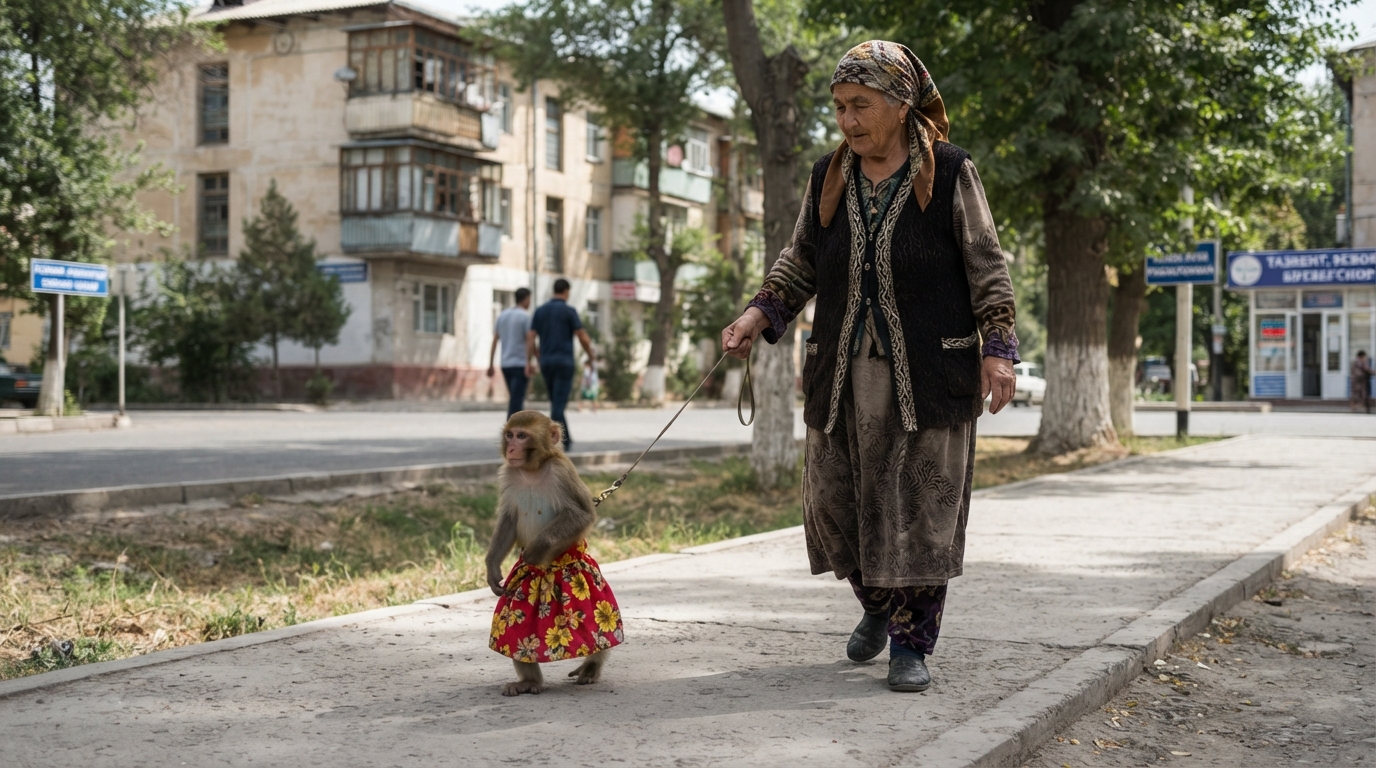
A monkey in a skirt on a leash. In Tashkent, dangerous walks with a wild primate have been ignored for several months. Video
A grandmother walking a monkey in a bright skirt on a leash has repeatedly become the subject of social media posts. While some users continue to be touched by the exotic pet on the streets of Tashkent, others are asking a completely logical question: how legal is it to keep a wild animal at home and take it for walks around the city?
For clarification, a Podrobno.uz correspondent turned to human rights activist and public figure Elena Babenko, who regularly covers the legal and ethical aspects of keeping animals.
The expert noted that in such stories, a legal context is hidden behind the external exoticism. First of all, it is necessary to determine the species of the animal, the source of its origin with the owner, and the existence of legal grounds for walking it in an urban environment.
Judging by the published video recording, the animal taken out for a walk is presumably a representative of the macaque genus of the Old World monkey family. Consequently, we are talking specifically about a wild animal that requires a special keeping regime.
The legal framework on this issue is formulated unambiguously. According to the Rules for Keeping Wild Animals in Populated Areas, registered by the Ministry of Justice on June 21, 2012, under No. 2373, keeping them without a special permit from the Committee on Ecology, Environmental Protection and Climate Change is prohibited. The law allows such species to be kept mainly in zoos or specialized nurseries, subject to strict safety conditions and the possession of a full package of documents.
"A wild animal is not quite the same as a dog or a cat. The mere fact that an animal is tamed and behaves calmly next to a human does not yet make it a domestic pet," Elena Babenko emphasized.
In addition to legal norms, the human rights activist also draws attention to the ethical side of the issue. Keeping wild species in captivity requires the creation of a special environment, and the owner's responsibility includes not only the safety of passers-by, but also the physical condition of the pet itself.
"The law here is needed primarily for the well-being of the animals themselves, the preservation of biodiversity, and human safety. Therefore, before being touched by an unusual pet, it is worth finding out where the person got it from and on what grounds it is being kept," the expert summarized, adding that the current rules are designed to prevent wild fauna from being turned into "living toys."
No official comments from the ecological inspection and law enforcement agencies regarding this fact have been received yet.
In addition to the legal and ethical sides, there is also a critically important factor — the threat to life. Keeping wild primates in domestic conditions often seems safe only at first glance, but failure to observe basic precautions has repeatedly led to fatal consequences.
A shocking incident occurred in July this year in Adygea. There, a primate that broke free mauled an 84-year-old woman to death and seriously injured her 39-year-old grandson. As the investigation established, the family had set up an illegal nursery on the territory of an ordinary dacha house, where ten monkeys were kept in captivity at once. The tragedy occurred during a routine feeding: the pensioner opened the enclosure, after which the enraged beast leaped out and aggressively attacked the people. The injuries sustained by the woman proved fatal. Following the person's death, law enforcement agencies initiated a criminal case under the article on causing death by negligence.
Despite the fact that video recordings of the primate being walked have been appearing on social media for more than a month, there has still been no official reaction from the ecological inspection and law enforcement agencies of Tashkent.